
Lime plaster: properties, use and application inside and outside

Lime plaster is one of the oldest mineral plasters and still the first choice today where clay reaches its limits, i.e. outdoors, on the plinth, in damp rooms and on the facade. It is vapour-permeable, highly alkaline and therefore naturally inhibits mould and algae, and it binds moisture reversibly. This article explains the types of lime and application layer by layer, and uses the Graefix system and the Saint-Astier binders to show how ready-made plasters and binders complement each other by grain and application.
Lime plaster for your interior wall
Base plaster and fine plaster with Saint-Astier NHL 2 for interiors, also in the bathroom. Enter the area and you get quantities and total price.
- Saint-Astier® NHL 2, the supple one 4 × standard73,24 €
Total for 15 m²73,24 €
incl. VAT, plus shipping
Plus on site, not in the list
- approx. 231 l Washed sand 0/4 for the base plaster (1 part lime : 2 parts sand)
- approx. 149 l Washed sand 0/2 for the fine plaster (1 part lime : 3 parts sand)
What characterises lime plaster
Lime plaster consists of a lime binder, aggregate and water. Its high pH value of around 12 to 13 when fresh makes the surface alkaline and inhibits mould and algae without chemical additives. It is vapour-permeable, absorbs humidity peaks and releases them again, and unlike clay it also tolerates splash water and weathering. Lime thus covers exactly the areas of use that are unsuitable for clay, and together the two make a complete mineral plaster system for the whole house.
Air lime and hydraulic lime
Lime is divided into two families. Air lime (CL) hardens solely by absorbing carbon dioxide from the air, slowly, very vapour-permeable and supple, ideal for fine interior surfaces and monument conservation. A pure air lime is Saint-Astier CL90, the white one. Hydraulic lime (NHL) additionally hardens hydraulically with water, making it faster, harder and more weather-resistant. Saint-Astier grades it by application: NHL 2, the supple one, for soft substrates and fine work, NHL 3,5, the versatile one, as an all-rounder for base and finishing plasters, and NHL 5, the robust one, for plinths, exterior plaster and areas exposed to moisture. Through the choice of binder you adjust strength and vapour permeability to suit the substrate.
The Graefix lime system by grain size
Where Saint-Astier supplies the binder, Graefix offers the ready-matched lime system, graded by grain and ready to use. The Graefix lime base plaster forms the load-bearing layer, in the coarse variant reinforced with hair for uneven substrates. This is followed by the fine Graefix lime thin-coat plaster for a smooth, even surface. The finest surface is provided by the Graefix lime smoothing plaster, the coloured finish is provided by the Graefix lime paint. This way you work from coarse to fine through a matched system without having to dose binder and aggregate yourself.
Saint-Astier and Graefix working together
The two systems complement each other through aggregates, grain and application. Graefix covers the ready-mixed, graded build-up from coarse base plaster to smoothing coat and is the quick way to a mineral lime surface. Saint-Astier puts the binder in your hands if you want to adjust the mortar yourself to substrate and load, from supple NHL 2 for interior surfaces to the resilient NHL 5 for plinth and facade, plus special systems such as Kalamua or the stone replacement mortar ST.ONE. For a standard project you reach for Graefix; for demanding substrates, listed surfaces or exterior plaster you combine the matching Saint-Astier binder.
Lime plaster, clay plaster or gypsum
The three mineral routes differ clearly in use. Clay plaster regulates the indoor climate most strongly and can be reworked as often as you like, but remains reserved for dry interiors. Lime plaster is vapour-permeable and alkaline, and therefore mould-inhibiting, and covers exterior, plinth and damp areas. Gypsum is quick and smooth but neither vapour-permeable enough for timber framing nor suitable for surfaces exposed to moisture. For old buildings and timber framing, the way is therefore clay in dry interiors and lime wherever moisture or weathering come into play.
Use indoors and outdoors
Indoors, you use lime plaster mainly in bathrooms, kitchens and cellars and wherever the alkaline, moisture-regulating surface prevents mould. Outdoors, lime is the classic facade and plinth plaster because it tolerates driving rain and frost and lets the wall breathe. In timber framing, you plaster the panels outside with lime, and clay follows inside. In monument conservation lime is the obvious choice anyway, because it complements the historic stock in a materially appropriate way.
Application layer by layer
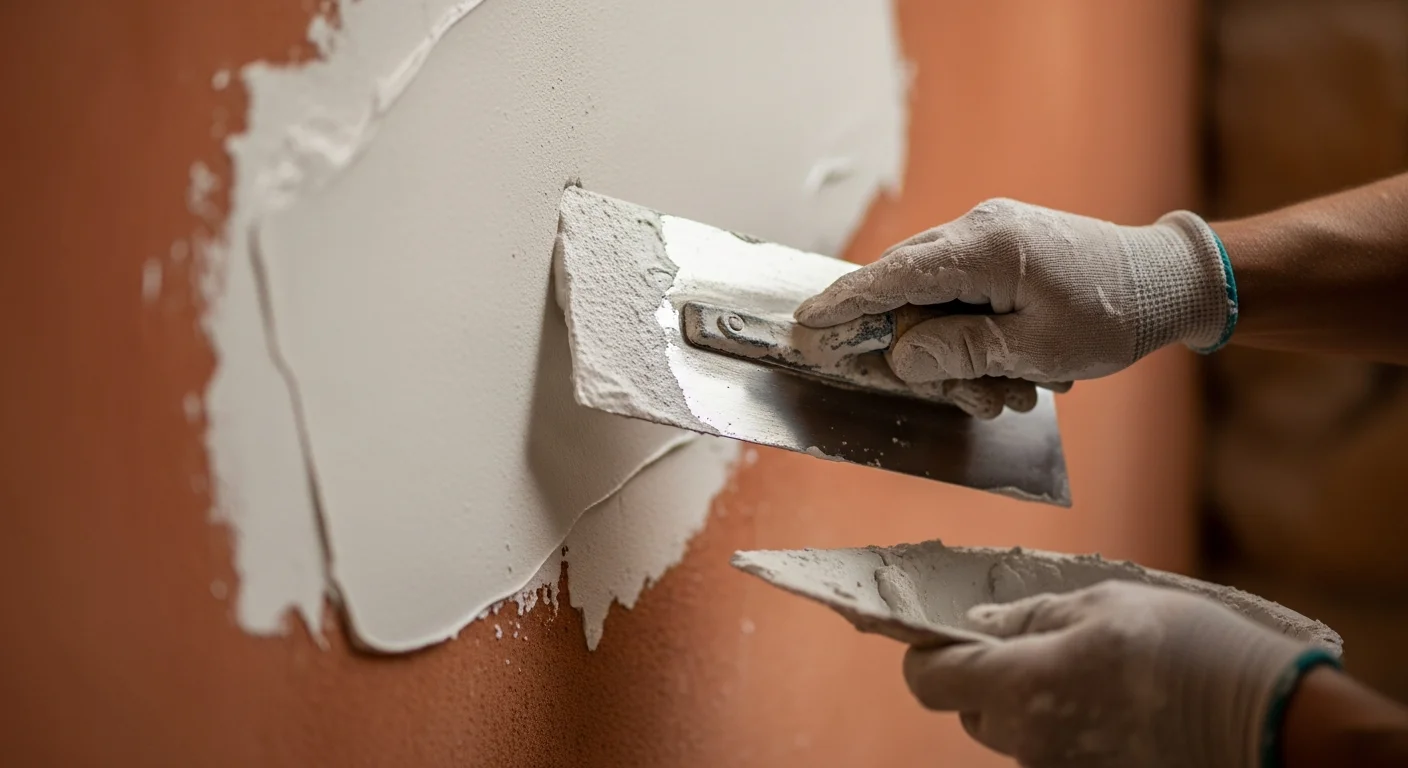
Lime plaster is applied in the classic three-layer build-up. First a thin spatter coat as a bonding bridge, then the base plaster as the supporting, levelling layer at 10 to 20 millimetres, and finally the top or fine plaster. Each layer must have set sufficiently before the next follows, and the rule is soft layer on hard, i.e. never a firmer layer on a softer one. Lime hardens through carbonation, which needs time, moisture and air. Keep the fresh plaster evenly damp for several days, protect it from blazing sun, draughts and frost, and do not force drying artificially. Drying too quickly interrupts carbonation and weakens the plaster.
Safety during application
Fresh lime is strongly alkaline and irritates skin and eyes. Work with gloves and safety goggles and rinse off splashes immediately. This alkalinity is also the reason for its mould-inhibiting effect; it fades with carbonation, while the vapour-permeable, mineral surface remains.
When lime is the right choice
You reach for lime where moisture, weathering or the risk of mould come into play, i.e. on the facade and plinth, in the bathroom, kitchen and cellar and on moisture-exposed timber frame panels outside. In dry interiors, clay remains the materially appropriate choice. With both systems in the house, clay inside and lime in the stressed areas, you plaster the whole building purely mineral and vapour-permeable.
Regional context and use in practice
In Achim, Bremen and throughout northern Germany there are many old buildings and timber frame houses whose facades, plinths and damp rooms call for lime. Lehm-Revival delivers Graefix lime plasters and Saint-Astier lime binders throughout Germany and advises in the region on choosing the binder, grain and build-up for your project.
Frequently asked questions
What is the difference between air lime and hydraulic lime?
Air lime (CL) hardens solely through carbon dioxide from the air, slowly, very vapour-permeable and supple, good for fine interior surfaces and monument conservation. Hydraulic lime (NHL) also hardens with water, making it faster, stronger and more weather-resistant. At Saint-Astier, CL90 is the pure air lime.
Where do I use lime plaster and where clay plaster?
Clay belongs in dry interiors, lime wherever moisture or weathering come into play: facade, plinth, bathroom, kitchen, cellar and timber frame panels outside. Lime is strongly alkaline and therefore inhibits mould and algae without chemical additives. With both systems you plaster the whole building purely mineral and vapour-permeable.
Graefix or Saint-Astier: ready-mixed plaster or binder?
Graefix is the ready-matched lime system, graded by grain from lime base plaster through thin-layer plaster to smoothing coat and lime paint, without you having to dose binder and aggregate yourself. Saint-Astier supplies the binder with which you adjust the mortar yourself to substrate and load. For a standard project you reach for Graefix; for demanding substrates, listed surfaces or exterior plaster you combine the matching Saint-Astier binder.
Sources and standards
Further links
Products in the shop
More items in Clay building
- Monument protection and clay building: age line, permit and typical mistakes
- Buy hemp insulation: hemp insulation batts for interior insulation, rafters and timber framing
- Hempcrete: mixture, application and insulation values for wall, floor and roof
- Interior insulation costs per m², wood fibre with clay vs. calcium silicate vs. drywall
- When clay does not work: limits, mistakes and decision rules
- Clay in interior finishing: a healthy indoor climate with natural building materials
- Clay, lime or cement: which binder is right for old buildings and timber framing?
- Advantages of clay building, healthy indoor climate, sustainability and building physics explained clearly
- Clay building: building and renovating with clay
- Clay boards in interior finishing: drywall construction with clay according to DIN 18948
- Buy fine clay plaster and YOSIMA design plaster: application, choice of colour and prices
- Clay paint on plasterboard: pre-treatment, consumption and painting
- Clay paint in interior finishing: mineral wall paint for a healthy indoor climate
- Clay mortar in clay building: masonry mortar and plastering mortar
- Clay plaster on concrete: preparation, primer and plaster thickness
- Clay plaster on gypsum plaster and old plaster: check, prime, plaster thinly
- Clay plaster on sand-lime brick and brick: plastering masonry correctly
- Clay plaster on Rigips and plasterboard: preparing the substrate correctly
- Applying clay plaster: the complete step-by-step guide
- Clay plaster costs per m², prices, material requirements and packs compared
- Renovating clay plaster: recognising types of damage, understanding causes and repairing correctly for the long term
- Clay plaster on different substrates: concrete, brick, wood and drywall
- Building up clay plaster: base coat, finishing coat and fine plaster
- Wall heating with clay: planning and installation step by step
To take away: the free clay building diary with drying log.
Download free of charge