
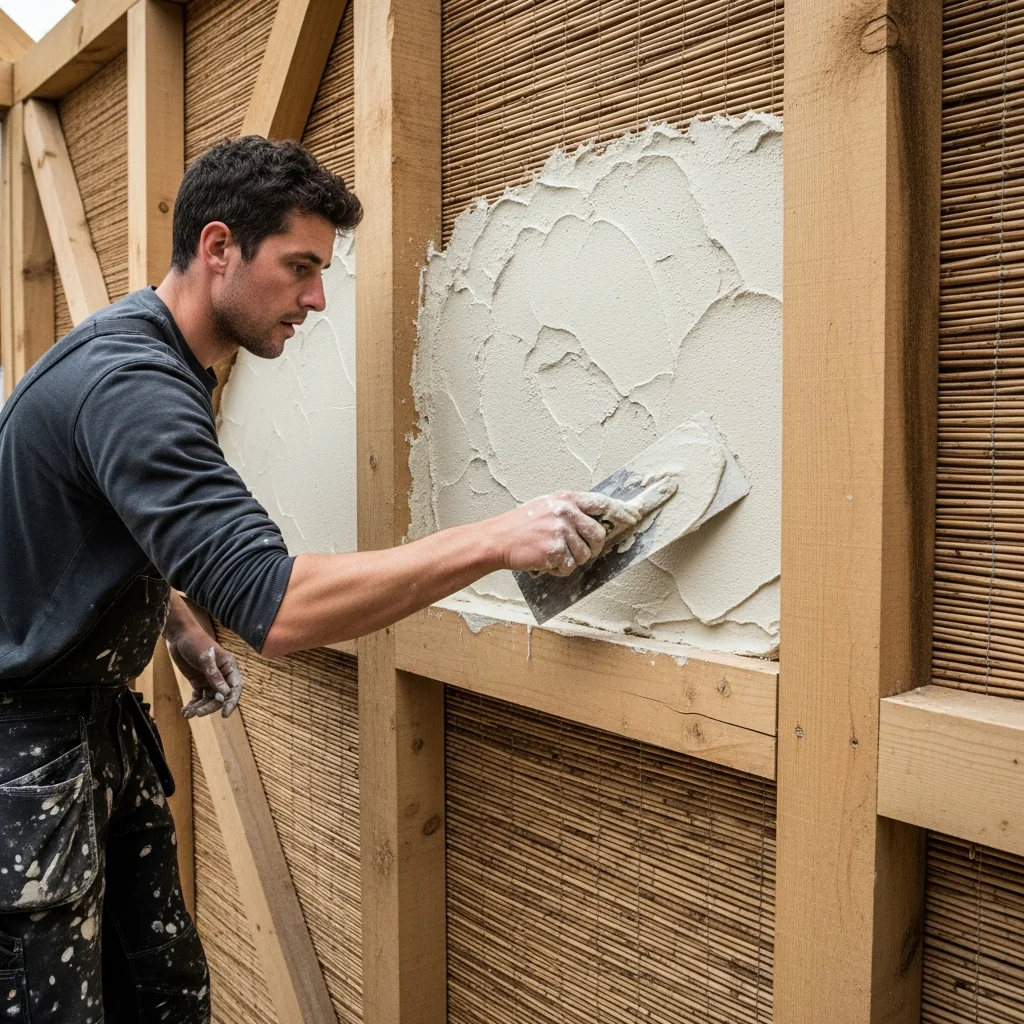
Lime in timber frame construction: using NHL and alpine lime

Alongside clay, lime is one of the most important building materials in the renovation of historic timber frame houses. While clay is used mainly indoors and for panel infills, lime shows its strengths particularly outdoors. Lime plasters are more weather-resistant, strongly alkaline and therefore naturally mould-inhibiting. At the same time they remain vapour-permeable and capillary-active.
Why lime works in timber framing
The reason lies in the chemical reaction of the lime. During setting, calcium hydroxide reacts with carbon dioxide from the air and turns back into calcium carbonate. This process is called carbonation. The result is a solid, mineral structure that still lets moisture pass through.
It is exactly this property that makes lime the ideal exterior partner for clay in timber framing. The timber structure stays dry because moisture that diffuses through the construction from inside can escape again outside. With cement plaster this balance is blocked and the timber stays permanently damp.
Another advantage of lime is its alkalinity. A pH value above 12 makes fresh lime plaster mould-inhibiting and additionally protects the timber from fungal attack. This property was the reason why historic timber frame houses survived for centuries without biocides or wood preservatives.
Types of lime in timber framing
White lime, NHL and lime putty compared
White lime (CL 90) is a classic air lime. It sets exclusively by carbonation and therefore remains very soft and vapour-permeable. White lime is particularly suitable for interior plasters, lime paints or decorative lime smoothing coats. On its own, white lime is not sufficiently weather-resistant for exposed outdoor areas subject to driving rain.
Natural hydraulic lime (NHL) also contains natural silicates from the limestone. As a result, it can partly set hydraulically and harden even without direct contact with air. Typical classes are NHL 2, NHL 3.5 and NHL 5. NHL 3.5 is used for timber frame facades, as it remains sufficiently weather-resistant without becoming too stiff. Excessive stiffness would inevitably lead to cracks with the seasonal movements of the timber structure.
Lime putty is air lime stored for several months or years. This storage makes the lime particularly plastic and fine. The lime crystals dissolve more and form a denser, smoother surface when setting. Lime putty is used above all for restoration plasters, lime smoothing coats and historic surfaces. It can be applied very thinly and produces particularly homogeneous surfaces.
The setting of NHL lime differs fundamentally from white lime. While white lime needs only CO₂ from the air, NHL can also harden without contact with air through reaction with water. This makes NHL more weather-resistant and better suited to outdoor areas. At the same time NHL is reversible. It can be dissolved again with suitable solutions and repaired with fresh lime. This property is particularly important in monument conservation.
Saint-Astier lime in timber framing
An internationally known manufacturer of high-quality hydraulic limes is Saint-Astier from the Périgord in France. The company has been producing natural hydraulic lime from pure limestone without artificial additives for over 150 years. The lime is extracted from a single deposit whose limestone contains natural silicates in defined proportions.
Particularly widespread in timber frame renovation is Saint-Astier NHL 3.5. This lime offers a good combination of strength, elasticity and vapour permeability. The μ value is 15–25, which is optimal for timber frame facades. For plinth areas or heavily weathered facades, the recommendation is Saint-Astier NHL 5 is used, which achieves a higher compressive strength.
For particularly sensitive historic substrates, Saint-Astier offers the Saint-Astier NHL 2. It has low strength and high plasticity and is suitable for delicate restoration work on timber framing, stucco and historic surfaces.
Saint-Astier limes are available in Germany from specialised building materials dealers. They are used by restorers, monument conservators and craft businesses specialising in timber frame renovation because they offer consistent quality and clearly defined technical properties.
Alpine lime for high-quality lime plasters
Alpine lime comes from particularly pure limestone deposits in the Alpine region, above all in Austria and Bavaria. Due to its purity (the calcium carbonate content is often over 98 percent) and its fine crystal structure, it is excellently suited to high-quality lime plasters and mineral lime smoothing coats.
Typical properties of Alpine lime are very good workability, high alkalinity and a long open time. After mixing, the lime remains workable longer than many other lime types, which is a particular advantage for large-area facade work.
On historic facades with visible panels in particular, Alpine lime can be used to create particularly homogeneous surfaces. The lime sets evenly and leaves a very fine, dense surface after setting. In combination with natural-grain sand or marble grain, high-quality fair-faced plasters are created that match the historic appearance of timber frame houses.
In practice, Alpine lime is combined with lime putty to improve plasticity. A typical mix consists of two parts Alpine lime to one part lime putty, slurried in water. This mix can be applied very thinly and, after carbonation, produces a hard, dense lime smoothing coat.
Lime instead of cement in timber framing
A common mistake in timber frame renovation is using cement plaster. Cement is very dense and much stiffer than lime. The vapour diffusion resistance of cement plaster is five to ten times that of a comparable lime plaster. As a result, moisture can no longer dry out of the component.
At the same time, stresses arise between timber and plaster. Timber moves with the seasons: in summer it dries out and contracts, in winter it absorbs moisture and swells. A stiff cement plaster cannot absorb these movements. Cracks inevitably develop, and water penetrates through the cracks, which then cannot dry out because of the dense plaster.
Lime plasters are much more elastic and vapour-permeable. They can absorb movements of the timber structure and support the natural moisture balance of the wall. Lime plaster can also be repaired in case of damage: cracks can be closed with fresh lime mortar, and the repair bonds mineralogically with the existing plaster.
Applying lime plaster in timber framing
Before applying lime plaster, the substrate must be carefully prepared. Old, loose plaster and above all cement residues must be removed completely. Timber surfaces are coated with a thin lime slurry to improve adhesion and prevent the fresh plaster from drying out too quickly on the timber.
As a plaster base, Reed mat proven. It is fixed to the timber beams with galvanised staples and bridges the critical zone between timber and panel. This zone is particularly stressed mechanically because timber and infill move to different extents.
NHL lime plaster is always applied in thin layers, at most 10 to 15 millimetres per layer. For greater unevenness, several layers are applied one after the other, with each layer having to stiffen sufficiently. Drying too quickly due to sunlight, wind or frost prevents complete carbonation and leads to shrinkage cracks.
After application, lime plaster must be kept damp for three to five days. To do this, the surface is regularly sprayed with water or covered with damp jute fabric. Shrinkage cracks under 0,3 millimetres wide are normal and not a quality defect; they largely close themselves through ongoing carbonation.
When lime and when clay?
In many timber frame renovations both materials are combined. Clay and lime complement each other ideally in terms of building physics: clay regulates moisture and creates a healthy indoor climate, lime protects the outer envelope and provides alkaline protection.
Clay is particularly suitable for interior plasters and panel infills. It can absorb, store and release moisture again. This moisture balancing capacity is a central advantage of clay indoors.
Lime is used above all outdoors, for example for exterior plasters, plinth zones or areas with permanently increased moisture load. There it protects the construction from driving rain and weather.
A typical wall build-up in timber framing therefore consists of a clay or Hemp blockpanel with clay plaster inside and lime plaster outside. This combination links moisture regulation indoors with weather protection on the facade and follows the traditional principle of historic timber frame houses. The sequence of layers must always be built up so that the outer layer is at least as vapour-permeable as the inner one, otherwise moisture condenses in the wall plane.
| Lime type | Setting | Weather resistance | Recommended application |
|---|---|---|---|
| White lime CL 90 | Air carbonation | low | Interior plaster, lime paint, lime smoothing coat |
| NHL 2 | Air + weakly hydraulic | moderate | Interior plaster in damp rooms |
| NHL 3.5 (Saint-Astier) | Air + hydraulic | good | Exterior plaster on timber framing, joint repair |
| NHL 5 (Saint-Astier) | predominantly hydraulic | very good | Plinth plaster, exposed areas |
| Lime putty | Air carbonation | low | Restoration plaster, lime smoothing, stucco work |
| Alpine lime | Air carbonation | low to medium | Fair-faced plasters, lime smoothing, historic facades |
Regional context and use in practice
In northern Germany, especially in the Achim, Verden and Hamburg area, driving rain is a constant load on historic timber frame houses. Choosing the right type of lime is decisive here for the durability of the renovation. Lehm-Revival at Danziger Str. 59, 28832 Achim advises on lime applications in timber framing and handles material orders. I deliver NHL limes and lime plasters nationwide by parcel or haulier.
Frequently asked questions
NHL 3,5 or NHL 5: which lime for the timber frame facade?
NHL 3,5 is moderately hydraulic and remains more elastic and vapour-permeable. It is suitable for normal timber frame facades. NHL 5 is more strongly hydraulic and more weather-resistant but stiffer. It is suitable for plinths or particularly exposed areas. For most timber frame renovations, NHL 3,5 is the right choice.
Sources and standards
Further links
Products in the shop
More items in Timber framing & wood
- Building physics for natural building materials: vapour diffusion, heat storage and dew point
- Timber frame wall build-up: layers, materials and structure fully explained
- Filling a timber frame panel: definition, materials and step-by-step guide
- Timber framing in central Germany: history, construction methods and regional features
- Timber framing in northern Germany: history, construction methods and regional features
- Renovating timber framing with clay: step by step to a healthy timber frame wall
- Timber framing in southern Germany: history, construction methods and regional features
- Historic roof windows in listed buildings: permit, models and installation
- Lime screed in a timber frame house: planning and professional execution on sandy ground
- Clay in timber framing: infill, plaster and renovation
- Clay vs. brick in timber framing: which material really suits the panels?
- Filling a panel: clay block or hemp block in timber framing
- Clay-wrapped staves in timber framing: historic restoration, reuse and professional new production
- What is timber framing? Structure, function and materials simply explained
- Reusing old bricks in timber framing: cleaning, triangular battens and professional reinstallation
To take away: the free clay building diary with drying log.
Download free of charge