
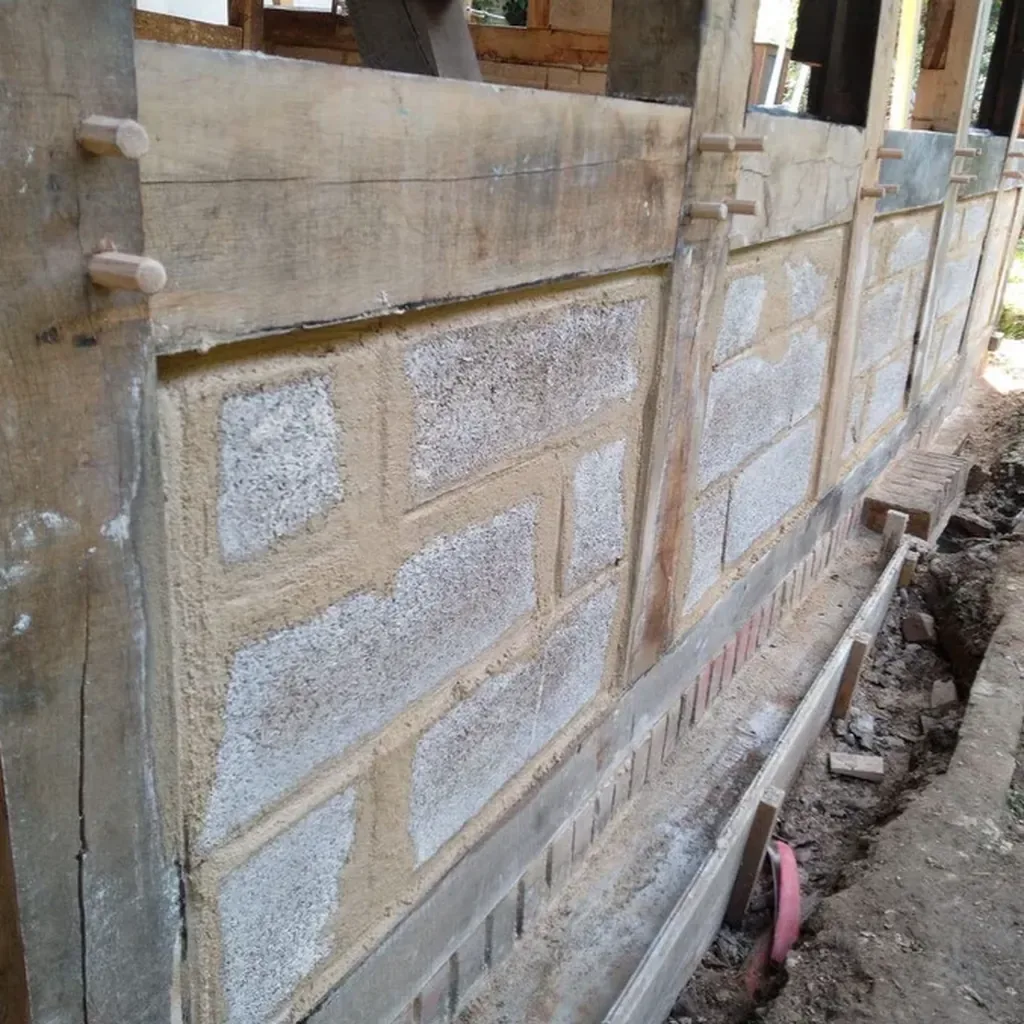
Filling a panel: clay block or hemp block in timber framing

The panel is the area between the timber beams of a timber frame. It is filled with a non-load-bearing material and forms the wall section between the timbers. Although the panel has no structural function, it is decisive for thermal protection, moisture regulation and the durability of the building.
Historic and modern infill
Historically, panels were filled with wattle and clay. Thin Willow rods or hazel rods were woven as a lattice between the timbers and thrown on both sides with a clay-straw mixture. This construction is fully vapour-permeable, repairable and very robust in terms of building physics.
Today, besides traditional methods, industrially made clay blocks or modern hemp blocks are also available. These prefabricated products speed up execution considerably and at the same time offer defined, standard-compliant properties. The choice of the right material depends on the condition of the building, the aim of the renovation and any monument protection requirements.
Clay block in timber framing
Clay blocks are among the classic materials for panel infills. They consist of clay, sand and sometimes plant aggregates such as straw or hemp fibres. Industrially made clay blocks are produced according to DIN 18945 and with Clay masonry mortar according to DIN 18946 .
Clay blocks have a bulk density between 1.200 and 1.800 kilograms per cubic metre. This mass makes them good heat stores: they absorb heat during the day and release it slowly at night. This leads to stable indoor temperatures and a pleasant living climate.
At the same time, clay blocks are fully vapour-permeable and capillary-active. This means that moisture can be absorbed and released both by diffusion and by capillary transport. This dual ability makes clay blocks particularly robust against changing humidity.
Especially for listed timber frame houses, clay blocks are the first choice. They correspond to traditional construction, meet modern DIN standards and are usually accepted by monument protection authorities without problems. Clay blocks from ClayTec are developed specifically for timber frame infills and are tested according to DIN 18945.
Application is straightforward: clay blocks are cut to size, fitted between the timber beams and laid with clay masonry mortar. A rigid connection to the timber is not necessary. A soft, low-stress connection prevents cracks when the timber structure moves due to moisture or temperature.
Schönthaler hemp block with Alpine lime
A modern alternative to the clay block is the Schönthaler hemp block. This building material consists of hemp shives, the woody core of the hemp stalk, and a mineral lime-based binder, usually alpine lime.
Hemp block combines several building physics advantages. According to the manufacturer, with a bulk density of around 300 to 360 kilograms per cubic metre the material is much lighter than clay block. At the same time it has much better insulation values: thermal conductivity is 0,07 watts per metre and kelvin, compared with 0,47 to 0,91 for clay block.
Thanks to the lime content, the hemp block remains alkaline and mould-inhibiting. The pH value of the lime binder is above 12 and prevents mould growth even in areas with changing moisture. At the same time, the hemp block remains fully vapour-permeable; the hemp fibres actively transport moisture through the block.
The Alpine lime used as binder comes from particularly pure limestone deposits in the Alpine region. It gives the hemp block lasting strength through carbonation and bonds mineralogically with the clay or lime plaster that is applied afterwards.
In timber frame construction, hemp block is particularly suitable for renovations that require additional thermal insulation without losing the vapour permeability of the construction. As hemp block manages entirely without synthetic insulation, the whole wall construction remains capillary-active and regulates moisture naturally.
Hemp block or clay block?
The choice depends above all on the aim of the renovation and the conditions of the building.
Clay blocks are particularly suitable for restorations in keeping with monument protection and for historic constructions. They correspond to traditional construction, have very good heat storage properties and are preferred by monument authorities. If original fabric is to be preserved and no increased insulation value is required, clay block is the right choice.
Hemp blocks, on the other hand, offer much better insulation values at lower weight. They are used when energy improvements are to be achieved without installing additional conventional insulation. In buildings without strict monument protection, hemp block combines energy efficiency and ecology.
Both materials can easily be combined with clay or lime plasters. In both cases the connection to the timber structure is made soft and stress-free. Neither clay block nor hemp block is rigidly glued or screwed to the timber beams.
Wall build-up in timber framing
A typical build-up in a timber frame renovation with vapour-permeable materials consists of three layers: interior plaster of clay, panel of clay block or hemp block and exterior plaster of lime.
This system has worked for centuries because all materials remain capillary-active and vapour-permeable. Moisture can migrate through the entire wall plane and dry out again on the outside. No material blocks this balance, and no material traps moisture in the timber.
The layer rule must be observed: from inside to outside, the vapour diffusion resistance of the layers must not increase. Clay plaster inside and lime plaster outside are both very vapour-permeable. This sequence is automatically fulfilled with the wall build-up described.
It is precisely this combination of wood, clay and lime that makes timber frame houses so durable. When the materials are properly matched, the result is a wall build-up that regulates moisture, stores heat and at the same time remains permanently stable. Timber frame houses several centuries old with their original clay and lime build-up prove the durability of this system.
Cost and availability
Clay blocks according to DIN 18945 are readily available in Germany and are offered by several manufacturers. ClayTec clay blocks are among the best-known products on the German market and are available in various formats.
Schönthaler hemp blocks are available in Germany from specialist retailers and specialised building materials dealers. As production is more elaborate than for clay blocks, prices are somewhat higher. However, the better insulation values can mean less overall effort is needed to meet energy standards.
For both materials: for larger renovation projects, a detailed calculation that takes into account material costs, labour and the achievable energy standard is worthwhile. Lehm-Revival is happy to advise on the right choice of material and delivers clay blocks and hemp blocks throughout Germany.
For a typical panel infill in a northern German timber frame house with a wall area of 30 square metres, the material requirement is about 1.500 to 2.000 clay blocks in NF or DF format. With hemp blocks the requirement is lower because of the larger format, around 270 to 300 blocks depending on format. Both materials are also delivered on pallets by haulier by arrangement.
As an alternative to clay blocks and hemp blocks, panels in non-load-bearing areas can also be filled with Hemp insulation batts with reed plaster base. This combination is easier to work with and well suited to DIYers. The hemp insulation is clamped into the panel, then reed is nailed on as plaster base and clay plaster is applied.
Calculate material quantities with the quantity calculator →
| Property | Clay block (DIN 18945) | Schönthaler hemp block |
|---|---|---|
| Bulk density | 1.200–1.800 kg/m³ | 300–360 kg/m³ |
| Thermal conductivity λ | 0,47–0,91 W/(mK) | 0,07 W/(mK) |
| Heat storage | very good | medium |
| Vapour permeability | very good | very good |
| Capillary activity | yes | yes |
| Alkalinity / mould protection | neutral | good (lime binder) |
| Weight per m² of panel | high | low |
| Heritage compliance | very high | high |
| Typical application | restoration in line with heritage requirements | energy-efficient renovation |
Regional context and use in practice
In the Achim, Verden and Lower Saxony area, many timber frame houses are over 150 years old. When choosing the infill, monument protection, energy efficiency and building physics play an equally important role. Lehm-Revival at Danziger Str. 59, 28832 Achim stocks both clay blocks and hemp blocks and advises on the right choice for each property. Delivery nationwide by parcel or haulier.
Frequently asked questions
Clay block or hemp block: what suits my panel?
Clay block is the choice for restorations in keeping with monument protection and for historic constructions: it corresponds to traditional construction, stores a lot of heat and is preferred by monument authorities. Schönthaler hemp block insulates much better (λ 0,07 compared with 0,47 to 0,91 W/(mK) for clay block) and is lighter but stores less heat; it fits if you want to improve energy performance and there is no strict monument protection. For protected buildings, agree hemp block with the authority beforehand.
Which mortar do I use to lay hemp blocks?
For hemp blocks, the manufacturer specifies cement-free lime masonry mortar of class M5, with a joint about 1 cm thick. Clay masonry mortar is intended for clay blocks.
Is there a lighter solution for DIYers?
For panels in non-load-bearing areas, hemp clamping felt with reed as a plaster base is also suitable. You clamp the hemp insulation into the panel, nail on reed as plaster base and apply clay plaster. This combination is easier to work with than laid blocks.
Sources and standards
- DIN 18945: Lehmsteine
- DIN 18946: Lehmmauermörtel
- Hanfhaus, Hanfbaustoffe und Naturbaumaterialien
- DIN 4108-4:2020-11: Wärmeschutz, Tabelle 1 Bemessungswerte
- Schönthaler Hanfstein, Technisches Merkblatt und Anbauanleitung
- DIBt Allgemeine bauaufsichtliche Zulassung Z-17.25-1299 (Schönthaler Hanfstein)
Further links
Products in the shop
Knowledge articles
More items in Timber framing & wood
- Building physics for natural building materials: vapour diffusion, heat storage and dew point
- Timber frame wall build-up: layers, materials and structure fully explained
- Filling a timber frame panel: definition, materials and step-by-step guide
- Timber framing in central Germany: history, construction methods and regional features
- Timber framing in northern Germany: history, construction methods and regional features
- Renovating timber framing with clay: step by step to a healthy timber frame wall
- Timber framing in southern Germany: history, construction methods and regional features
- Historic roof windows in listed buildings: permit, models and installation
- Lime screed in a timber frame house: planning and professional execution on sandy ground
- Lime in timber frame construction: using NHL and alpine lime
- Clay in timber framing: infill, plaster and renovation
- Clay vs. brick in timber framing: which material really suits the panels?
- Clay-wrapped staves in timber framing: historic restoration, reuse and professional new production
- What is timber framing? Structure, function and materials simply explained
- Reusing old bricks in timber framing: cleaning, triangular battens and professional reinstallation
To take away: the free clay building diary with drying log.
Download free of charge