
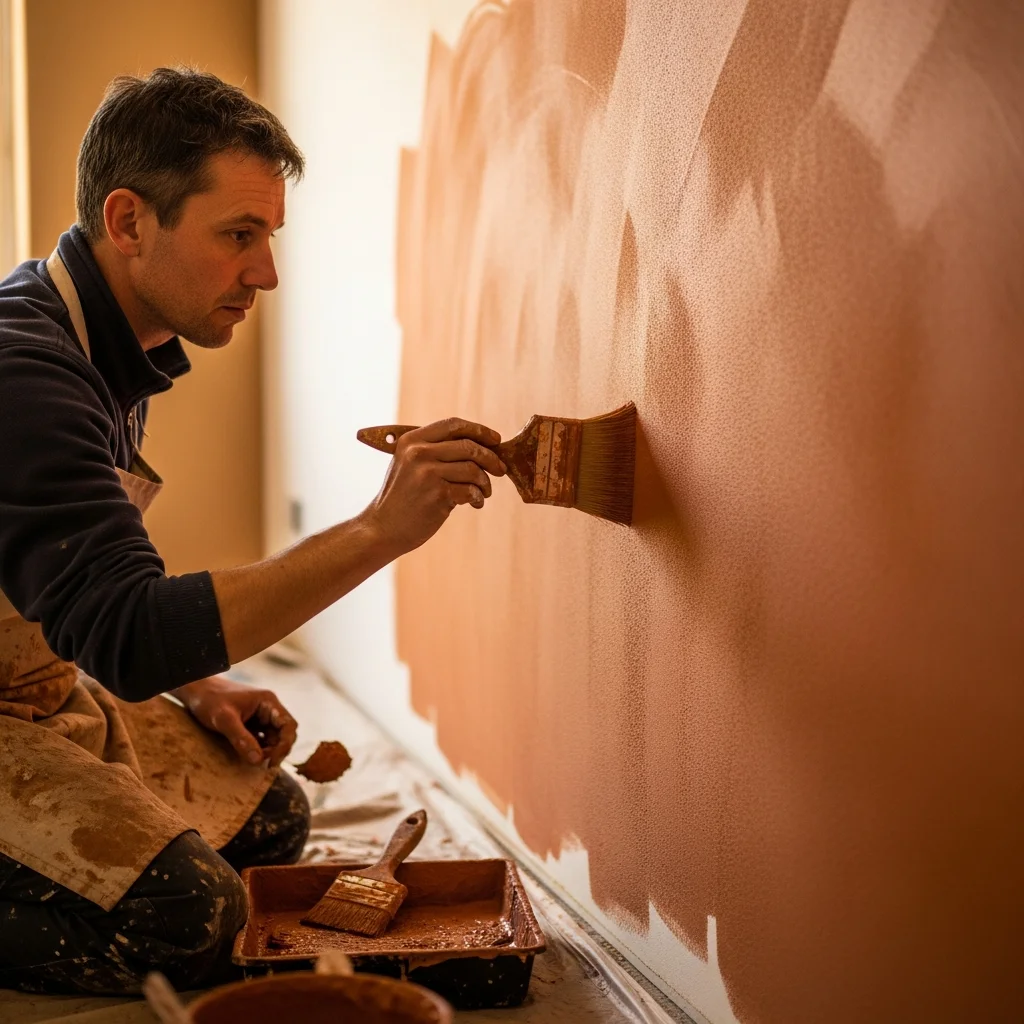
Clay paint in interior finishing: mineral wall paint for a healthy indoor climate

Clay paint is a purely mineral wall coating based on clay, water and natural pigments. It is applied to dry clay plasters, clay boards, lime plasters or suitable mineral substrates and forms a fully vapour-permeable surface. Unlike conventional emulsion paints, high-quality clay paint contains no synthetic resins, no solvents and no biocides. The coating therefore stays capillary-active and supports the natural moisture regulation of the wall surface. Two coats are enough to achieve an evenly covering, velvety matt surface. Clay paints are used above all in ecological interior finishing, in old building and timber frame renovations, in timber and clay construction and in living rooms, bedrooms and children's rooms. At Lehm-Revival, mainly ClayTec clay paints as well as ClayTec Yosima clay design surfaces are used, consistently based on natural clays and mineral pigments.
Composition of clay paint
Clay paint consists of a few natural components: very finely ground clay, natural clays, mineral pigments and water. The clay acts both as binder and as a moisture-regulating component. The microporous structure of the material creates a capillary-active surface that can absorb and release water vapour.
In high-quality products, small amounts of vegetable cellulose or mineral wetting agents are also used to improve workability. However, these additives do not change the mineral structure of the paint. The clay paints in the shop contain no solvents or preservatives. They differ in binder: ClayFix clay paint binds with coloured clays and loams, chalk and gum arabic and contains no dispersion, while the white ClayTec clay paint contains up to 3,5 % dispersion. Both remain vapour-permeable and support the indoor climate.
Natural pigmentation: the difference from other paints
An important quality difference in clay paints lies in the pigmentation. ClayTec and Yosima use only natural clays and mineral earth pigments. The colour therefore comes from natural mineral components of the earth itself.
Typical pigments are ochre, umber, sienna, terra di Siena, iron oxide pigments and natural clay minerals. These pigments form geologically over millennia and have very high colour stability. They are UV-stable, mineral and durable and contain no synthetic dyes.
With Yosima clay design plasters, the colour even comes directly from different natural clays. The clay minerals act both as binder and as colourant. This creates particularly deep, natural shades. Many other manufacturers, by contrast, partly use synthetic pigments or industrial colour additives, which can reduce the vapour permeability of the surface. ClayTec deliberately takes a different approach: the colour palette is consistently based on natural earths.
Why there is no blue in pure clay paints
Using only natural earth pigments has a logical consequence: the colour palette is based on the shades found in natural clays. Typical natural clay colours are sand shades, cream and beige, ochre, umber, terracotta, brown, greys and anthracite. An intense blue practically does not occur in natural clays.
Historically, blue in mineral colours was obtained from lapis lazuli. This rare mineral comes mainly from deposits in Afghanistan and was already being made into pigment in antiquity. Lapis lazuli was long one of the most expensive pigments in the world and was used mainly for religious works of art. Such pigmentation would theoretically be possible today but hardly makes economic sense.
For this reason, manufacturers such as ClayTec deliberately do without artificial blue pigments. The result is a particularly harmonious colour effect that goes perfectly with mineral building materials such as clay, lime, wood and natural stone.
Indoor climate and moisture regulation
A key advantage of clay paints is their ability to regulate moisture. Clay has a microporous structure. Water vapour can be stored in these pores and is released again when the air is dry. This process is called sorption capacity.
Thin layers of clay paint can also absorb moisture from the indoor air and release it again. Typical values are about 5 to 20 grams of moisture per square metre during humidity jumps. The effect depends heavily on the substrate. Clay paint is particularly effective on clay plaster, clay filler and clay boards, because here the whole wall surface works as a moisture buffer.
By comparison, emulsion paints usually have only a very low sorption capacity of about 0 to 5 grams per square metre. Moisture buffering with clay paints can therefore noticeably reduce humidity peaks in the indoor climate.
Surface and colour effect
Clay paints create a characteristic mineral surface. The surface looks velvety matt, slightly cloudy, naturally deep in colour and lively in texture. This effect comes from the fine clay particles in the clay.
Unlike synthetic emulsion paints, the surface is not completely homogeneous. Instead, the wall shows a slight natural liveliness. Many builders value exactly this property because it goes particularly well with natural materials such as wood, lime and clay.
Suitable substrates
Preparing the substrate
Clay paint adheres to many mineral substrates as long as they are sufficiently absorbent and load-bearing. Suitable substrates are clay plaster, clay base plaster, top plaster or fine plaster, clay boards according to DIN 18948, lime plaster, lime-gypsum plasters and primed plasterboard.
Emulsion paints, latex paints, synthetic resin plasters and very dense coatings are not suitable. Such surfaces usually have to be removed or prepared with suitable mineral primers. For a good result the substrate must be dry, dust-free, load-bearing and evenly absorbent.
Sanding or unevenly absorbent substrates are first pre-treated with ClayTec deep primer and consolidant. This primer reduces absorbency and ensures even drying. On very smooth substrates, a mineral bonding primer or quartz primer can also be used.
Applying clay paint
Clay paint can be applied with classic painting tools. Flat brushes, ceiling brushes, short-pile rollers and clay paint brushes are suitable. The paint should be stirred thoroughly before use, as mineral pigments can settle during storage.
The first coat is applied undiluted or with at most 2 % water so that it can soak well into the substrate. Drying time: about 6 to 8 hours with good ventilation. The second coat is applied undiluted, ideally across the direction of the first. This produces even coverage. Two coats are enough for full coverage.
Material consumption depends heavily on the substrate and the tool used. Typical consumption per coat: about 150 to 280 ml per square metre. With two coats, total consumption is about 0,3 to 0,55 litres per square metre. Very absorbent substrates may need more material.
Airtightness and indoor climate
For the sorption effect to work optimally, the room should be well airtight. If large air flows or strong convection occur, moisture is transported faster by ventilation than by sorption of the wall surface. In well-planned interiors, clay paint together with clay plaster or clay boards therefore supports stable indoor humidity.
Clay paints at Lehm-Revival
At Lehm-Revival you will find a selection of high-quality mineral wall surfaces for interior finishing, including ClayTec clay paints, ClayTec Yosima clay design plasters, clay fillers and fine plasters as well as clay boards and clay plaster systems.
These products enable fully vapour-permeable wall surfaces and ensure a naturally regulated indoor climate. Clay paints are therefore one of the simplest ways to bring the advantages of clay construction into existing rooms, even when there is no complete clay plaster build-up.
| Product | Layer thickness | Sorption capacity | Special feature |
|---|---|---|---|
| ClayTec clay paint | < 1 mm | 5–20 g/m² | 2 coats, easy application |
| ClayTec Yosima design plaster | 1–2 mm | higher than clay paint | 146 natural shades |
| Emulsion paint | < 1 mm | 0–5 g/m² | not vapour-permeable |
| Clay fine plaster | 2–3 mm | 30–50 g/m² | best moisture buffering |
Regional context and use in practice
In the Achim region (28832) and the greater Bremen area, Lehm-Revival advises craftsmen, DIYers and builders on choosing and using clay paints and Yosima design plasters. I deliver ClayTec clay paints and Yosima systems by parcel throughout Germany. For projects in Lower Saxony I offer personal on-site advice and help with substrate assessment, colour choice and quantity calculation.
Frequently asked questions
What can I paint clay paint on?
On mineral, absorbent and load-bearing substrates: clay plaster, clay boards according to DIN 18948, lime plaster, lime-gypsum plaster and primed plasterboard. Emulsion paints, latex paints and synthetic resin plasters are not suitable; these surfaces must be removed before painting or prepared with a mineral primer.
What is the difference between clay paint and YOSIMA design plaster?
Clay paint is a thin coat under one millimetre thick and buffers about 5 to 20 grams of moisture per square metre, most strongly on clay plaster and clay boards. YOSIMA clay design plaster is a thin-layer plaster 1 to 2 mm thick made from natural clays and mineral pigments. YOSIMA creates a deeper colour effect, a livelier surface and higher sorption capacity than clay paint.
Can I also apply clay paint myself (DIY)?
Yes, clay paint is also well suited for DIYers. It is applied like normal wall paint with a brush or roller. Important: stir the paint thoroughly before application, as mineral pigments settle. First coat with at most 2 % water, second coat undiluted and across the first direction. A test strip beforehand helps you judge the shades on your own substrate.
Is there clay paint in blue?
Not with pure clay paints. The shades come from natural clays and earth pigments: sand, cream, beige, ochre, umber, terracotta, brown, grey and anthracite. An intense blue practically does not occur in natural clays, which is why ClayTec does without artificial blue pigments.
Sources and standards
Further links
Products in the shop
Knowledge articles
More items in Clay building
- Monument protection and clay building: age line, permit and typical mistakes
- Buy hemp insulation: hemp insulation batts for interior insulation, rafters and timber framing
- Hempcrete: mixture, application and insulation values for wall, floor and roof
- Interior insulation costs per m², wood fibre with clay vs. calcium silicate vs. drywall
- Lime plaster: properties, use and application inside and outside
- When clay does not work: limits, mistakes and decision rules
- Clay in interior finishing: a healthy indoor climate with natural building materials
- Clay, lime or cement: which binder is right for old buildings and timber framing?
- Advantages of clay building, healthy indoor climate, sustainability and building physics explained clearly
- Clay building: building and renovating with clay
- Clay boards in interior finishing: drywall construction with clay according to DIN 18948
- Buy fine clay plaster and YOSIMA design plaster: application, choice of colour and prices
- Clay paint on plasterboard: pre-treatment, consumption and painting
- Clay mortar in clay building: masonry mortar and plastering mortar
- Clay plaster on concrete: preparation, primer and plaster thickness
- Clay plaster on gypsum plaster and old plaster: check, prime, plaster thinly
- Clay plaster on sand-lime brick and brick: plastering masonry correctly
- Clay plaster on Rigips and plasterboard: preparing the substrate correctly
- Applying clay plaster: the complete step-by-step guide
- Clay plaster costs per m², prices, material requirements and packs compared
- Renovating clay plaster: recognising types of damage, understanding causes and repairing correctly for the long term
- Clay plaster on different substrates: concrete, brick, wood and drywall
- Building up clay plaster: base coat, finishing coat and fine plaster
- Wall heating with clay: planning and installation step by step
To take away: the free clay building diary with drying log.
Download free of charge