

fast delivery
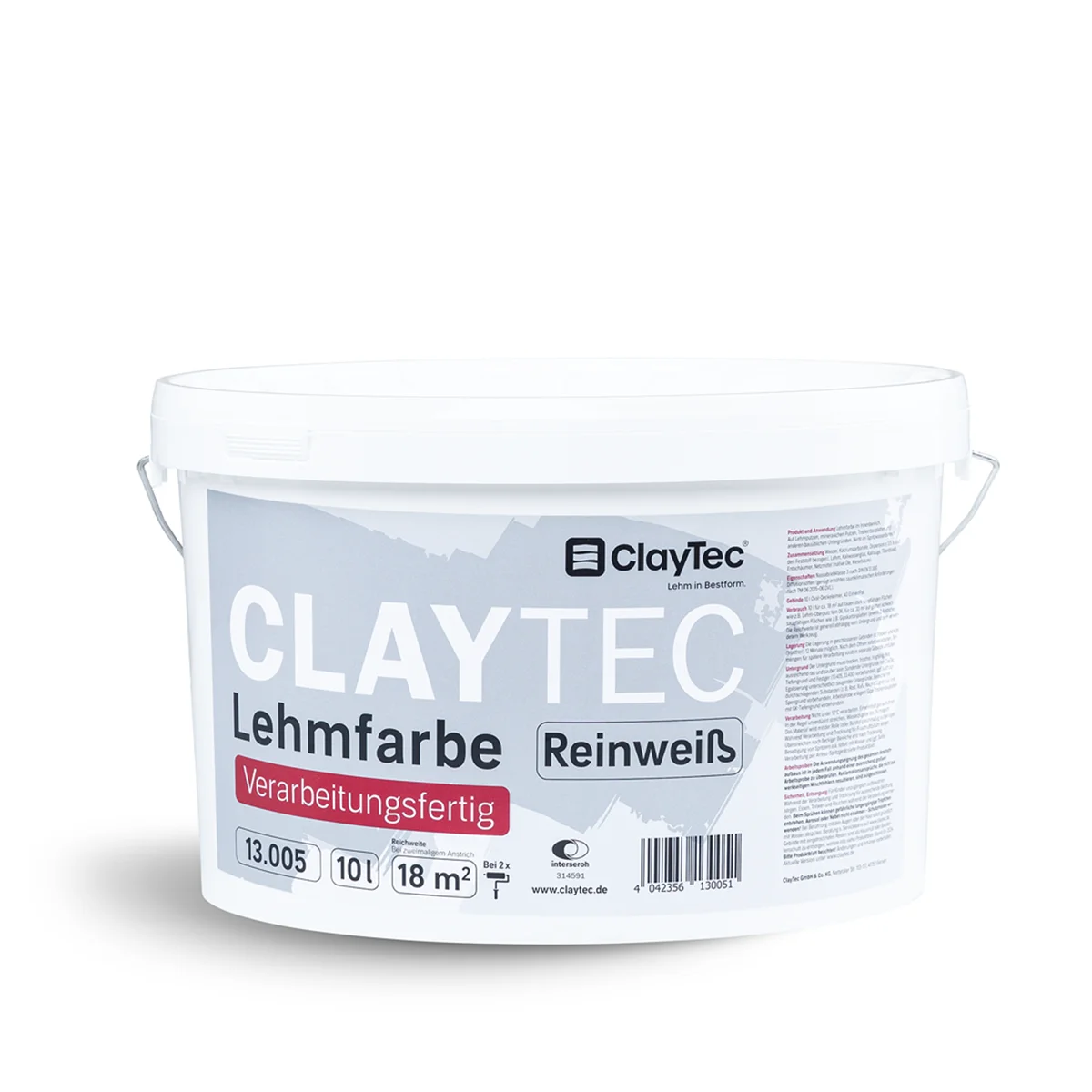
ClayTec clay paint pure white
Natural clay paint in pure white, brilliant, vapour-permeable and made purely of earth.
64,99 €
Clay paint can be applied to plasterboard. The manufacturer explicitly names drywall boards as a substrate. The boards are pre-treated beforehand with a deep primer for plasterboard, and the joints are filled and sanded. Then two coats follow with a roller. A 10 l bucket covers about 33 m² on plasterboard. Here I explain what I pay attention to in pre-treatment, application and surface.
Clay paint for smooth walls, clay brush plaster for a finely grained surface. You only need the filler if the wall is to be particularly smooth.
Natural clay paint in pure white, brilliant, vapour-permeable and made purely of earth.
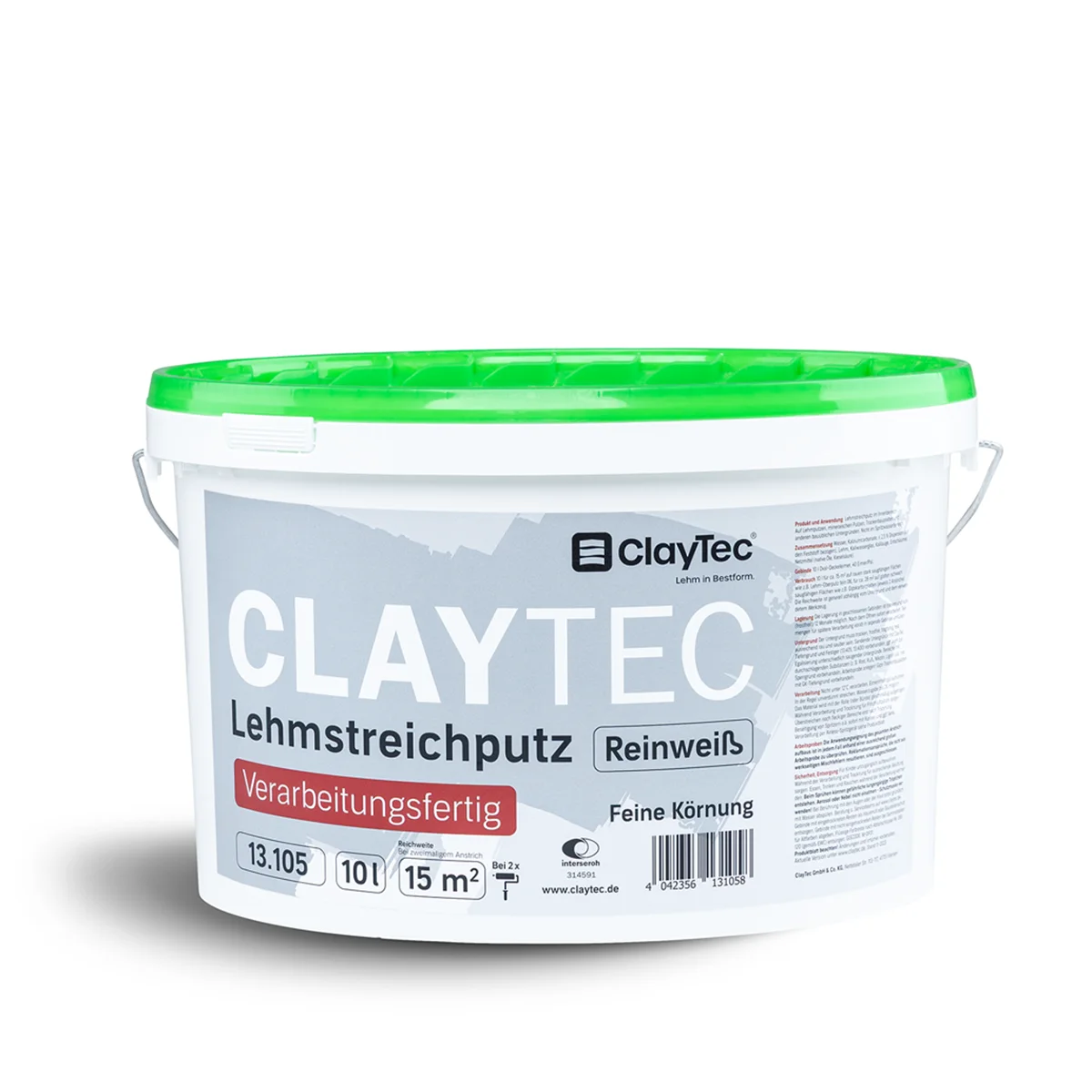
Fine pasty brush plaster, between paint and fine plaster, for textured white surfaces.
Smooth surfaces with filler, naturally!

Yes. The According to the product sheet, ClayTec clay paint is intended for clay plasters, mineral plasters, drywall boards and other common surfaces indoors. The splash zone is excluded, i.e. the wall directly at the shower and bath.
The substrate for painting must be dry, load-bearing, firm, clean and sufficiently rough. For a new drywall this means: the boards are firmly screwed, the joints are fully filled and dried, and the sanding dust has been swept off.
The product sheet is clear on this point: gypsum drywall boards are pre-treated with a deep primer for plasterboard. It evens out the different absorbency of the board and the filled joints so that the joints do not show through the paint later.
Use the product recommended by the manufacturer of your boards. ClayTec's deep primer and consolidant is expressly not intended for gypsum drywall boards. I do not stock a deep primer for plasterboard; you can get it where you buy the boards.
Clay paint usually does not need an additional clay primer. The white primer DIE WEISSE belongs to another product, the ClayFix clay coating.
On walls that have already been lived in, I first check for bleeding substances. Nicotine, soot, rust or water stains migrate through a water-based paint to the surface. Such areas are pre-treated with a blocking primer. Then you make a work sample.
If the plasterboard is already painted, the condition of the old paint decides. It must be firmly adhered, clean and not glossy. Here too, the test area shows after drying whether the clay paint holds and covers evenly. I remove wallpaper, including the paste, before painting.
Plasterboard is smooth and weakly absorbent. That is why the paint goes further than on clay plaster. For two coats, ClayTec states the following coverage per 10 l bucket: clay paint about 33 m², clay paint plaster about 28 m². On rough, highly absorbent clay top plaster it is only about 18 and 15 m².
Coverage depends on the tool and the substrate, so plan a small reserve. For continuous surfaces, use material from one batch. If you need several buckets for one room, it is best to order them together.
Do not apply the paint below 12 °C. Stir the bucket contents well. It is usually applied undiluted; up to 2 % water is possible. Apply evenly with a roller, and with a brush at corners and connections.
After drying, the first coat may still look patchy. The second coat only follows once the first is dry. Work each wall in one go from corner to corner. Laps over areas that have already dried may remain visible.
Ensure fresh air while painting and drying. Wipe splashes on the floor, windows or frames away immediately with water and a little soap. Larger areas can also be sprayed with clay paint using an airless device. This is not possible with clay paint plaster.
Both coatings are ready to use and differ in grain. Clay paint is smooth. Clay brush plaster contains a fine 0,13 mm grain and gives a slightly rough, plaster-like surface.
On plasterboard this has a practical benefit: slightly uneven surfaces can be evened out with the paint plaster, and small traces of filling are less noticeable. If the wall is to look completely calm and smooth, clay paint is the right choice.
For very smooth walls, ClayTec offers the clay filler and surface filler onto. It is suitable for plasterboard and gypsum fibreboard as preparation for painting and is applied up to 3 mm thick in one work step. A 10 kg bucket covers about 1 m² at 7,5 mm thickness.
After about 24 hours the filler is hard and can be dry sanded with 100 grit paper or sanding mesh. On the light filler, the clay paint is slightly diluted for the first coat and applied undiluted for the second.
The clay paint is vapour-permeable; the manufacturer states an sd value of 0,04 m. It is free of solvents and preservatives and achieves wet abrasion class 3 according to DIN EN 13300. As binder, besides clay and potassium water glass, it contains a small proportion of dispersion of at most 3,5 % of the solids.
A coat of paint remains a thin layer. The moisture buffering for which clay is known comes from mass, i.e. from clay plaster or clay boards. If you want it on a drywall, a thin clay plaster on the plasterboard is the right way.
| Feature | Clay paint | Clay brush plaster |
|---|---|---|
| Grain size | without | 0,13 mm |
| Coverage 10 l on plasterboard, two coats | about 33 m² | about 28 m² |
| Order | Roller, brush, airless | Roller, brush |
| Surface | smooth | slightly rough, evens out small irregularities |
| Pre-treating plasterboard | Deep primer from the board manufacturer | Deep primer from the board manufacturer |
Clay paint and clay paint plaster in pure white are on the shelf in the specialist shop in Achim. If you know the wall area of your drywall, I will calculate the number of buckets on site so that the paint for a room comes from one batch.
Clay paint, clay brush plaster and the coloured clay coatings are in one category. There you can see packs and coverage per product.
View clay paintsYes, with a deep primer for plasterboard, ideally the board manufacturer's product. An additional clay primer is usually not necessary for clay paint.
A 10 l bucket covers about 33 m² with two coats on smooth, poorly absorbent surfaces such as plasterboard. With clay brush plaster it is about 28 m².
If the old paint is firm, clean and matt, make a work sample and check adhesion and coverage after drying. Stains from nicotine, soot or water are treated beforehand with a blocking primer.
Clay paint for smooth, calm surfaces. Clay brush plaster with its 0,13 mm grain evens out slight unevenness and looks like a very fine plaster.
Products in the shop
Knowledge articles
To take away: the free clay building diary with drying log.
Download free of charge