
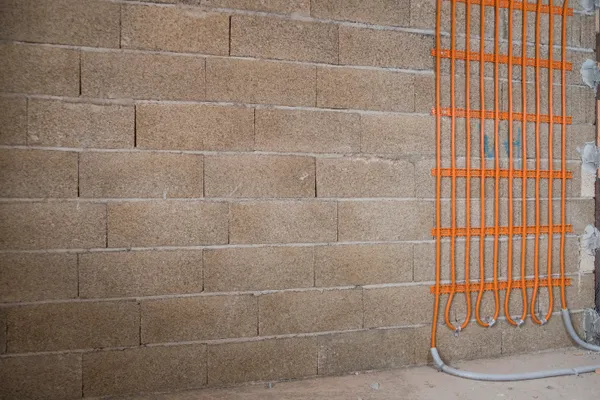
Hempcrete: mixture, application and insulation values for wall, floor and roof

Hemp-lime is a mixture of hemp shives, a lime-based binder and water. Mixed on site and filled into formwork, it creates a light wall that insulates, stores heat and absorbs and releases moisture. In England and France the material is known as hempcrete or béton de chanvre. In this article I show you how hemp-lime is made up, where you can use it, how to mix and apply it and how much material you need for your wall, floor or roof. The figures come from Saint-Astier's data sheet for the binder BATICHANVRE PLUS.
Hempcrete at a glance
Values for BATICHANVRE PLUS with hemp shives, according to the Saint-Astier product sheet, September 2026 edition
| Feature | Value |
|---|---|
| Mix for wall | 2 sack of binder (25 kg each), 1 bales of hemp (20 kg), by hand 60 to 70 l of water, by machine 50 to 60 l |
| Mix for roof | 1 sack of binder, 1 bales of hemp, 40 to 50 l of water |
| Bulk density | 350 to 450 kg/m³ in wall and floor, 220 to 250 kg/m³ in the roof |
| Thermal conductivity λ | 0,069 W/(m·K) in wall and floor, 0,052 W/(m·K) in the roof |
| Diffusion resistance μ | 4,5 to 10 |
| Fire behaviour | B-s1,d0 |
| Working time | within 30 minutes of mixing |
| Working temperature | 8 to 30 °C |
What hempcrete is
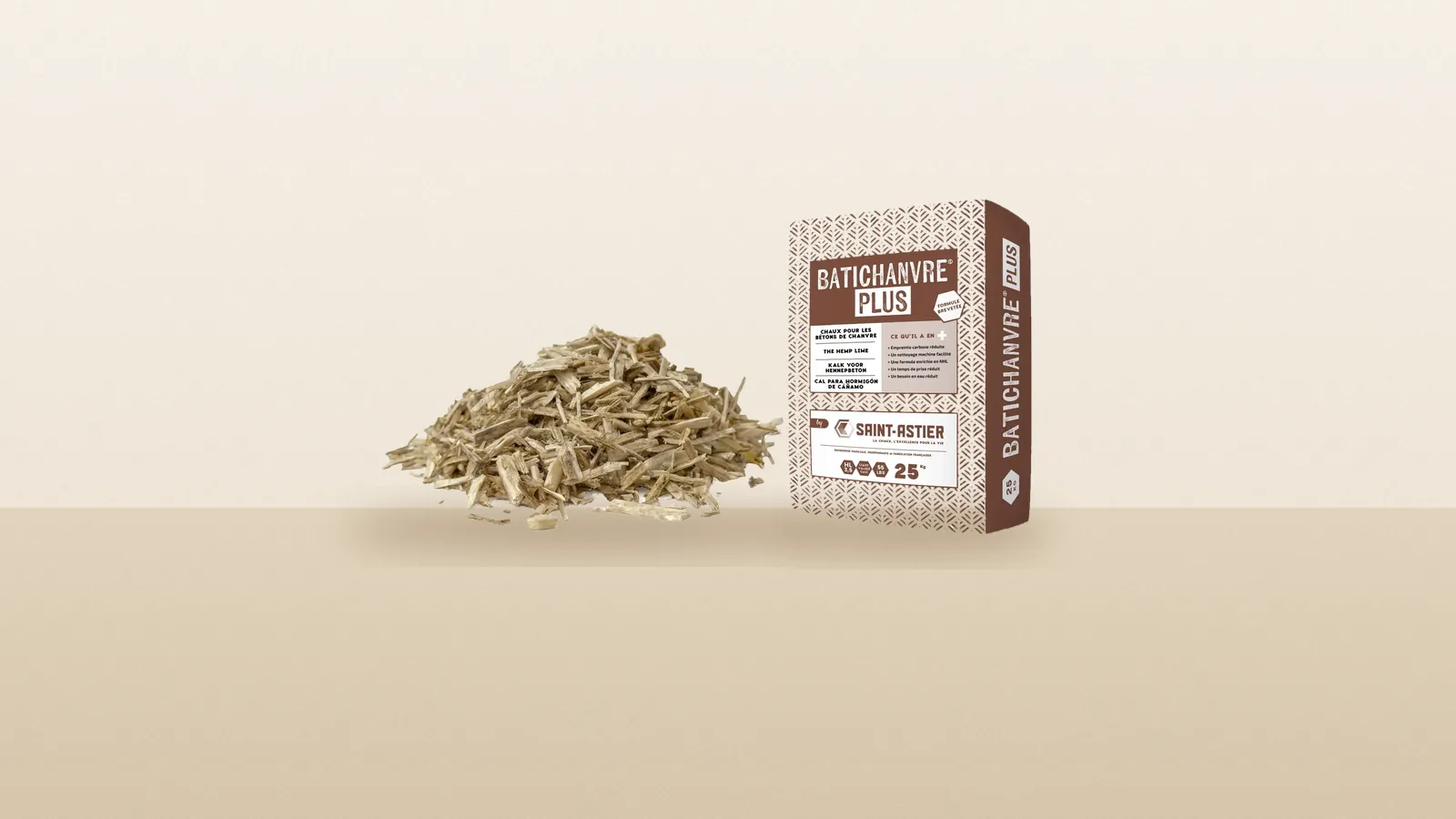
Hemp shives are the woody core of the hemp stalk. They are left over when the fibres are extracted. They consist mainly of cellulose and lignin, are light and have many fine pores. A 20 kg bale has a volume of around 200 litres.
The binder is a lime that consists largely of natural hydraulic lime. The hydraulic part makes the mix set. The lime then absorbs carbon dioxide from the air over a long period and continues to harden. The lime encases the shives and protects them because it is alkaline.
Hempcrete does not carry loads. In a wall, a timber stud frame or the timber framing carries the loads; the hempcrete fills the wall and insulates.
Where you can use hempcrete
Most often, hemp-lime is cast as a wall around a timber stud frame. You set up the studs, place formwork in front and fill in the mix layer by layer. The studs then lie in the wall, encased in hemp-lime on all sides.
In a timber frame house you can fill panels with hemp-lime or place interior insulation in front of the old wall. The hemp-lime lies directly against the existing wall. Because it absorbs and releases moisture, it suits clay, lime and wood.
On a timber joist floor, hemp-lime serves as an insulated floor build-up on the boards. In the roof or on the top storey ceiling, a lighter mix with less binder is used. It has a bulk density of 220 to 250 kg/m³ and insulates better than the mix for the wall.
With finer shives and more binder, a hemp-lime plaster is created. It is applied a few centimetres thick and makes the surface of a cold wall warmer. It does not replace an insulation layer. For this plaster I carry ISOCANNA fine, the plaster aggregate from Saint-Astier.
Insulation value, heat storage and moisture
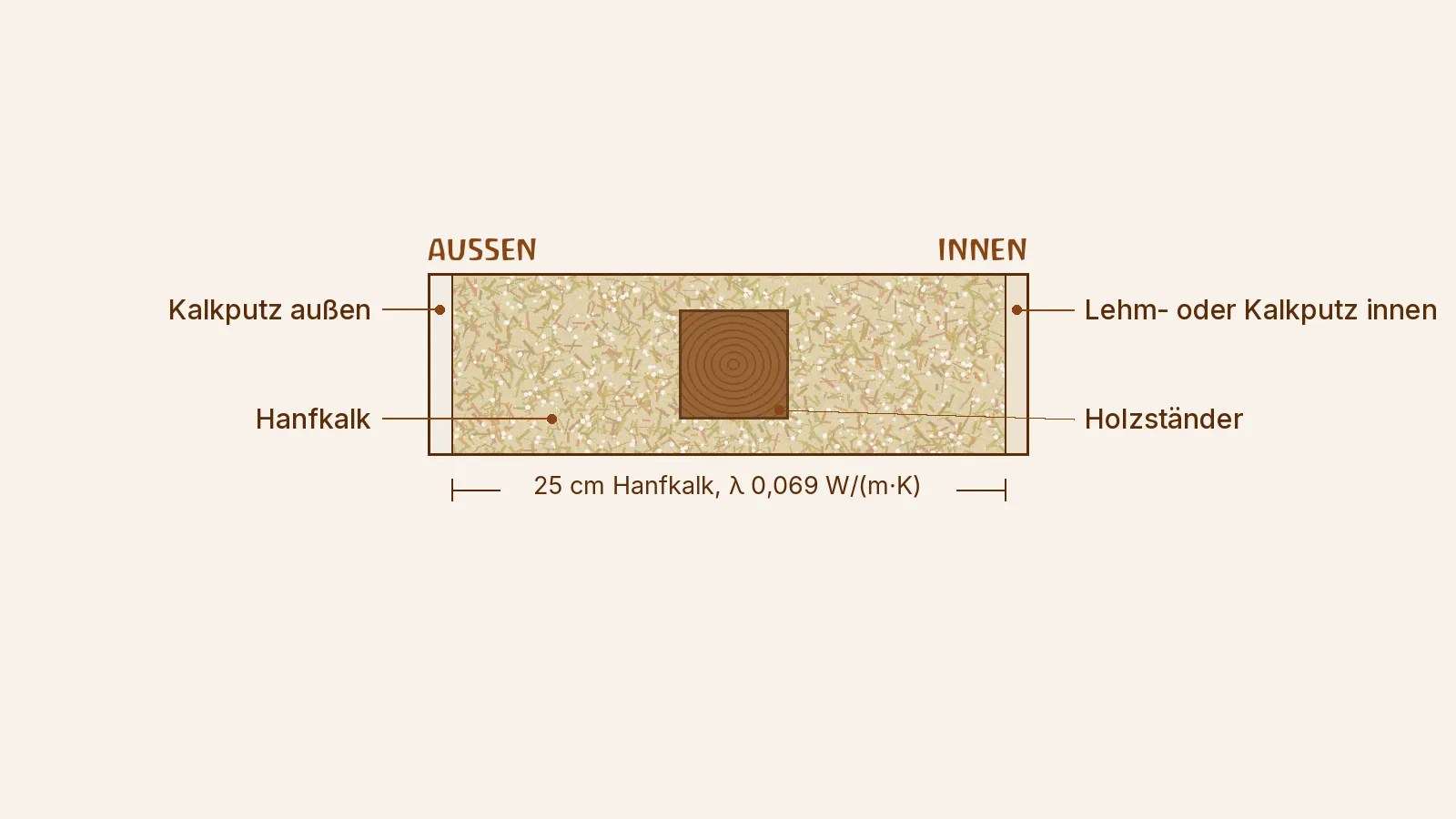
According to the data sheet, hemp-lime for the wall has a thermal conductivity of 0,069 W/(m·K). A 25 cm thick wall achieves a thermal resistance of 3,62 m²K/W. With the surface resistances and thin plaster layers, this gives a U-value of around 0,26 W/(m²K), not counting the timber studs. According to the clay building rules, a clay block of 1.200 kg/m³ has a thermal conductivity of 0,47 W/(m·K) and therefore insulates almost seven times worse.
Hemp-lime also stores heat. Saint-Astier states a phase shift of 25 hours for a 14,8 cm thick wall. The heat of a summer day therefore only arrives inside at night, and in weakened form. This helps above all in attic storeys and south-facing rooms.
The diffusion resistance factor is 4,5 to 10. Water vapour can therefore migrate easily through the wall. The shives and the lime absorb moisture from the indoor air and release it again. For this to remain so, both sides need an open plaster and an open paint.
In reaction to fire, hempcrete achieves class B-s1,d0, i.e. flame-retardant, with little smoke and no burning droplets. The lime protects the shives from fire.
Mixing ratio and mixing
For walls and floors you mix 2 sacks BATICHANVRE PLUS with 1 bales of hemp. Mixed by hand in a concrete mixer, 60 to 70 l of water are added for wall and floor; for machine application on the wall, 50 to 60 l. For the roof, 1 sack of binder to 1 bales of hemp with 40 to 50 l of water is enough.
First put the water and the binder into a concrete mixer and let them run for 3 to 5 minutes until an even, lump-free lime milk forms. Loosen the hemp beforehand and then add it. Mix until all the shives are coated with lime and the mass is crumbly. Then switch off the mixer.
You must use the mix within 30 minutes. Work at temperatures between 8 and 30 °C. Fresh hemp-lime must not be exposed to frost; in heat and wind you protect it from drying out too quickly.
For the wall and the floor I use the Hemp shives levelled and standardised from Saint-Astier with 2 to 25 mm. Saint-Astier has BATICHANVRE PLUS had tested together with its ISOCANNA shives by the French association Construire en Chanvre.
Placing in the formwork
You build the formwork from boards that you fix to the studs. Fill in the hemp-lime in layers of about 20 to 30 cm and press it in by hand or with a piece of wood, especially at the edges, at the studs and in the corners. You should not tamp it firmly. The denser the hemp-lime, the worse it insulates.
You can move the formwork upwards soon after filling, because the crumbly mass stays in place immediately. This way you work your way up layer by layer. At windows and doors you first install frames or boxes that receive the hemp-lime.
For interior insulation in timber framing, you build formwork in front of the existing wall. The old wall should be dry and load-bearing; remove loose parts and old paint beforehand. Timber embedded in the hempcrete must be dry and sound.
Drying and plastering
A hemp-lime wall takes a long time to dry. Depending on weather, season and wall thickness, it takes several weeks to a few months. So plan installation in spring or summer and ensure good ventilation when working indoors.
Plastering only takes place once the wall is dry. Outside, a lime plaster goes onto the hempcrete, for example with NHL 3,5. Inside you can use clay plaster or lime plaster. Cement plaster, synthetic resin plaster and dense paints seal the wall and do not belong on hempcrete.
The British distributor of Saint-Astier recommends applying hemp plasters in layers of at most 2 to 3 cm and letting them dry for 60 to 90 days before a limewash. This shows how much time the material needs.
Calculate quantities
First calculate the volume: wall area times wall thickness, minus windows and doors. For one cubic metre of hempcrete in the wall, according to the British distributor of Saint-Astier you need 10 sacks BATICHANVRE PLUS and 5 bales of hemp. That is five mixtures of 2 sack and 1 bales each.
An example: a wall with an area of 20 m² and a thickness of 25 cm has a volume of 5 m³. For this you need 50 sacks of binder and 25 bales of hemp. For water, mixing by hand you arrive at 25 mixes of 60 to 70 l each, i.e. 1.500 to 1.750 l.
Plan some reserve, because material is lost during mixing and installation. Store sacks and bales dry and on pallets until you use them. The binder keeps for one year from production in unopened packaging.
Hempcrete and building law in Germany
In France, the Règles professionnelles of the Construire en Chanvre association govern execution. In Germany, hemp-lime mixed on site is not a standardised building material, and there is no general building authority approval for it. For a building for which verification of thermal or fire protection is required, approval in the individual case may be necessary. Clarify this early with your planner and the building authority.
If you want to avoid this route, use Hemp block. It also consists of hemp and lime, is prefabricated in the factory and has a general building authority approval from DIBt for infill masonry. You can find more in the article on clay blocks and hemp blocks in timber framing.
| Wall thickness | Thermal resistance R | Phase shift | Binder per m² of wall | Hemp per m² of wall |
|---|---|---|---|---|
| 15 cm | 2,17 m²K/W | 8,7 h | 1,5 sack | 0,75 bales |
| 25 cm | 3,62 m²K/W | 14,8 h | 2,5 sack | 1,25 bales |
| 35 cm | 5,07 m²K/W | 20,7 h | 3,5 sack | 1,75 bales |
| 45 cm | 6,52 m²K/W | 26,6 h | 4,5 sack | 2,25 bales |
Hempcrete in northern Germany
In northern Germany there are many timber frame houses and old barns whose walls are made of timber, clay and brick. Hemp-lime suits these building materials because it absorbs and releases moisture. It is suitable for panels, for interior insulation and for new walls when converting a barn. I advise you on planning and on calculating quantities. Lehm-Revival is located at Danziger Str. 59, 28832 Achim.
Are you planning a wall, floor or insulation made of hempcrete? In 30 minutes on the phone we go through build-up, mixture and quantities.
Book telephone adviceFrequently asked questions about hempcrete
What is the mixing ratio of hempcrete?
For walls you mix 2 sack of BATICHANVRE PLUS of 25 kg each with 1 bales of hemp of 20 kg. Mixed by hand, 60 to 70 l of water are added; for machine application, 50 to 60 l. For floors you use 60 to 70 l of water. For the roof, 1 sack of binder to 1 bales of hemp with 40 to 50 l of water is enough.
How much material do I need for one cubic metre of hempcrete?
For one cubic metre of hempcrete in the wall, allow 10 sacks of BATICHANVRE PLUS and 5 bales of hemp. A 25 cm thick wall therefore needs 2,5 sacks and 1,25 bales per square metre. Plan some reserve for losses.
Is hempcrete load-bearing?
No. Hempcrete does not carry loads. The loads are carried by a timber stud frame or the timber framing; the hempcrete fills the wall and insulates.
Which plaster do I need on hempcrete?
Lime plaster outside, clay plaster or lime plaster inside. Cement plaster, synthetic resin plaster and dense paints do not belong on hempcrete, because they seal the wall. Plastering only takes place once the hempcrete is dry.
How long does hempcrete need to dry?
Several weeks to a few months, depending on weather, season and wall thickness. Plan the installation in spring or summer and ventilate well if you work indoors.
Sources and standards
Further links
Products in the shop
Knowledge articles
More items in Clay building
- Monument protection and clay building: age line, permit and typical mistakes
- Buy hemp insulation: hemp insulation batts for interior insulation, rafters and timber framing
- Interior insulation costs per m², wood fibre with clay vs. calcium silicate vs. drywall
- Lime plaster: properties, use and application inside and outside
- When clay does not work: limits, mistakes and decision rules
- Clay in interior finishing: a healthy indoor climate with natural building materials
- Clay, lime or cement: which binder is right for old buildings and timber framing?
- Advantages of clay building, healthy indoor climate, sustainability and building physics explained clearly
- Clay building: building and renovating with clay
- Clay boards in interior finishing: drywall construction with clay according to DIN 18948
- Buy fine clay plaster and YOSIMA design plaster: application, choice of colour and prices
- Clay paint on plasterboard: pre-treatment, consumption and painting
- Clay paint in interior finishing: mineral wall paint for a healthy indoor climate
- Clay mortar in clay building: masonry mortar and plastering mortar
- Clay plaster on concrete: preparation, primer and plaster thickness
- Clay plaster on gypsum plaster and old plaster: check, prime, plaster thinly
- Clay plaster on sand-lime brick and brick: plastering masonry correctly
- Clay plaster on Rigips and plasterboard: preparing the substrate correctly
- Applying clay plaster: the complete step-by-step guide
- Clay plaster costs per m², prices, material requirements and packs compared
- Renovating clay plaster: recognising types of damage, understanding causes and repairing correctly for the long term
- Clay plaster on different substrates: concrete, brick, wood and drywall
- Building up clay plaster: base coat, finishing coat and fine plaster
- Wall heating with clay: planning and installation step by step
To take away: the free clay building diary with drying log.
Download free of charge