
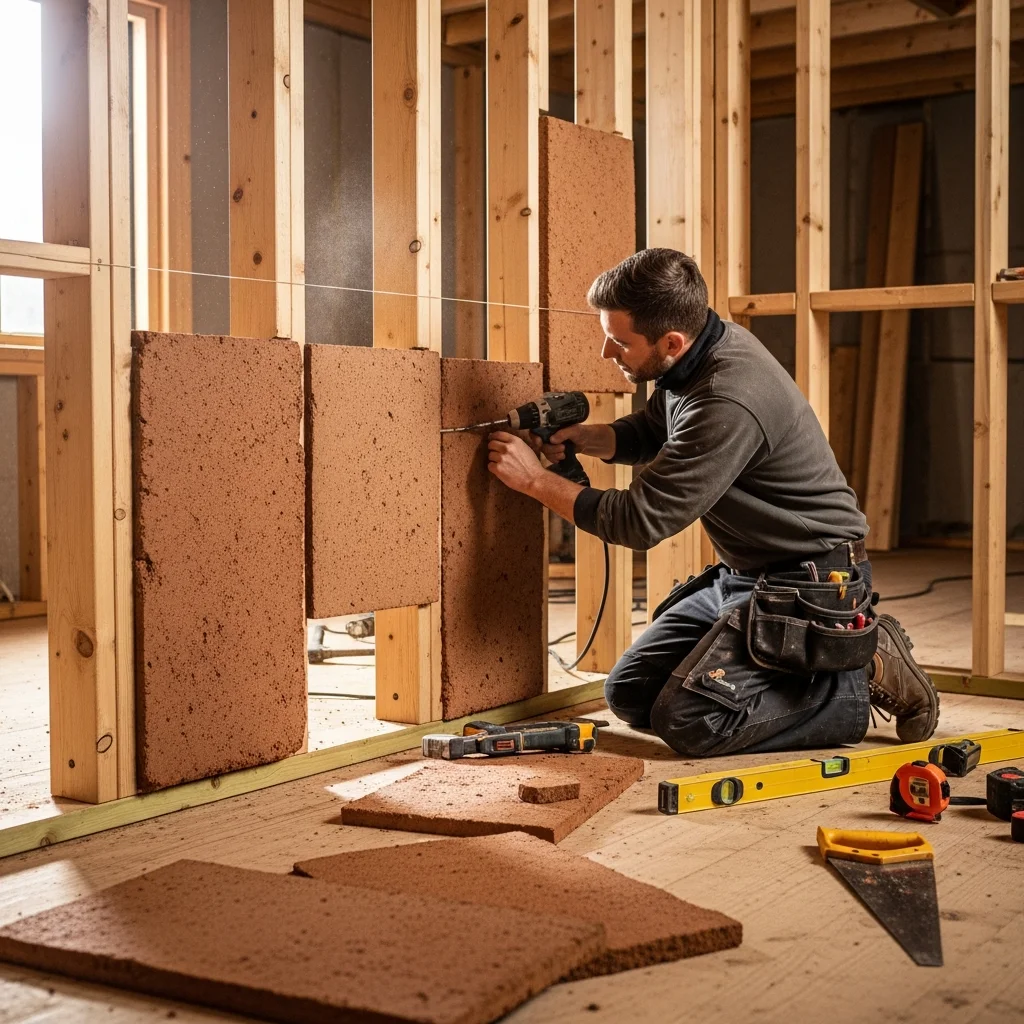
Clay boards in interior finishing: drywall construction with clay according to DIN 18948

Clay boards are among the most important products in modern clay construction. They combine the building physics advantages of clay with the quick application of conventional drywall systems. Instead of laboriously wet-plastering walls, clay boards can be mounted much like plasterboard, screwed to a substructure or bonded directly to solid walls. The boards consist of dried clay stabilised with natural fibres. As a result they remain vapour-permeable, capillary-active and free of synthetic binders or pollutants. A major advantage lies in their moisture buffering capacity. A 22 mm clay board can absorb and release about 6 to 8 grams of moisture per square metre and percent of relative humidity. Its sorption capacity is thus considerably higher than that of plasterboard. In interior finishing in particular, this ensures a more stable indoor climate: humidity peaks are buffered and relative humidity stays more balanced. Clay boards are particularly suitable for ecological interior finishing, for old building and timber frame renovations, for timber construction and sustainable new builds, and for bedrooms and living rooms where a healthy indoor climate is especially important. At Lehm-Revival, mainly ClayTec clay boards according to DIN 18948 are used, as they are manufactured industrially and tested to standard.
Clay board wall with hemp insulation
From insulation via board, joints and reinforcement to paint: the list for a lining with clay board D22, calculated for your wall.
- Naturwerk HANF FLEX Premium insulation batts 5 × 80 mm236,05 €
- ClayTec clay board D22 solar 22 × single board527,78 €
- LEMIX clay board screws 3 × standard66,21 €
- ClayTec drywall tape L=25m 1 × width 50mm22,07 €
- Clay joint filler natural 1 × natural brown15,35 €
- Clay adhesive and reinforcing mortar 4 × standard132,44 €
- Glass fabric 112 g/m², roll W=1m 1 × length 35 m91,19 €
- Clay filler and surface filler natural 3 × natural brown118,05 €
- ClayTec clay paint pure white 1 × standard62,39 €
Total for 15 m²1.271,53 €
incl. VAT, plus shipping
Plus on site, not in the list
- approx. 57 m Squared timber for studs and surrounding timbers (solid softwood C24, axis spacing 625 mm)
- approx. 51 pcs Fixings for stud framing on floor, ceiling and walls
Build-up and types of clay boards
Clay boards consist at their core of dried clay stabilised with natural fibres or mineral aggregates. This reinforcement prevents shrinkage cracks and ensures sufficient flexural strength. Basically, two types of construction can be distinguished.
Clay boards with fibre reinforcement
The classic clay board contains clay, sand and plant fibres such as grain meal, straw fibres or wood fibres. One example is the ClayTec clay board D22 solar, which consists of building clay with miscanthus fibres and a jute mesh insert.
Typical properties of these boards: thickness 16 or 22 mm, weight about 22 to 32 kg per square metre, very good moisture buffering and high thermal mass. These boards are mainly used in interior fit-out and then thinly plastered or painted.
Reed clay boards
A second variant is clay boards with integrated reed reinforcement. Here a reed mesh forms the supporting structure, which is coated with clay. Thanks to the higher proportion of air pores, these boards have a lower bulk density and therefore better thermal insulation properties.
The typical thermal conductivity is λ ≈ 0,13 W/(m·K). These boards are used when insulation and indoor climate effects are to be combined, for example in external wall build-ups in timber construction or as interior insulation on solid masonry. The lower bulk density makes this board variant lighter and therefore easier to transport and install.
Formats and application
Clay boards are made in handy formats so that they can be easily worked on site. Typical standard formats are 1250 × 625 mm and 625 × 625 mm. The boards can be cut with a jigsaw or a circular saw.
The cut edges can be lightly moistened or smoothed with clay filler so that a good bond with the plaster forms later. The site should be dry during installation. Clay boards should not be stored in damp surroundings, as they can absorb moisture. Short-term storage in dry interiors is ideal.
Installing clay boards
Drywall installation on a substructure
The most common method of installation is fixing to a timber or metal substructure. Usual axis spacings are 312,5 mm and 625 mm. The ClayTec clay board D22 solar is specifically matched to the 625 mm stud spacing. It therefore fits exactly on standard drywall profiles and can be mounted without cutting.
Fastening is done with ClayTec clay boardsscrews 5 × 50 mm or quick-build screws with coarse thread. The screws are set at intervals of about 15 to 20 cm and slightly countersunk. Advantages of this construction: quick installation, little moisture introduced, flexible installation layer and compatibility with standard drywall profiles.
With direct bonding to solid walls, Clay adhesive mortar is applied to the wall about 3 mm thick with a notched trowel (notching 8 to 10 mm). The board is then pressed against the wall and aligned. Advantage: no stud frame needed, space-saving. Disadvantage: the substrate must be load-bearing and sufficiently level, and there is no installation layer.
Joint treatment and surfaces
Joint treatment is an important step. Gaps between the boards are first closed with clay adhesive and reinforcing mortar. Then the whole surface is coated about 3 mm thick with clay adhesive and reinforcing mortar and glass mesh is embedded over the full surface. This reinforcement layer prevents cracking at the board joints.
Once the reinforcement layer has dried, the wall surface can be thinly coated with clay plaster or painted directly. Typical surfaces are ClayTec clay top plaster FINE 06, ClayTec YOSIMA clay design plaster, ClayFix clay paint or ClayTec clay paint. The choice of surface influences the visual character and the moisture buffering performance of the finished wall.
Indoor climate, acoustics and fire protection
The sorption capacity of clay boards is about 6 to 8 grams of moisture per square metre and percent of relative humidity. This allows humidity peaks to be absorbed from the indoor air and released again when the air is dry. The effect is particularly strong if the boards are also finished with clay plaster or clay filler.
Due to their high bulk density, clay boards have good acoustic properties. A typical drywall with clay boards on both sides and mineral wool in the stud frame achieves sound insulation values of about Rw ≈ 55 dB. This makes clay boards well suited for party walls between flats, bedrooms and workrooms.
Clay consists of mineral components and is non-combustible. Clay boards achieve building material class A2 according to DIN 4102. They are therefore also suitable for fire protection cladding of timber joist ceilings and steel beams, a combination of fire protection and indoor climate benefits that is particularly interesting in timber construction.
Standards and quality
The requirements for clay boards are regulated in DIN 18948. Among other things, this standard defines flexural tensile strength, shrinkage, water absorption and mechanical properties. Products such as ClayTec clay boards are tested according to these standards and quality-controlled in the factory.
With growing demand for clay building materials, many suppliers have entered the market. However, not all products meet the technical requirements of DIN 18948. Tested industrial products offer reproducible quality, defined strength classes and traceable building physics values. Especially for funded projects or those with structural relevance, only standard-compliant clay boards should be used.
Manufacturers such as ClayTec have contributed significantly to the development of the DIN standards for clay building products and publish environmental product declarations (EPD) and technical data sheets that enable precise planning.
Clay boards at Lehm-Revival
At Lehm-Revival you will find high-quality clay building products for interior finishing, including ClayTec clay boards, ClayTec clay base coat plasters, ClayTec clay finishing plasters, ClayTec clay fillers and ClayTec Yosima design plastere.
These systems enable vapour-permeable interior finishing with a natural indoor climate and combine the advantages of clay with the quick application of modern drywall systems.
Clay boards are therefore one of the most efficient ways to use the advantages of clay construction in modern buildings, without long drying times and without elaborate wet plastering. I am happy to help in person or by email with choosing the right system and the right product quantities.
| Property | Value |
|---|---|
| Thickness | 22 mm |
| Format | 1250 × 625 mm |
| Weight | approx. 32 kg/m² |
| Thermal conductivity λ | approx. 0,35 W/(m·K) |
| Moisture buffering | approx. 6–8 g/(m²·% RH) |
| Fire class | A2 |
| Standard | DIN 18948 |
Regional context and use in practice
In the Achim region (28832) and the greater Bremen area, Lehm-Revival advises craftsmen and builders on choosing and mounting clay boards. I deliver ClayTec clay boards by haulier on a EUR pallet and system accessories by parcel throughout Germany. For projects in Lower Saxony I offer personal on-site advice and help with quantity calculation, installation planning and surface design.
Frequently asked questions
How are clay boards fixed to masonry?
Clay boards can be bonded directly to masonry. To do this, clay adhesive mortar is applied to the wall about 3 mm thick with a notched trowel, and the board is then pressed against the wall and aligned. A load-bearing and sufficiently level substrate is a prerequisite. Alternatively, the boards can be fixed to a timber or metal substructure with ClayTec clay board screws (5 × 50 mm).
How do clay boards get their surface?
First close the gaps with clay adhesive and reinforcing mortar and coat the whole surface with it about 3 mm thick, with glass mesh embedded over the full area. After drying you can paint directly, for example with ClayFix clay paint or ClayTec clay paint, or coat thinly with ClayTec clay top plaster FINE 06 or YOSIMA clay design plaster. The choice of surface determines the look and moisture buffering performance of the finished wall.
What sound insulation do I achieve with clay boards?
A drywall with clay boards on both sides and mineral wool in the stud frame typically achieves Rw ≈ 55 dB. This makes it suitable for party walls between flats, bedrooms and workrooms. The reason is the high bulk density of the boards.
Are clay boards combustible?
No. Clay consists of mineral components and is non-combustible; clay boards achieve building material class A2 according to DIN 4102. This makes them suitable for fire protection cladding of timber joist ceilings and steel beams too; in timber construction they combine fire protection with a positive effect on the indoor climate.
Sources and standards
- DIN 18948: Lehmbauplatten
- DVL: Lehmbau Regeln
- ClayTec Lehmbauplatten Produktdaten
- ClayTec Produktblatt Lehmbauplatten schwer D22 und D16
- ClayTec Produktblatt Lehm-Trockenputzplatte
- ClayTec Produktblatt Lehmbauplatte D22 solar
- ClayTec Leitfaden Ökologische Trockenbauwände im System
- ClayTec Produktblatt Lehmklebe- und Armiermörtel
Further links
Products in the shop
Knowledge articles
More items in Clay building
- Monument protection and clay building: age line, permit and typical mistakes
- Buy hemp insulation: hemp insulation batts for interior insulation, rafters and timber framing
- Hempcrete: mixture, application and insulation values for wall, floor and roof
- Interior insulation costs per m², wood fibre with clay vs. calcium silicate vs. drywall
- Lime plaster: properties, use and application inside and outside
- When clay does not work: limits, mistakes and decision rules
- Clay in interior finishing: a healthy indoor climate with natural building materials
- Clay, lime or cement: which binder is right for old buildings and timber framing?
- Advantages of clay building, healthy indoor climate, sustainability and building physics explained clearly
- Clay building: building and renovating with clay
- Buy fine clay plaster and YOSIMA design plaster: application, choice of colour and prices
- Clay paint on plasterboard: pre-treatment, consumption and painting
- Clay paint in interior finishing: mineral wall paint for a healthy indoor climate
- Clay mortar in clay building: masonry mortar and plastering mortar
- Clay plaster on concrete: preparation, primer and plaster thickness
- Clay plaster on gypsum plaster and old plaster: check, prime, plaster thinly
- Clay plaster on sand-lime brick and brick: plastering masonry correctly
- Clay plaster on Rigips and plasterboard: preparing the substrate correctly
- Applying clay plaster: the complete step-by-step guide
- Clay plaster costs per m², prices, material requirements and packs compared
- Renovating clay plaster: recognising types of damage, understanding causes and repairing correctly for the long term
- Clay plaster on different substrates: concrete, brick, wood and drywall
- Building up clay plaster: base coat, finishing coat and fine plaster
- Wall heating with clay: planning and installation step by step
To take away: the free clay building diary with drying log.
Download free of charge