
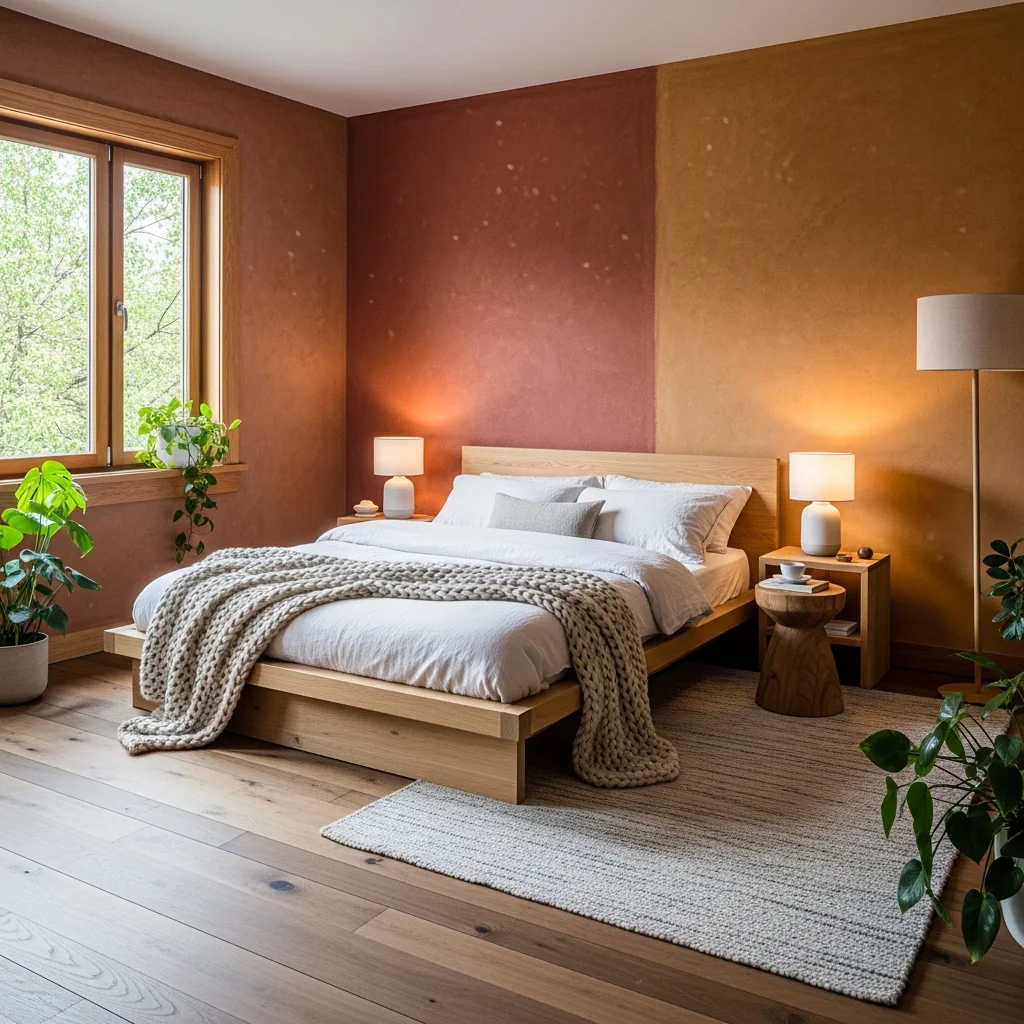
Clay in the bedroom: a healthy indoor climate, better sleep and a mindful start to the day

The bedroom is one of the most important rooms in the house. Here the body recovers, the mind processes the impressions of the day, and every new morning begins. Many people pay attention to mattresses, light or good ventilation. Wall surfaces, by contrast, are underestimated, even though they decisively influence the indoor climate. Natural building materials such as clay can measurably improve the indoor climate in the bedroom. Clay plaster, clay boards or clay paints regulate moisture, create calm surfaces and support a healthy living environment. This creates a room that allows restful sleep and at the same time supports a clear start to the new day.
Wall materials compared for the bedroom
Moisture regulation, pollutants and indoor climate: all common materials compared directly
| Wall material | Moisture buffer | Pollutants | Temperature buffer | Bedroom recommendation |
|---|---|---|---|---|
| Clay plaster (indoors) | very high | no | very good | First choice |
| Lime plaster (indoors) | medium | no | good | Well suited |
| Gypsum plaster | low | none (if clean) | low | Partly suitable |
| Cement plaster | very low | no | low | Not recommended |
| Plasterboard | very low | VOC in cheap products | very low | Not recommended |
| Emulsion paint on plaster | seals the substrate | VOC possible | — | Not recommended |
| Clay paint / lime paint as coating | retains buffering effect | no | — | Recommended |
Why the indoor climate in the bedroom is decisive
People spend about a third of their lives in the bedroom. During this time important regeneration processes take place: breathing, cell repair and hormonal control renew the organism. Air quality and humidity play a major role. A lot of moisture is produced in the bedroom at night. The human body releases water vapour through breathing and the skin. If this moisture remains in the room, the air can become heavy and unpleasant.
Values between 40 and 60 percent relative humidity are considered ideal. In this range the body works optimally, and the risk of mould and respiratory irritation falls significantly. Building materials such as clay can absorb moisture and release it again later. This keeps humidity more stable and the indoor climate more pleasant, without active technology or devices.
Conventional wall materials such as gypsum plaster with emulsion paint have a diffusion resistance of μ 30 to over 100 and provide hardly any moisture regulation. They leave the moisture in the indoor air, which can lead to humidity peaks at night with windows closed. Clay, by contrast, is μ 5 to 10: open enough to actually buffer.
How clay regulates moisture
Clay has a special property: the material can absorb water vapour from the air and release it again later. This ability is called sorption capacity. A clay plaster 15 to 20 millimetres thick can typically absorb and release 20 to 60 grams of moisture per square metre, depending on clay content, pore structure and layer thickness. By comparison: lime plaster reaches about 10 to 30 g/m², gypsum plaster about 5 to 10 g/m², and emulsion paints practically zero.
This effect is particularly helpful in the bedroom. During the night, humidity rises through breathing and body heat. Clay plaster absorbs part of this moisture. When the room is ventilated the next morning or the indoor air is drier, the material releases the moisture again in a controlled way. This creates a natural moisture buffer that keeps the bedroom air measurably more stable.
This property has been confirmed by measurement. Fluctuations in indoor climate are typically 15 to 35 percent lower in rooms with clay plaster walls than in rooms with conventional gypsum plaster walls. The difference is particularly noticeable in small bedrooms, where the ratio of wall area to room volume is large.
Building physics properties of clay at a glance
Besides moisture regulation, clay offers further building physics advantages relevant to the bedroom. Clay is vapour-permeable: the so-called μ value of clay is about 5 to 10, which is considerably more open than cement plaster at μ 30 to 100 or emulsion paints with even higher values. This openness allows natural moisture transport through the wall without build-up effects.
In addition, clay contains no synthetic binders. ClayTec clay plasters consist exclusively of clay, clay minerals, sand, natural fibres and water. The surface is antistatic, which reduces dust binding. And clay has a certain ability to bind odours and volatile substances. These properties make clay a material that is particularly well suited to bedrooms.
The antistatic property is particularly relevant for allergy sufferers: antistatic surfaces do not bind house dust electrostatically and produce no measurable electrical load. Synthetic emulsion paints and plastic surfaces, on the other hand, become statically charged and can hold fine dust particles.
Clay plaster in the bedroom: application and effect
Clay plaster is the most direct way to design a bedroom with natural building materials. The plaster consists of clay, sand and plant fibres. Typical applications are clay top plaster on existing walls, renovating old building walls, wall design in new builds and reworking drywall surfaces. The plaster is applied in layer thicknesses of about 5 to 20 millimetres.
Clay surfaces look warm and lively. Unlike emulsion paints, they reflect light very softly. This creates a calm atmosphere in the room. Fluctuations in humidity are reduced by 15 to 35 percent in rooms with clay surfaces, depending on layer thickness and room volume.
The application effort varies depending on the substrate. On load-bearing lime or gypsum substrates, clay plaster can be applied directly. On smooth concrete or emulsion paints, mechanical preparation or a bonding agent necessary. A specialist company can assess the suitability of the substrate quickly and reliably.
Clay boards and clay paint as an addition
Besides classic clay plaster, there are other ways to use clay in the bedroom. Clay boards consist of clay and plant fibres and are mounted in a similar way to drywall boards. They are particularly suitable for attic storeys, timber buildings, interior walls and old building walls with irregular surfaces. After mounting, clay boards are coated with a clay top plaster or clay paint.
Clay paints are another simple way to design walls naturally. They are applied thinly and create a matt mineral surface. The difference from clay plaster lies in the layer thickness: clay paint forms a thin coating of under one millimetre, while clay plaster is a supporting layer with a stronger buffering effect. For maximum moisture regulation, clay plaster is more effective. For pure wall design without building work, clay paint is the least complicated option.
In practice, a combination of clay boards and clay plaster has proven itself: the boards are mounted on a substructure, then reinforced with clay adhesive and reinforcing mortar and glass mesh, and finished with clay top plaster or ClayTec Yosima design plaster coated. The result combines the quick installation of board technology with the building physics effect of a fully plastered clay surface.
Design ideas with clay in the bedroom
Clay offers not only building physics advantages but also a special design quality. The surface looks calm, warm and natural. Popular design options are natural earth tones, soft textures in the plaster, combinations with wood and calm matt wall surfaces. Clay can be worked in numerous natural shades, from whites through sand tones to warm terracotta colours.
A particularly fine surface is achieved with the ClayTec Yosima design plaster. This clay fine plaster gets its colour solely from coloured clays and creates very calm mineral colour surfaces with an even, meditative effect. Especially in the bedroom, such a surface can create a relaxed and harmonious atmosphere. Even individual accent walls with clay can noticeably change the indoor climate and the feel of the room.
The surface can be textured by hand: smoothed surfaces look timeless and calm, while surfaces textured with a filler knife or brush create a lively, tactile quality. Combinations of different clay shades in one room are possible, most effective as a subtle change of shade at room edges.
Using clay in the bedroom
Anyone wanting to design a bedroom with clay has several options. In renovations, a clay top plaster can be applied to existing walls. A load-bearing, absorbent substrate is a prerequisite. Smooth emulsion paints must be removed or roughened so that the clay plaster adheres. In drywall constructions, clay boards can be used.
Use on just one wall is also possible. Even an accent wall of clay plaster can noticeably improve the indoor climate, especially if the area is large enough to buffer significant moisture. As a guide: the more square metres of clay surface there are, the stronger the buffering effect.
Applying clay plaster is also possible for experienced DIYers if the substrate preparation is carried out carefully. For first projects, use on a single accent wall is recommended. This reduces the risk and builds experience before designing a whole room. For this, Lehm-Revival offers Product advice in Achim and nationwide shipping of the required materials.
| Product | Layer thickness | Moisture buffer approx. | Particularly suitable for |
|---|---|---|---|
| Clay base coat + clay finishing plaster | 10–20 mm | 30–60 g/m² | Maximum buffering effect, walls of old buildings |
| Clay finishing plaster directly | 5–10 mm | 15–35 g/m² | Renovation on a load-bearing substrate |
| Clay boards 22 mm | 22 mm | 20–45 g/m² | Attic, timber construction, uneven walls |
| ClayTec Yosima design plaster | up to 2 mm | 5–15 g/m² | Fine surface, design accents |
| ClayTec clay paint | < 1 mm | < 5 g/m² | Pure wall design without conversion work |
Clay plaster in the bedroom: experience from northern German projects
Lehm-Revival at Danziger Str. 59, 28832 Achim advises builders and DIYers in the Lower Saxony region on choosing natural building materials for healthy bedrooms. I deliver ClayTec clay plasters, clay boards and clay paints by parcel and haulier throughout Germany and offer personal on-site advice in the greater Bremen area and the Verden district.
Clay plaster and clay boards for the bedroom, directly from the Lehm-Revival shop. ClayTec products for a measurably better indoor climate, deliverable nationwide by parcel and freight.
Clay plaster & clay boards for the bedroomPractical question on clay plaster in the bedroom
Is a single wall of clay plaster in the bedroom enough?
To start with, yes. Even an accent wall can noticeably improve the indoor climate if the area is large enough to buffer significant moisture; the more square metres of clay surface, the stronger the effect. For DIYers, a single wall is also a good start before the whole room follows. A load-bearing, absorbent substrate is a prerequisite.
Sources and standards
Further links
Products in the shop
Knowledge articles
More items in Sustainable living
- Healthy living and a natural indoor climate: why building materials are decisive
- Beekeeping in the natural garden: keeping bees sustainably and harvesting real garden honey
- Kreuz ohne Haken: diversity on the farm, in the village and on the building site
- Natural garden in northern Germany, herbs, field plants and natural cycles
- Self-sufficiency on a historic farm in northern Germany
- Wild bees, bumblebees and honey bees in the natural garden: promoting biodiversity and building a stable ecosystem