
Kreuz ohne Haken: diversity on the farm, in the village and on the building site
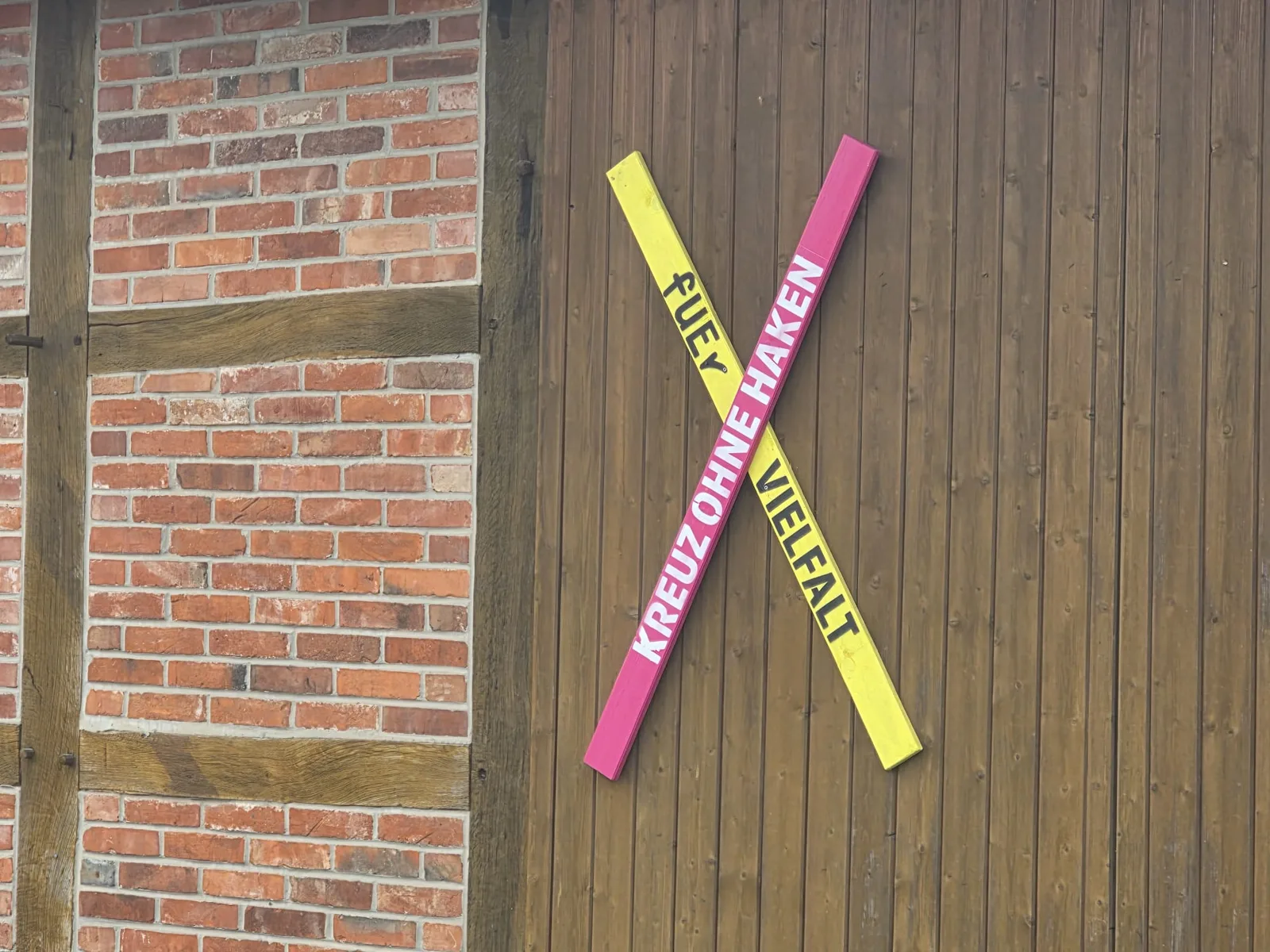
Two old barns, timber frame and brick, a shed of grey wood under oak trees. On the wall a cross of two battens, one pink, one yellow: "Kreuz ohne Haken. fUEr Vielfalt." (Cross without hooks. For diversity.) This sign needs nothing more. I discovered it this summer on a farm in my region, and since then it has been part of me too.
What the cross without a hook says
The cross is the mark on the ballot paper. Without hooks means: without the swastika, without exclusion, without the idea that a village or a farm would be better if people were banished from it. The idea comes from the Lüneburg Heath. In 2018, the Gruppe beherzt from Ebstorf in the Uelzen district put up the first crosses; today it is a non-profit association with around 600 members. The occasion was new neighbours: völkisch (ethnic-nationalist) settlers who buy old farms in the heath and want to entrench their worldview in the villages. The capital UE in "fUEr" is the district's licence plate code, a small greeting from home. Meanwhile the crosses hang on gables, farm entrances and fences throughout northern Germany and beyond. In 2024 the group received the Julius Rumpf Prize of the Martin Niemöller Foundation for it.
Why a clay building shop takes a position on this
Because building with clay, lime and hemp has never been a matter for individuals alone. Clay plaster has existed for thousands of years on every continent, and the knowledge of it has travelled: with traders, craftsmen, refugees and the curious. The barns in the photos are standing because generations built, patched and passed them on, no matter where the people came from. When you renovate timber framing today, you carry on exactly there. Exclusion is not a sustainable strategy. It uses up trust, knowledge and neighbourliness, and none of these grows back.
A look over the farm fence
In Germany, in Europe and worldwide, movements are gaining ground that promise simple answers: close the borders, get rid of what is foreign, and everything will be fine. Anyone who works with natural building materials knows that simple answers are rarely right. A house stays healthy because its walls are open and let moisture through. A region stays alive because people and ideas can come and go. That the campaign started in the Lüneburg Heath makes it a neighbourhood matter for me. The heath is part of my delivery area, and the old farmsteads it is about are exactly the houses for which I supply clay, lime and hemp. For me, sustainability means that nature, people and animals belong together, and this togetherness does not ask about origin.
Timber framing, barn, hall: what really counts in renovation
Old farms like those in the photos forgive a lot, but not cement. Timber framing lives from walls and floors absorbing moisture and releasing it again. That is exactly what my building materials are for.
Panels: you fill open or crumbly infills with clay blocks in Clay mortar. The blocks are heavy, store heat, can be cut with a saw and adapt to the movement of the timber. For panels outdoors you use dense blocks with high density; inside they may be light ones.
Walls: inside comes Clay plaster onto the panels and, if you like, across the timber with a plaster base. On the outside, Lime plaster with NHL keeps out wind and rain and yet remains open to water vapour.
Floors: for halls, barns and workshops that are not to receive concrete screed, there is Lime screed. It dries capillary, tolerates moisture from below, can be covered with bricks or natural stone and is compatible with underfloor heating.
Insulation: between rafters and in linings you use Hemp insulation, renewable and moisture-regulating.
All together this makes a house that stands for decades and in which people and animals feel good. The building materials come as a pallet or big bag to the kerbside; each product page states from which quantity this is worthwhile.
Why I support this

I am Kenny Kent Bridgewater; I run Lehm-Revival in Achim near Bremen. I work on building sites, in barns and workshops, and the people there have the most diverse roots, languages and stories. In construction that is perfectly normal, and it works. That is why the Kreuz ohne Haken (cross without hooks) now also stands for my shop. In the Community on lehm-revival.de I gather people and projects who think the same way: farms that take in volunteers via WWOOF craftswomen, interior designers and building biologists from the region. If you want to be part of it, get in touch.
Get involved

The crosses are available in 1 m and 1,5 m board lengths for a donation directly from the Gruppe beherzt, write to kreuze@beherzt.info. The motif is protected by trademark law; for building your own in quantity, the association has templates with a licence agreement. Put your cross on the fence, the barn or the building site and share the photo. And if you are renovating anyway: Clay plaster for a healthy indoor climate, Hemp insulation for insulation that grows back. I clarify questions about your own project in the Advice. And anyone who wants more thoughts on nature, people and animals will find them in the Morgenbuch.
| Component | Material | Why |
|---|---|---|
| Panels outside | Clay blocks, dense, high density | can be used outdoors when plastered, stores heat |
| Panels inside | Clay blocks, light | insulates, regulates moisture |
| Masonry of the panels | Clay mortar | adapts to the movement of the wood |
| Walls inside | Clay plaster | regulates room humidity, healthy indoor climate |
| Walls outside | Lime plaster with NHL | keeps rain out, remains vapour-permeable |
| Floors without concrete slab | Lime screed | dries capillary, tolerates moisture from below |
Cross without a hook in my region
The campaign comes from the Uelzen district and the Lüneburg Heath, my delivery area towards Lüneburg and Hamburg. From Achim near Bremen I deliver clay, lime and hemp to farms and timber frame houses in the Weser-Aller region, in the Verden district, in Celle, Oldenburg and around Bremen. Anyone there who puts up a cross and plasters a wall with clay says the same thing twice: this house stays open.
Questions about your own farm or timber frame house? 30 minutes of clay advice with Kenny Kent Bridgewater.
Book a consultationFrequently asked questions about the cross without a hook
What is the cross without a hook?
A pink and yellow wooden cross with the inscription "Kreuz ohne Haken. fUEr Vielfalt." It comes from the group beherzt from the district of Uelzen and has stood since 2018 for democracy and living together without exclusion.
Why does a building materials dealer speak out politically?
Because sustainable building is a community project. Clay, lime and hemp have been used across cultures for millennia. Anyone serious about sustainability cannot let exclusion pass as a strategy.
How do I get a cross?
The crosses are available in 1 m and 1,5 m board length for a donation directly from the group beherzt, enquiries to kreuze@beherzt.info. The motif is protected by trademark law; for building your own in quantity, the association has templates with a licence agreement.
Sources and standards
Further links
Products in the shop
More items in Sustainable living
- Healthy living and a natural indoor climate: why building materials are decisive
- Beekeeping in the natural garden: keeping bees sustainably and harvesting real garden honey
- Clay in the bedroom: a healthy indoor climate, better sleep and a mindful start to the day
- Natural garden in northern Germany, herbs, field plants and natural cycles
- Self-sufficiency on a historic farm in northern Germany
- Wild bees, bumblebees and honey bees in the natural garden: promoting biodiversity and building a stable ecosystem