
Wild bees, bumblebees and honey bees in the natural garden: promoting biodiversity and building a stable ecosystem
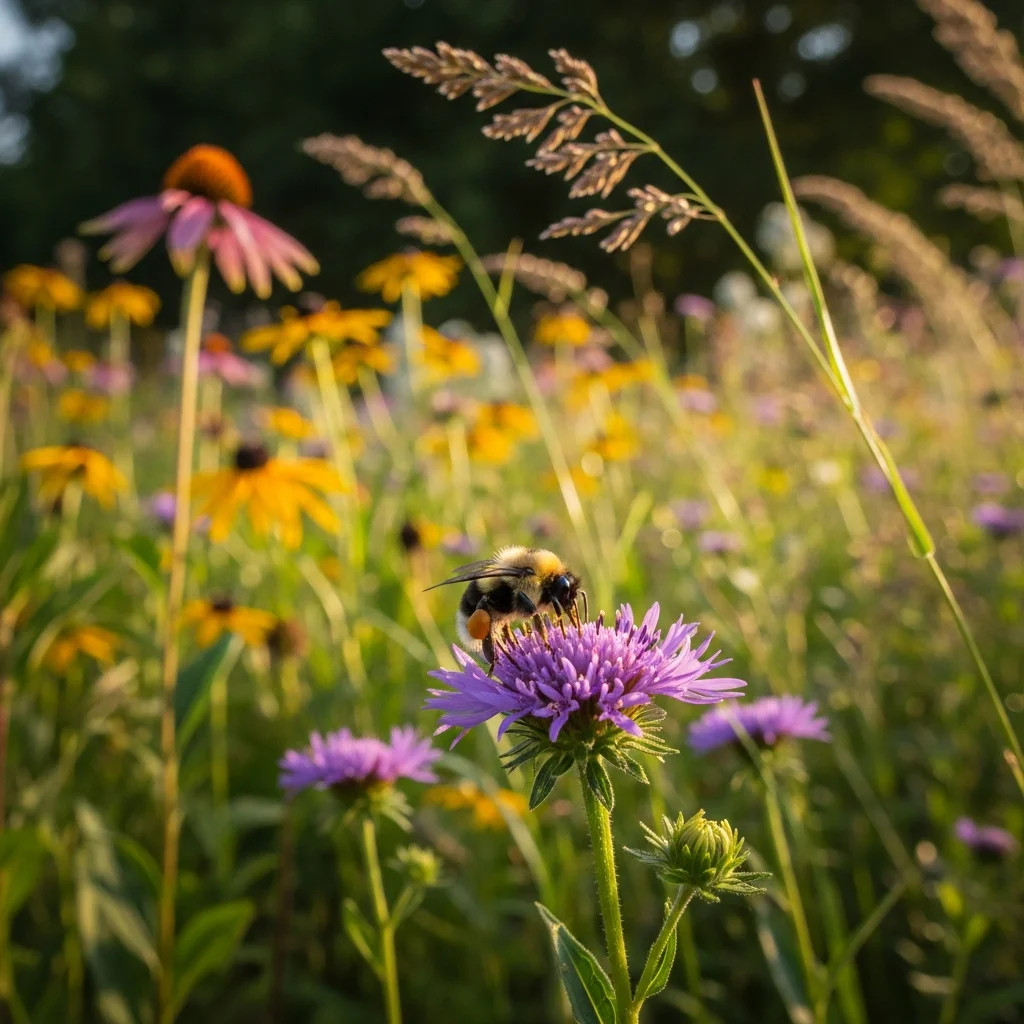
A real natural garden is not a designed space but a functioning system. Honey bees, wild bees and bumblebees work in it at the same time, complement each other and take on different tasks. They pollinate different plant species, are active at different times and react differently to temperature, wind and weather. Anyone who specifically promotes this interplay creates not only more biodiversity but builds a stable, self-sustaining ecosystem. For Lehm-Revival this results in a clear line: create natural habitats, understand cycles and develop systems that work in the long term.
Wild bees and bumblebees in the natural garden: measures at a glance
Practical overview, from simple to complex, with an estimate of the effect
| Measure | Effect | Effort | Best time | Special feature |
|---|---|---|---|---|
| Wildflower meadow (native species) | very high | low (sowing) | March to May | Most important single measure |
| Sandarium / open sand area | high | low | April to May | Indispensable for ground-nesting bees (around three quarters nest in the soil) |
| Leave deadwood standing / lying | medium to high | no effort | all year round | For cavity nesters |
| Nesting aid made of hardwood (drilled) | medium | low to medium | March to April | Use only untreated timber |
| Flowering hedge of wild shrubs | high | medium (planting) | Autumn / spring | Most valuable measure in the long term |
| Doing without pesticides | very high | no effort | immediately | Basis for all other measures |
| Set up a bumblebee box | low (bumblebees only) | low | February to March | Location and depth are decisive |
| Leave meadow areas unmown | high | no effort | April to October | Protect flowering ground |
Why wild bees and bumblebees are indispensable
Honey bees are the focus of attention, but they are only one part of the overall system. In Germany there are over 600 species of wild bee, including numerous bumblebee species. A large proportion of these species are endangered or have already disappeared from many regions.
Many wild bees are highly specialised and depend on certain plant species without which they cannot survive. Bumblebees, on the other hand, are particularly robust. They fly at low temperatures, in wind and even in light rain. As a result they play an important role in phases when other pollinators are not yet active. The interplay of these groups ensures complete pollination. If one group is missing, gaps arise. A natural garden must therefore do justice to all pollinators.
The natural garden as a habitat, more than just food
A stable natural garden offers not only flowers but also habitats. What matters is the combination of food, nesting sites and shelter. Open patches of ground of Sand or clay allow ground-nesting wild bees to build their nests. Dead wood and dead plant stems offer nesting opportunities for above-ground species. Stone piles, dry stone walls and root areas create retreats.
Structurally rich hedges and shrubs complement the offering and provide protection from wind and predators. Flowering areas all year round secure the food supply throughout the season. Such a garden looks less tidy but is considerably more stable. Diversity replaces control.
For Lehm-Revival this connection is directly tangible: open clay areas, for example on paths, unpaved areas or embankments, are preferred nesting sites for ground-nesting wild bees. Avoiding sealed surfaces in outdoor works incidentally creates ecologically valuable areas without additional investment.
Spring, the most critical phase of the year
Spring decides the course of the whole year. After winter, pollinators need quickly available food to build up their populations. Willow catkins play a central role here. They provide large quantities of pollen and nectar exactly when they are needed.
They are supplemented by hazel, cornelian cherry and early perennials such as lungwort and liverwort. Without these early bloomers, many colonies remain weak. This has a direct effect on pollination performance and the development of all bee populations throughout the garden.
Year-round flowering, the basis of a stable system
A functioning natural garden provides food over many months. The decisive factor is staggering flowering times over the whole year. In spring, willow, hazel and early perennials dominate. In early summer, plants such as viper's bugloss, meadow sage, bird's-foot trefoil and knapweed follow.
In summer, lavender, oregano and clover species add to the offering. In late summer and autumn, asters, ivy and stonecrop secure the supply. In addition, shrubs and trees such as fruit trees, elder and blackthorn provide large quantities of flowers over longer periods. This diversity ensures continuity and stability in the whole system.
The gaps in the flower supply, at the beginning of June and the end of August, are particularly critical. They arise when garden owners plant ornamental summer perennials instead of native meadow and field plants. Closing these gaps specifically with chicory, yarrow, stonecrop or clover creates a continuity of supply that has a measurable effect on pollinator population size.
Supporting wild bees specifically
Wild bees need specific conditions that are missing in many gardens. Open areas of soil without dense turf are essential for ground-nesting species. Avoiding blanket mulch leaves the soil accessible. Leaving plant stems standing over winter creates nesting opportunities for cavity-nesting species. Dead wood and natural structures maintain the supply of nesting sites.
Insect hotels can be a useful addition but do not replace natural habitats. The decisive factor is the combination of structure and a continuous food supply. Anyone who only puts up an insect hotel without shaping the surroundings achieves little.
Bumblebees as key species in the natural garden
Bumblebees are particularly adaptable and take on tasks that other pollinators cannot. They fly at low temperatures and even in bad weather, thereby securing pollination in spring and in unfavourable weather conditions. For crops such as tomatoes, strawberries and blueberries, bumblebees are more important than honey bees.
Bumblebees often nest in the ground or in sheltered cavities. They need early-flowering plants and prefer flowers with plenty of nectar. A structurally rich natural garden with a wide range of early bloomers offers exactly these conditions and makes bumblebees reliable partners in the gardening year.
Around 40 bumblebee species live in Germany, of which only about six to eight are found in gardens. Many species are highly specialised and tied to certain plants or nest structures. Anyone wanting to promote ground-nesting bumblebee species specifically should preserve undisturbed areas of soil at the edge of hedges or compost heaps. Ground bumblebee queens prefer to nest there after overwintering.
Correctly classifying predators and invasive species
A functioning system always includes antagonists. Natural enemies such as birds, spiders and predatory insects are part of it and stabilise the overall system. Invasive species or strong parasites that disturb the balance become a problem.
The Asian hornet is spreading increasingly and can put regional pressure on honey bee colonies. It hunts in front of hive entrances and weakens smaller colonies in particular. The varroa mite remains the most important parasite of the honey bee and requires continuous attention. Wax moths occur mainly in weakened colonies and are usually a sign of an unstable system. The decisive factor is overall stability: a healthy natural garden can compensate for many stresses.
Why diversity stabilises the system
Diversity is the central factor for stability. Different plants, different pollinators and different structures ensure that losses can be compensated. If one species fails, others take over its role.
This leads to lower susceptibility to disease, more stable yields, healthier plants and more resilient bee populations. A monotonous system reacts sensitively to disturbances. A diverse system remains stable and regenerates itself.
This system logic also applies to the garden as a whole: the more different structures there are (flowering area, dead wood, open soil, hedge, pond, orchard), the more niches arise for specialised species. A garden with ten structural elements contributes more to regional biodiversity than an area of the same size with only one function.
Competition between honey bees and wild bees
The assumption that honey bees displace wild bees is not correct under good conditions. Honey bees mainly use mass nectar flows. Wild bees specialise in certain plants. This creates a natural division of food resources.
What matters is sufficient plant diversity, not too many honey bee colonies and specific promotion of nesting sites for wild bees. This creates a system in which all species benefit and no group displaces another. The natural garden must be large enough and structurally rich enough to support everyone.
Typical mistakes in the natural garden
Many gardens look well kept but are ecologically weak. Large lawns without flowers offer neither food nor structure. Exotic ornamental plants that are worthless for native insects fill the space but contribute nothing. Removing all dead wood and plant remains in autumn destroys nesting opportunities and overwintering sites.
Too intensive care and the use of pesticides, even supposedly harmless ones, damage the system in the long term. A functioning natural garden needs time, structure and diversity. Order in the classic sense is often counterproductive.
Connection to beekeeping
A well-designed natural garden has a direct effect on beekeeping. Stronger colonies, less stress and better honey quality are the result. At the same time, fewer interventions are needed because the colony obtains the necessary food and stability from its surroundings.
Beekeeping becomes easier and more stable in a structurally rich natural garden. The garden takes over part of the work that would otherwise have to be compensated for by supplementary feeding or frequent interventions. Wild bees and bumblebees benefit as much as the honey bee colony.
Wild bees in the Achim and Bremen region: what really helps
In the Achim region and the area around Bremen there are still structurally rich landscapes with hedgerows, hedges, orchards and natural gardens. This diversity offers ideal conditions for wild bees, bumblebees and honey bees. Lehm-Revival at Danziger Str. 59, 28832 Achim sees natural building and nature-oriented living as a unity. A natural garden with diverse pollinators is not a luxury but a key building block.
Those who live naturally also build naturally. In the Lehm-Revival shop you will find ecological clay building materials for a low-pollutant interior, complementing the natural garden.
Natural building materials for house and gardenFrequently asked questions about wild bees and bumblebees
What do ground-nesting wild bees need in the garden?
Ground-nesting wild bees need open, unvegetated patches of sandy or loamy soil without dense turf. Sunshine, shelter from wind and a quiet location without frequent disturbance are also important. Mulch or dense planting down to the ground prevents access. Open clay areas on paths, unpaved areas or embankments are preferred nesting sites; avoiding sealed surfaces there creates them without additional investment.
Do honey bees displace wild bees?
Not under good conditions. Honey bees mainly use mass nectar flows, while many wild bees specialise in certain plants, so the food sources are shared out. What matters is sufficient plant diversity, not too many honey bee colonies and specifically promoted nesting sites for wild bees.
Is an insect hotel enough to support wild bees?
Not on its own. An insect hotel is a useful addition but does not replace natural habitats. The decisive factor is the combination of nesting sites, such as open patches of soil, dead wood and plant stems left standing over winter, and a continuous food supply from spring into autumn.
Sources and standards
Further links
Products in the shop
Knowledge articles
Videos & external links
More items in Sustainable living
- Healthy living and a natural indoor climate: why building materials are decisive
- Beekeeping in the natural garden: keeping bees sustainably and harvesting real garden honey
- Kreuz ohne Haken: diversity on the farm, in the village and on the building site
- Clay in the bedroom: a healthy indoor climate, better sleep and a mindful start to the day
- Natural garden in northern Germany, herbs, field plants and natural cycles
- Self-sufficiency on a historic farm in northern Germany