
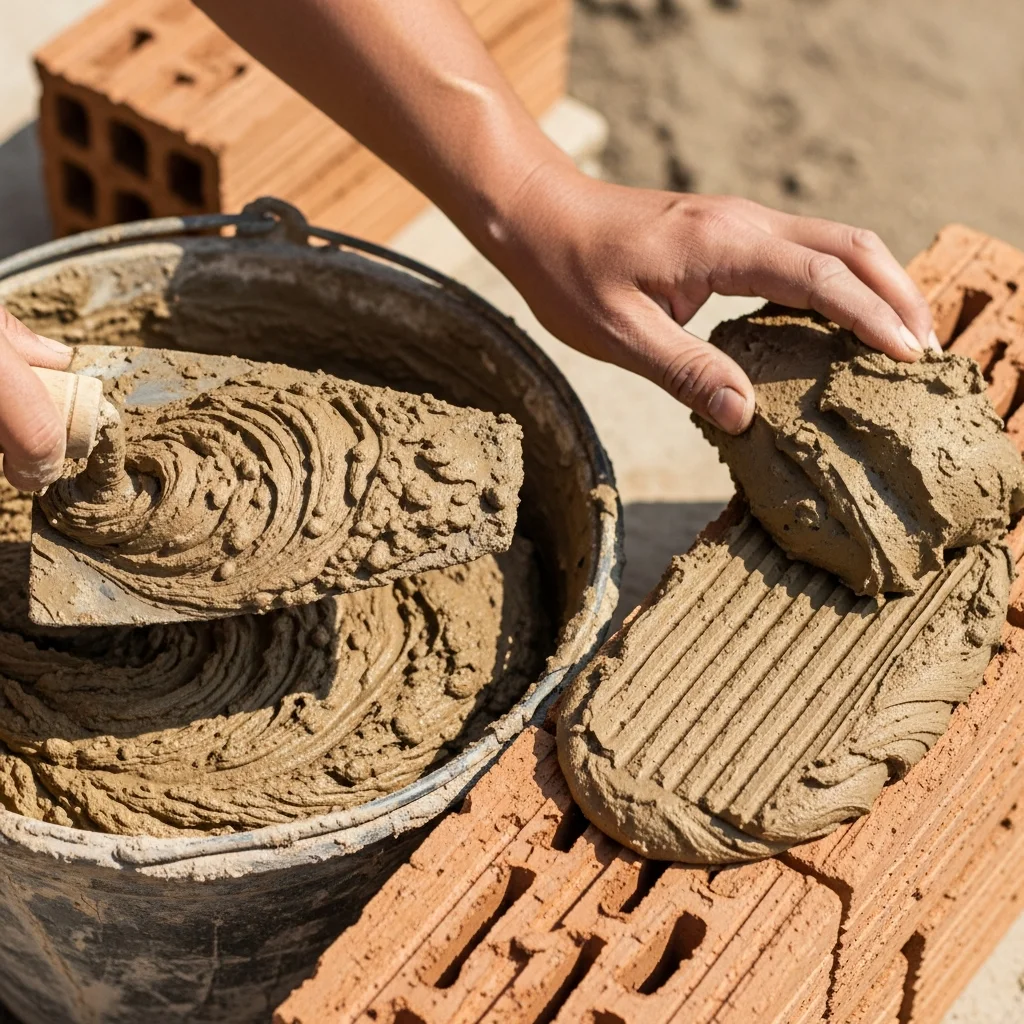
Clay mortar in clay building: masonry mortar and plastering mortar

Clay mortar is the umbrella term for two key building materials: clay masonry mortar according to DIN 18946 for laying clay blocks, bricks or natural stones, and clay plaster mortar according to DIN 18947 for wall plasters. Unlike lime or cement mortar, clay mortar does not harden hydraulically but solely by drying. It therefore remains permanently repairable, vapour-permeable and fully reusable. At Lehm-Revival, standard-compliant ClayTec products according to the current DIN status are preferred.
Types of clay mortar at a glance: standards, mixture and use
Clay masonry mortar (DIN 18946) and clay plastering mortar (DIN 18947) for building practice
| Mortar type | Standard | Aggregate / binder | Compressive strength | Use |
|---|---|---|---|---|
| Clay masonry mortar | DIN 18946 (LMM 0/4 m) | Clay + sand | Strength class M3 | Clay block masonry |
| Clay masonry mortar LIGHT | DIN 18946 (LMM 0/4 f) | Clay, bulk density class 1,4 | M0, not load-bearing | Light clay blocks |
| Clay base coat plaster LP | DIN 18947 | Clay + coarse sand + straw | — | First coat of plaster, panels |
| Clay base coat plaster LR (light) | DIN 18947 | Clay + light aggregate (perlite) | — | Thermally insulating base coat |
| Clay finishing plaster LO | DIN 18947 | Clay + fine sand | — | Smoothing intermediate coat |
| Clay fine plaster LF | DIN 18947 | Clay + fine sand | — | Visible surface, interior |
| Light clay plaster LL | DIN 18947 | Clay + chopped straw | — | Panel infill, historic |
Clay masonry mortar according to DIN 18946
Clay masonry mortar is used to lay clay blocks and other mineral building materials in clay construction. Typical areas of use are interior walls of clay blocks, panel infills in timber framing, natural stone masonry indoors and repairs to historic clay buildings.
The mortar consists of clay as binder, sand as aggregate and partly fibre additives such as straw or hemp. The fibres reduce shrinkage cracks and improve stability during drying.
Especially in historic timber frame houses, clay masonry mortar is the mortar that suits clay infills, natural stone walls indoors and repairs to historic building fabric in terms of building physics. It remains capillary-active and vapour-permeable and thereby supports healthy moisture behaviour of the entire wall construction.
Unlike cement mortar, clay masonry mortar absorbs excess moisture and releases it again when the air is dry. This behaviour is particularly noticeable in spring and autumn and contributes significantly to regulating building moisture in old buildings. Anyone renovating a historic timber frame building should therefore consider clay masonry mortar as the first choice.
Strength classes and load-bearing masonry
According to DIN 18946, clay masonry mortar is divided into strength classes designated M1 to M4. Its compressive strength is well below that of cement mortar. Light clay masonry mortar is therefore only intended for non-load-bearing walls or panels.
Load-bearing clay masonry is, however, possible if standard-compliant clay blocks according to DIN 18945 are used and structural verification is available. Since the introduction of DIN 18940 for load-bearing clay masonry, clay construction has also been possible in higher building classes. Execution, however, requires proper planning and structural design.
Clay plastering mortar according to DIN 18947
Types and classes of plaster
Clay plaster mortar is used for wall plasters in clay construction. It is applied in several layers and creates a vapour-permeable and moisture-regulating surface. Typical applications are interior plaster on masonry, interior plaster on clay boards, timber frame interior walls and ecological interior fit-out.
According to DIN 18947, clay plaster mortar is divided into different classes. The strength classes S I and S II are common. Testing according to DIN 18947 covers, among other things, shrinkage, compressive strength, adhesive tensile strength and water absorption. Industrial products such as ClayTec clay plasters are tested regularly in independent laboratories and meet these requirements.
Light clay plasters in clay building
In addition to normal clay plasters, light clay plasters (LLPM) are distinguished. These contain mineral or biogenic lightweight aggregates such as straw, reed or expanded minerals. Light clay plasters have lower bulk densities, usually about 0,9 to 1,2 kg per cubic decimetre, and therefore offer better thermal insulation properties.
Typical areas of use for light clay plasters are straw bale construction, thicker plaster layers and ecological insulation constructions. The shop does not carry a light clay plaster. For light, insulating clay components there is the Expanded clay light clay for interior insulating linings and the Clay-wood dry fill LIGHT.
Quality differences in clay mortar
With growing demand for clay building products, many suppliers have entered the market. However, not all products meet the same technical requirements. Some clay mortars are offered as simple mixes of local clay and sand, without standard-compliant testing or classification. Such materials can work for simple applications but do not deliver reproducible building physics properties.
In today's construction, especially in timber framing, in new builds or in funded projects, standard-compliant and tested products should therefore be used. Manufacturers such as ClayTec are among the pioneers of clay construction standardisation in Germany and have contributed significantly to the development of the DIN standards for clay building products. Industrially made clay mortars therefore offer much greater application reliability and consistent quality.
Clay mortar compared to lime and cement mortar
Clay mortar differs fundamentally from lime and cement mortars. Clay mortar hardens exclusively by drying. If it is moistened again, it can become plastic again. This means clay mortars and clay plasters can easily be repaired even after years.
Lime mortar hardens through carbonation and is therefore also suitable for exterior plasters. Cement mortar hardens hydraulically and becomes very hard and dense. These properties can be problematic in historic buildings. Especially in timber frame houses and old buildings, cement mortar can trap moisture in the masonry. This leads to timber damage, salt efflorescence, cracking and moisture damage.
Clay mortar, on the other hand, remains vapour-permeable and capillary-active. Moisture can be absorbed and released again. For historic building fabric, clay mortar is therefore the right choice ecologically and in terms of building physics.
Drying and application
Clay mortar hardens through evaporation of the water. Drying time depends heavily on layer thickness, temperature, humidity and air exchange. For plaster layers over about 15 mm or difficult substrates, a controlled drying protocol is recommended to avoid stress cracks.
Even drying without direct sunlight or strong heating is ideal. Draughts and aggressive construction drying should be avoided, as they can cause uncontrolled shrinkage cracks. Depending on plaster thickness and indoor climate, drying can take from a few days to several weeks.
In the cold season, the application temperature should be at least 8 degrees Celsius. Frost during the drying phase damages the clay structure irreversibly. In summer, on the other hand, spraying with moisture can help prevent the surface from drying out too quickly in direct sunlight. Regular ventilation of the rooms during the drying phase speeds up moisture release and improves the end result.
Clay mortar at Lehm-Revival
At Lehm-Revival you will find a selection of high-quality clay building products for clay building, timber frame renovation and sustainable interior finishing. These include ClayTec clay masonry mortar according to DIN 18946, ClayTec clay base coat plasters and finishing plasters according to DIN 18947, ClayTec clay boards and ClayTec Yosima design plasters.
These products have been used in clay construction for many years and enable safe application according to the current state of the art. The technical details are based on DIN 18946 and DIN 18947, the clay building rules of the Dachverband Lehm and manufacturer data from ClayTec.
Clay mortar combines traditional building with modern requirements for sustainability, indoor climate and building physics, and thus remains a central building material in ecological building.
For questions about choice of material, the appropriate mortar class or the right application technique, I am happy to help by email, phone or in a personal consultation . Anyone unsure which clay mortar is suitable for their project receives an honest, practical recommendation from me based on their specific building situation.
| Product | Standard | Application | Special feature |
|---|---|---|---|
| ClayTec clay masonry mortar | DIN 18946 | Masonry, joints, panels | for clay blocks and natural stone |
| ClayTec coarse clay base coat plaster | DIN 18947 | Base coat plaster on masonry | 10–20 mm layer thickness |
| ClayTec clay base coat plaster with straw | DIN 18947 | Base coat, thicker application | 8 to 35 mm per layer |
| ClayTec Lehm-Oberputz fein 06 | DIN 18947 | Finishing plaster, smoothing layer | 2–3 mm, smooth surface |
| ClayTec Yosima design plaster | DVL TM 06 | Fine plaster, visible surface | 146 natural shades |
Clay mortar in practice: application experience in northern Germany
Lehm-Revival at Danziger Str. 59, 28832 Achim advises homeowners and craftsmen in the Lower Saxony region on choosing the right clay mortar for their projects. Especially in the town of Achim and the Verden district there are many historic buildings whose joint mortar and plaster layers have been damaged by wrongly chosen cement mortar. I help choose suitable clay mortars for renovation and restoration and deliver them by parcel or haulier throughout Germany.
Frequently asked questions about clay masonry mortar
Can I lay natural stone with clay masonry mortar?
Indoors, yes: clay masonry mortar according to DIN 18946 is suitable for natural stone masonry indoors, for panel infills and for repairs to historic clay buildings. It remains capillary-active and vapour-permeable and can be repaired by moistening even after years. For outdoors you use lime mortar, because clay mortar is not water-resistant.
Sources and standards
Further links
Products in the shop
More items in Clay building
- Monument protection and clay building: age line, permit and typical mistakes
- Buy hemp insulation: hemp insulation batts for interior insulation, rafters and timber framing
- Hempcrete: mixture, application and insulation values for wall, floor and roof
- Interior insulation costs per m², wood fibre with clay vs. calcium silicate vs. drywall
- Lime plaster: properties, use and application inside and outside
- When clay does not work: limits, mistakes and decision rules
- Clay in interior finishing: a healthy indoor climate with natural building materials
- Clay, lime or cement: which binder is right for old buildings and timber framing?
- Advantages of clay building, healthy indoor climate, sustainability and building physics explained clearly
- Clay building: building and renovating with clay
- Clay boards in interior finishing: drywall construction with clay according to DIN 18948
- Buy fine clay plaster and YOSIMA design plaster: application, choice of colour and prices
- Clay paint on plasterboard: pre-treatment, consumption and painting
- Clay paint in interior finishing: mineral wall paint for a healthy indoor climate
- Clay plaster on concrete: preparation, primer and plaster thickness
- Clay plaster on gypsum plaster and old plaster: check, prime, plaster thinly
- Clay plaster on sand-lime brick and brick: plastering masonry correctly
- Clay plaster on Rigips and plasterboard: preparing the substrate correctly
- Applying clay plaster: the complete step-by-step guide
- Clay plaster costs per m², prices, material requirements and packs compared
- Renovating clay plaster: recognising types of damage, understanding causes and repairing correctly for the long term
- Clay plaster on different substrates: concrete, brick, wood and drywall
- Building up clay plaster: base coat, finishing coat and fine plaster
- Wall heating with clay: planning and installation step by step
To take away: the free clay building diary with drying log.
Download free of charge