
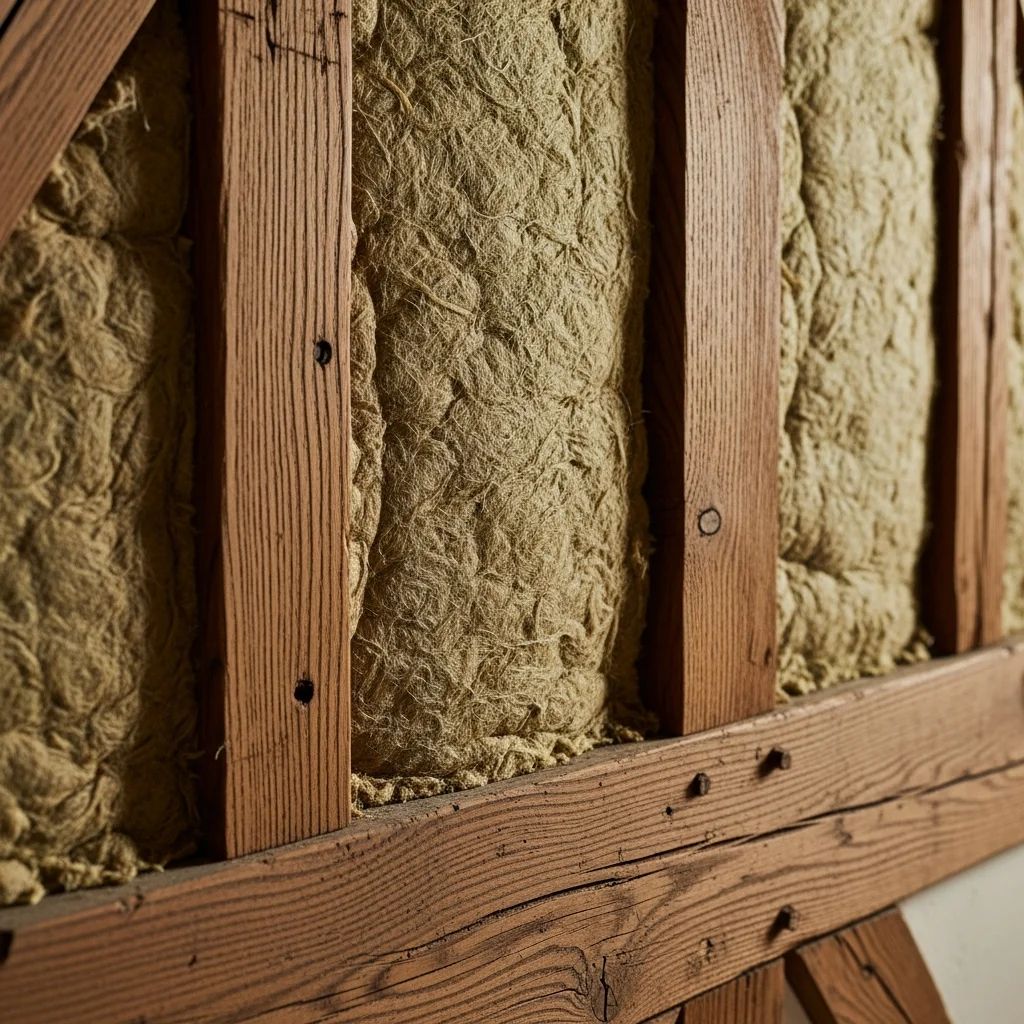
Buy hemp insulation: hemp insulation batts for interior insulation, rafters and timber framing

Hemp is one of the oldest crop plants in the world and is experiencing a clear renaissance in ecological building. Hemp insulation in the form of clamping felts, mats and stuffing hemp offers a convincing combination of thermal insulation performance, moisture regulation and ecological soundness. This article explains how hemp clamping felts work, which applications they are particularly suited to, how installation works and what the materials cost.
Hemp insulation as a complete wall
Hemp insulation batts between the substructure, in front of them the clay board up to the finished surface. Enter the area, order everything in one step.
- Naturwerk HANF FLEX Premium insulation batts 5 × 80 mm236,05 €
- ClayTec clay board D22 solar 22 × single board527,78 €
- LEMIX clay board screws 3 × standard66,21 €
- ClayTec drywall tape L=25m 1 × width 50mm22,07 €
- Clay joint filler natural 1 × natural brown15,35 €
- Clay adhesive and reinforcing mortar 4 × standard132,44 €
- Glass fabric 112 g/m², roll W=1m 1 × length 35 m91,19 €
- Clay filler and surface filler natural 3 × natural brown118,05 €
- ClayTec clay paint pure white 1 × standard62,39 €
Total for 15 m²1.271,53 €
incl. VAT, plus shipping
Plus on site, not in the list
- approx. 57 m Squared timber for studs and surrounding timbers (solid softwood C24, axis spacing 625 mm)
- approx. 51 pcs Fixings for stud framing on floor, ceiling and walls
Hemp insulation compared to other natural insulation materials
Characteristic data of various natural insulation materials, as of 2026
| Insulation material | Lambda [W/(mK)] | Moisture buffer | Workability | Life cycle assessment |
|---|---|---|---|---|
| Hemp insulation batts | 0,038 to 0,045 | Very good | Very easy | Very good |
| Wood fibre board | 0,038 to 0,042 | Good | Good | Very good |
| Sheep's wool | 0,035 to 0,042 | Very good | Simple | Very good |
| Mineral wool | 0,032 to 0,045 | Low | Simple | Average |
| EPS rigid foam | 0,030 to 0,040 | None | Simple | Poor |
| Cellulose | 0,038 to 0,045 | Good | Specialist needed | Very good |
What hemp insulation is and how it is made
Hemp insulation is made from the fibres of the crop plant Cannabis sativa. After harvesting, the fibres are retted, cleaned and processed into mats or felts. Only approved low-THC industrial hemp varieties are used to make insulation. The product has no mind-altering properties.
Unlike mineral wool, hemp is processed without a melting process and without chemical binders. The fibres are consolidated mechanically and held together with a proportion of binding fibres, for Naturwerk HANF FLEX 15 percent polyester bicomponent fibres. The result is a pressure-resistant, elastic felt that adapts to the substrate.
The production energy for hemp insulation is considerably lower than for mineral wool or EPS. Hemp grows without intensive irrigation or pesticides, binds CO₂ during growth and delivers a positive climate balance over its entire life cycle. At the end of its service life, hemp insulation can be recovered thermally.
Thermal insulation performance of hemp insulation batts
The thermal conductivity of hemp clamping felts is typically between 0,038 and 0,045 W/(mK). These values are comparable with mid-range mineral wool and much better than many conventional building materials without insulating properties. For a calculation under the GEG, the design value applies, for Naturwerk HANF FLEX 0,041 W/(mK).
It is important to note that the insulation value of natural insulation materials depends heavily on the quality of installation. Poorly fitting clamping felts that shrink between rafters or studs and form gaps lose considerable insulating performance. Careful fitting without compressing and without gaps is therefore decisive for the actual insulating effect.
Compared with wood fibre boards, hemp clamping felt has the advantage of easier installation. It does not need to be sawn but is cut to the right size and clamped between the panels or studs. This saves time and produces less waste when cutting.
Moisture regulation: why hemp is particularly valuable in old buildings
Hemp can absorb up to 20 to 30 percent of its own weight in moisture and release it again without significantly losing its insulating performance. For old buildings with damp walls or fluctuating humidity, this property is a decisive advantage over vapour-tight insulation.
In timber frame houses, old brick buildings and historic buildings, moisture movement in walls is a permanent issue. Mineral wool and EPS cannot actively regulate moisture. Hemp, on the other hand, absorbs humidity peaks and slowly releases the moisture again when the surrounding air becomes drier. This reduces the risk of mould forming in the wall construction.
This property makes hemp an ideal partner for clay plaster systems. Clay and hemp are compatible with each other in terms of building physics: both materials are vapour-permeable and moisture-regulating. A build-up of hemp clamping felt followed by clay plaster is considered by natural building experts to be one of the safest solutions for ecological interior insulation.
Areas of application for hemp insulation batts
The most common area of use for hemp clamping felts is insulation between rafters in the roof. The felts are clamped precisely between the rafters and completely fill the cross-section. As hemp is elastic, it also adapts well to panels that are not perfectly rectangular and prevents air gaps.
In wall insulation, hemp is used for timber stud frames, timber frame constructions and light partition walls. For timber frame houses, hemp clamping felt is the first choice for infill because the material suits the historic wall construction of timber and clay in terms of building physics. None of the fibre insulation materials destroys the sensitive timber construction through expansion pressure.
Stuffing hemp is a loose hemp fibre with a fibre length of 20 to 200 mm, used for sealing joints, stuffing cavities and as a sealing material between timber components. It is pressed into cracks and gaps by hand and swells slightly there, which produces a reliable seal.
Working with hemp insulation batts: step by step
Hemp clamping felts are cut with a knife or scissors. A straight metal rail as a guide is recommended for cutting to panel width. The clamping felt is cut about 10 to 30 mm wider than the panel so that it clamps after insertion and no gaps form at the sides.
When inserting, the felt is compressed slightly and fed into the panel. It then expands by itself and clamps firmly. Care should be taken that no air gaps form at the beams or rafters. For irregular substrates or round beams, the felt must be cut accordingly.
After installation, the hemp clamping felt can be covered with battens and a plaster base or boarding on top. On roofs, an underlay membrane is laid on the cold side before the roof covering is applied. Hemp does not rot as long as it is protected from permanent soaking in a construction.
Hemp insulation costs and material prices
Depending on thickness and manufacturer, hemp clamping felts cost between twelve and 17 euros per square metre in material. A 120 mm thick mat for insulation between rafters is at the upper end of the price scale, a 80 mm thick mat correspondingly cheaper. Prices have remained stable in recent years because hemp cultivation is increasing again in Germany and Europe.
Compared with conventional mineral wool, hemp is about 30 to 50 percent more expensive in material. This premium is offset by the lower installation effort and better building physics suitability in old buildings. Anyone installing mineral wool in historic timber framing also has to pay for moisture problems caused by the wrong choice of material.
Stuffing hemp for sealing joints costs between two and five euros per running metre of joint, depending on quality and quantity. For a typical old building renovation with numerous joints between timber beams and masonry, the requirement for stuffing hemp can be considerable. It is advisable to map the joints before starting insulation work and estimate the requirement.
Calculate material requirements with the quantity calculator →
Hemp insulation and fire protection
Hemp clamping felts such as Naturwerk HANF FLEX have a European Technical Assessment (ETA-16/0947) and are classified in Euroclass C-s2,d0. They burn when exposed to an open flame but hardly smoulder and go out when the ignition source is removed. For fire protection requirements beyond C-s2,d0, special protective measures or other insulation materials are required.
In practice, the plaster or boarding on the hemp protects the insulation from fire. In properly plastered or boarded constructions, hemp clamping felts meet the same requirements as mineral wool in comparable constructions. Building authorities in Germany know and accept hemp insulation in residential and non-residential buildings.
For projects with increased fire protection requirements, for example in apartment buildings or public buildings, consulting the responsible fire protection planner is recommended. In many cases, hemp insulation can also be used in such buildings with suitable construction measures.
Hemp compared to wood fibre insulation
Wood fibre and hemp are the two most commonly used ecological insulation materials in old buildings. They differ in their form: wood fibre is available as a dimensionally stable board or as blown granulate, hemp mainly as clamping felt or stuffing fibre. They are therefore suited differently to different types of construction.
For insulation between rafters and timber stud frames, hemp clamping felt is the more convenient solution because no saw cuts are needed. For constructions that need dimensionally stable boards, for example on the facade or as a plaster base board, wood fibre is better suited. Many projects combine both materials: wood fibre boards for the plastered surfaces, hemp clamping felts for the panels.
In terms of building physics, both materials behave very similarly: vapour-permeable and moisture-regulating. Both are suitable for combination with clay plaster. Anyone wanting to use both materials can take advantage of their respective strengths without making any building physics compromises.
Insulation washers and fixing accessories for hemp insulation
Hemp clamping felts are held in timber constructions by the clamping effect without additional fixing. For applications where the mats must be additionally secured, for example on inclined surfaces or in constructions under pressure, insulation washers are used. These flat discs are fixed into the substrate with a nail or screw and hold the batt securely in position.
Plastic insulation washers are sufficient for most applications. For constructions that may come into contact with moisture, corrosion-resistant washers of galvanised or stainless steel are recommended. The cost of fixing accessories is usually less than five percent of the overall project.
Besides the actual insulation mats, the accessories for the plaster layer are also part of it. Reinforcing fabric made of jute harmonises particularly well in terms of building physics with hemp and clay systems. It is embedded in the fresh clay base coat plaster and prevents shrinkage cracks that can occur with thick plaster layers.
Hemp insulation and pest infestation, a myth
A common prejudice against hemp and other natural insulation materials is their supposed susceptibility to pest infestation. In fact, high-quality hemp insulation is far less attractive to insects and rodents than many conventional building materials, because it offers no food and has a certain protective effect through natural constituents of hemp.
The right installation situation is decisive for a lasting protective effect. Hemp clamping felts should be installed so that there are no access points from outside through which mice or other animals could enter. In roof constructions, a carefully connected eaves detail is more important than the choice of material.
In practice, pest infestations in hemp insulation are rare and usually due to poor installation details, not the material itself. Mineral wool offers no more reliable protection in this respect, because rodents can gnaw through mineral wool.
Hemp insulation as part of an ecological building concept
Ecologically built and renovated buildings benefit most when all materials are matched to each other in terms of building physics and ecology. As an insulating material, hemp insulation fits seamlessly into a concept based on vapour-permeable layers, natural surfaces and healthy indoor air.
A typical ecological wall build-up for a renovated timber frame house could look like this: existing external wall with timber frame, hemp clamping felt in the panels, reed as plaster base on the inside, coarse clay base plaster with straw and clay top plaster FINE 06 as the surface. All layers are vapour-permeable, and the materials are predominantly of natural origin.
Such build-ups are also increasingly recognised in building certification according to DGNB, Passivhaus Plus or similar standards. Hemp insulation contributes to the material score in ecological building certificates because production conserves resources and disposal is fully circular.
Sources of supply and regional availability
Hemp insulation batts and stuffing hemp are available from specialist suppliers of ecological building materials. Lehm-Revival carries Hemp insulation batts from the Naturwerk brand in 80, 100 and 120 mm thickness, Stuffing hemp for sealing joints and insulation washers as fixing accessories. The products are matched to the common panel dimensions in German timber construction.
For building sites in northern Germany, Lehm-Revival delivers hemp insulation directly to the site. Delivery times are short because the warehouse in Achim is well managed. For larger projects, ordering in advance is recommended so that the goods are available in time.
For combination with clay plaster systems, I put together hemp clamping felts, clay base plaster and top plaster in the right quantities for you. This simplifies planning and ensures that all materials come from one source and are matched to each other in terms of building physics.
Hemp insulation in northern German timber frame houses and old buildings
In northern Germany, hemp insulation has proven itself for years, especially in timber frame houses and historic timber constructions. Around Achim, Verden and Bremen, Lehm-Revival at Danziger Str. 59, 28832 Achim supports builders in planning ecological insulation measures with hemp and clay plaster systems.
Frequently asked questions about hemp insulation and hemp insulation batts
How does hemp insulation differ from mineral wool?
Hemp insulation is made from the fibres of the hemp crop plant, without a melting process and without chemical binders; in Naturwerk HANF FLEX, 15 percent polyester bicomponent fibres hold the felt together. Hemp absorbs humidity peaks and releases them again, whereas mineral wool cannot actively regulate moisture. Hemp is therefore a better fit in terms of building physics for old buildings and timber framing with vapour-permeable walls. Both are in a comparable range for thermal conductivity.
Can I install hemp insulation batts myself?
Yes. You cut the felt with a knife or scissors against a metal rail, about 10 to 30 mm wider than the panel, and clamp it lightly compressed between rafters or studs. It expands and holds without further fixing. Make sure no air gaps remain at beams and rafters.
How thick does hemp insulation need to be?
That depends on the construction and the thermal protection target. Between rafters, the felt fills the cross-section completely, so the rafter depth sets the frame. For verification under the GEG you calculate with the design value, for Naturwerk HANF FLEX 0,041 W/(mK). The thermal protection calculation for your component shows which thickness fits.
Where can I install hemp insulation batts?
In timber constructions: between rafters, in timber stud frames, timber frames, light partition walls and timber frame panels. After installation you cover it with battens and a plaster base or boarding. It must be protected from permanent soaking; then it does not rot.
Is hemp insulation combustible?
Yes, hemp burns in an open flame. Naturwerk HANF FLEX has a European Technical Assessment (ETA-16/0947), is classified in Euroclass C-s2,d0, hardly smoulders and goes out when the ignition source is removed. Plastered or boarded, the felt meets the same requirements as mineral wool in comparable constructions. With increased fire protection requirements, for example in an apartment building, talk to the fire protection planner beforehand.
Sources and standards
- nova-Institut: Marktdaten für Hanffasern in der Bau- und Dämmstoffindustrie
- Dachverband Lehm e.V.: Naturbaustoffe im Altbau
- Fraunhofer IBP: Hygrothermische Bewertung natürlicher Dämmstoffe
- Informationsdienst Holz: Naturfaserdämmstoffe im Holzbau
- Naturwerk HANF FLEX Premium, Technisches Datenblatt
- Europäische Technische Bewertung ETA-16/0947 (Naturwerk HANF FLEX)
- Naturwerk Stopfhanf, Technisches Datenblatt
- Naturwerk Dämmstoffteller, Technisches Datenblatt
- DIN EN 13501-1: Brandverhalten von Bauprodukten
Further links
Products in the shop
Knowledge articles
More items in Clay building
- Monument protection and clay building: age line, permit and typical mistakes
- Hempcrete: mixture, application and insulation values for wall, floor and roof
- Interior insulation costs per m², wood fibre with clay vs. calcium silicate vs. drywall
- Lime plaster: properties, use and application inside and outside
- When clay does not work: limits, mistakes and decision rules
- Clay in interior finishing: a healthy indoor climate with natural building materials
- Clay, lime or cement: which binder is right for old buildings and timber framing?
- Advantages of clay building, healthy indoor climate, sustainability and building physics explained clearly
- Clay building: building and renovating with clay
- Clay boards in interior finishing: drywall construction with clay according to DIN 18948
- Buy fine clay plaster and YOSIMA design plaster: application, choice of colour and prices
- Clay paint on plasterboard: pre-treatment, consumption and painting
- Clay paint in interior finishing: mineral wall paint for a healthy indoor climate
- Clay mortar in clay building: masonry mortar and plastering mortar
- Clay plaster on concrete: preparation, primer and plaster thickness
- Clay plaster on gypsum plaster and old plaster: check, prime, plaster thinly
- Clay plaster on sand-lime brick and brick: plastering masonry correctly
- Clay plaster on Rigips and plasterboard: preparing the substrate correctly
- Applying clay plaster: the complete step-by-step guide
- Clay plaster costs per m², prices, material requirements and packs compared
- Renovating clay plaster: recognising types of damage, understanding causes and repairing correctly for the long term
- Clay plaster on different substrates: concrete, brick, wood and drywall
- Building up clay plaster: base coat, finishing coat and fine plaster
- Wall heating with clay: planning and installation step by step
To take away: the free clay building diary with drying log.
Download free of charge