
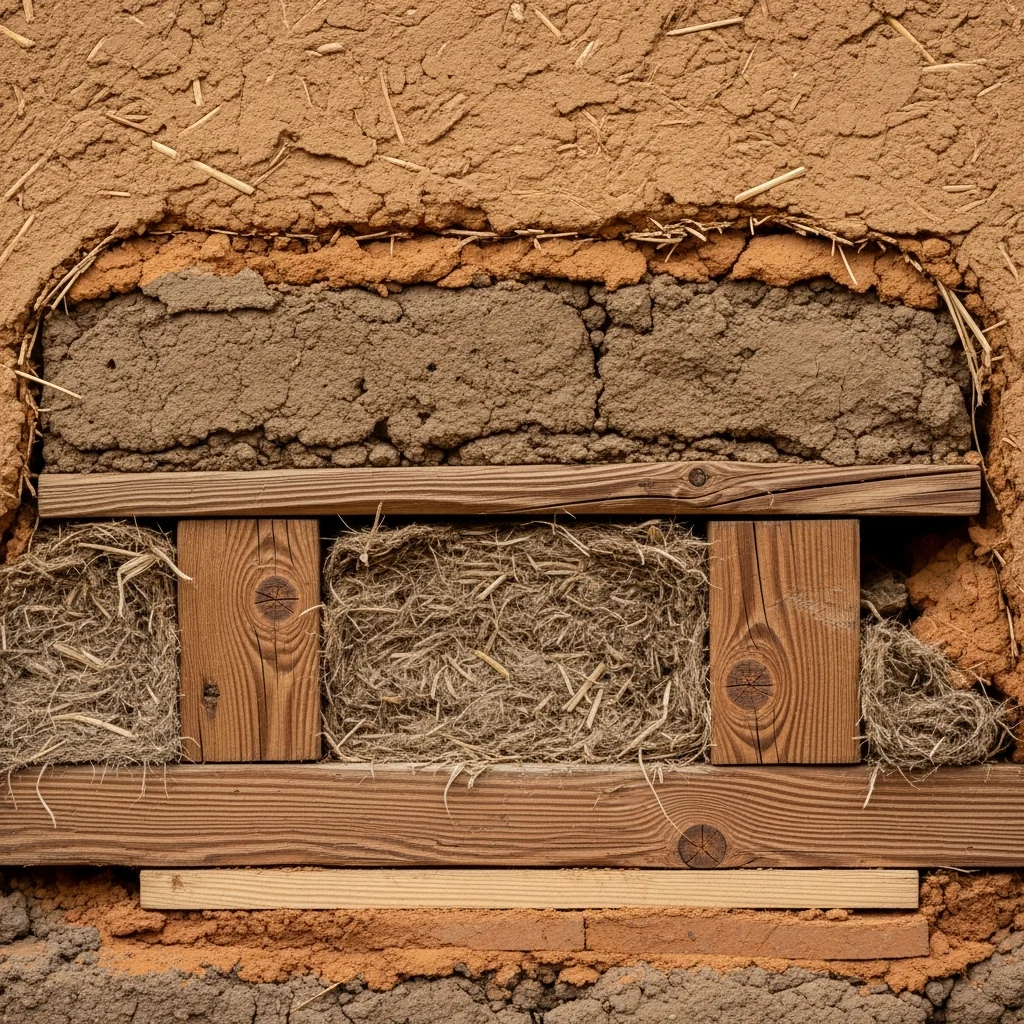
Building physics for natural building materials: vapour diffusion, heat storage and dew point

Building physics sounds theoretical, but it is the basis for durable and healthy building. Anyone who understands how moisture is transported through components, why certain layer sequences encourage mould and how building materials store heat makes better decisions when renovating and building. This article explains key building physics terms using typical natural building materials such as clay, lime, wood and hemp.
Natural building materials compared in terms of building physics
Decision aid for choosing building materials: diffusion, moisture and life cycle assessment at a glance
| Building material | Diffusion (μ) | Moisture buffer | Life cycle assessment | Typical use |
|---|---|---|---|---|
| Clay plaster | 5–10 | very high | very good (no firing) | Interior plaster, indoor climate |
| Lime plaster | 10–25 | medium | good | Interior and exterior plaster |
| Lime-cement plaster | 15–35 | low | medium | Exterior plaster, cellar |
| Cement plaster | 15–35 | very low | poor (CO₂-intensive) | Cellars, wet areas |
| Wood (solid) | 20–50 | medium | very good (CO₂ storage) | Structure, cladding |
| Plasterboard | 4–10 | very low | medium | Drywall, indoors |
| Hemp block | 4 | high | very good | Panel infill, insulation |
Vapour diffusion: how moisture migrates through components
Warm indoor air contains water vapour. This water vapour moves along a vapour pressure gradient from areas of higher vapour pressure to areas of lower vapour pressure. In buildings this means from inside to outside. This process is called vapour diffusion.
Building materials let water vapour through to different degrees. Vapour diffusion resistance is described by the μ value. It indicates how strongly a material slows water vapour transport compared with air. By definition, air has μ = 1.
Typical values: clay plaster μ ≈ 5 to 10, lime plaster μ ≈ 8 to 20, cement plaster μ ≈ 15 to 35, EPS insulation (polystyrene) μ ≈ 20 to 100.
The higher the μ value, the more strongly diffusion is slowed. In practice, however, planning considers not just the μ value but the sd value of the entire layer.
The sd value and its practical significance
The sd value describes the total diffusion resistance of a layer. It is calculated as sd = μ × d, where d is the layer thickness in metres. The sd value corresponds to the thickness of a still air layer that would have the same diffusion resistance.
Example: clay plaster with μ = 7 and a thickness of 20 mm gives sd = 7 × 0,02 m = 0,14 m. Cement plaster with μ = 35 and 20 mm thickness gives sd = 35 × 0,02 m = 0,7 m.
When planning vapour-permeable components, a proven planning rule is that diffusion resistance should decrease towards the outside. The decisive factor is the sd value of the individual layers. On the outside the sd value should be smaller than on the inside, so that moisture that has penetrated can dry out to the outside.
Example of timber frame interior plaster: clay base plaster with μ = 7 and 20 mm thickness gives sd = 0,14 m. Clay fine plaster with μ = 8 and 3 mm thickness gives sd = 0,024 m. Total interior plaster sd ≈ 0,16 m. This build-up is very vapour-permeable and allows good drying of the wall build-up.
Problematic build-up: interior cement plaster with μ ≈ 35 and 20 mm thickness gives sd ≈ 0,7 m. If this is applied to a clay infill, a strongly vapour-retarding inner layer is created. Moisture can then dry out less well towards the interior. Combined with low temperatures in the component, condensation can form at interfaces. In the long term this encourages mould and moisture damage.
Dew point: where condensation can occur
The dew point is the temperature at which air with a certain relative humidity is saturated and water vapour condenses. In components, the temperature falls from inside to outside. If the dew point temperature is undercut within a wall cross-section, condensation can occur there.
In vapour-permeable wall build-ups with clay plaster, wood and mineral outer layers, the area of possible condensation lies near the outer surface and can dry out there again.
It becomes problematic when strongly vapour-retarding or airtight layers are arranged unfavourably and moisture is trapped in the component. Combinations of vapour-tight interior plasters and moisture-sensitive building materials such as timber are particularly critical.
A practical rule of thumb is therefore: components should become more vapour-permeable towards the outside, or at least should not have significantly more vapour-tight outer layers than inside. The decisive factor is the comparison of the sd values.
Thermal conductivity and heat storage of natural building materials
Thermal phase shift
Thermal conductivity λ describes how quickly a building material transports heat. It is given in W/(m·K). Low values mean better insulation. Typical values: clay plaster and clay block λ ≈ 0,7 to 1,0 W/(m·K), wood λ ≈ 0,13 to 0,18 W/(m·K), Hemp insulation λ ≈ 0,04 to 0,05 W/(m·K). Clay is therefore not a classic insulation material, but has a very high heat storage capacity.
Heat capacity c describes how much heat energy a material can store per kilogram. For clay it is typically about 1000 to 1200 J/(kg·K), similar to concrete. Solid clay components absorb heat during the day and release it with a delay. This effect leads to more stable room temperatures.
Phase shift describes how long a temperature impulse from outside takes to reach the inside of a component. For a solid clay wall about 20 cm thick with a bulk density of around 1800 kg/m³, the phase shift is typically about 8 to 12 hours. The heat of the day therefore only reaches the interior at night, when the outside temperature is already falling again.
Moisture sorption: a special property of clay
Clay has a pronounced sorption capacity. At high relative humidity the material can absorb moisture from the room air and release it again when the air is dry.
Especially in the range between about 40 and 70 percent relative humidity, clay plaster acts as a natural moisture buffer. Short-term moisture peaks, for example from cooking or breathing, are thereby considerably flattened.
The strength of this effect depends heavily on the plaster thickness. Even a few millimetres of clay plaster show a measurable sorption effect. In practice it becomes clearly noticeable from about 10 to 15 mm of plaster, and it is particularly effective at about 20 mm. Thin layers of clay paint without plaster underneath, on the other hand, have only a small moisture buffering effect.
| Building material | μ value | λ W/(m·K) | Bulk density kg/m³ | Special feature |
|---|---|---|---|---|
| Clay plaster | 5 to 10 | 0,7 to 1,0 | 1600 to 2000 | High sorption capacity |
| Lime plaster NHL 3,5 | 8 to 20 | 0,7 to 1,0 | 1200 to 1600 | Weather-resistant and alkaline |
| Cement plaster | 15 to 35 | 0,9 to 1,4 | 1800 to 2200 | Highly vapour-retarding and rigid |
| Spruce wood | 20–50 | 0,13 to 0,18 | 450 to 550 | Good insulating effect, hygroscopic |
| Hemp insulation | 1 to 2 | 0,04 to 0,05 | 25 to 45 | Very vapour-permeable and well insulating |
| Clay block according to DIN 18945 | 5 to 10 | 0,47 to 0,91 | 1200 to 1800 | High heat storage capacity and good moisture regulation |
Building physics in northern Germany: what counts in a coastal climate with high humidity
In Lower Saxony, a federal state with high annual rainfall and moderate temperatures, wall build-ups that are correct in terms of building physics are particularly important. Timber frame houses in the Achim and Verden area are exposed to driving rain from the west and north-west. Lehm-Revival at Danziger Str. 59, 28832 Achim advises on correct build-ups and carries out moisture damage analyses on site.
Frequently asked questions about building physics and choice of building materials
How do I calculate whether my wall build-up is correct in terms of building physics?
For a simple check: determine the sd value of all layers from inside to outside (sd = μ × layer thickness in metres). The sd values inside should be greater than those of the outer layers, or at least equal. For complex wall build-ups, I recommend a calculation according to DIN 4108-3 (condensation verification using the Glaser method).
Can clay be used as thermal insulation?
Clay plaster and clay blocks are not thermal insulation materials (λ 0,7 to 1,0 W/(m·K)), but they store a lot of heat. For insulation, you combine clay with hemp (λ about 0,04 to 0,05 W/(m·K)) and then plaster the insulation layer with clay. Hemp insulation is very vapour-permeable and therefore suits clay plaster in terms of building physics.
Sources and standards
- DIN 4108-3: Tauwassernachweis (Glaserverfahren)
- DIN 18947: Lehmputzmörtel
- DIN 18945: Lehmsteine
- DVL: Lehmbau Regeln
- DIN 4108-4:2020-11: Wärmeschutz, Tabelle 1 Bemessungswerte
- ClayTec Produktblatt Lehm-Oberputz fein 06
- Schönthaler Hanfstein, Technisches Merkblatt und Anbauanleitung
- Naturwerk HANF FLEX Premium, Technisches Datenblatt
Further links
Products in the shop
More items in Timber framing & wood
- Timber frame wall build-up: layers, materials and structure fully explained
- Filling a timber frame panel: definition, materials and step-by-step guide
- Timber framing in central Germany: history, construction methods and regional features
- Timber framing in northern Germany: history, construction methods and regional features
- Renovating timber framing with clay: step by step to a healthy timber frame wall
- Timber framing in southern Germany: history, construction methods and regional features
- Historic roof windows in listed buildings: permit, models and installation
- Lime screed in a timber frame house: planning and professional execution on sandy ground
- Lime in timber frame construction: using NHL and alpine lime
- Clay in timber framing: infill, plaster and renovation
- Clay vs. brick in timber framing: which material really suits the panels?
- Filling a panel: clay block or hemp block in timber framing
- Clay-wrapped staves in timber framing: historic restoration, reuse and professional new production
- What is timber framing? Structure, function and materials simply explained
- Reusing old bricks in timber framing: cleaning, triangular battens and professional reinstallation
To take away: the free clay building diary with drying log.
Download free of charge