
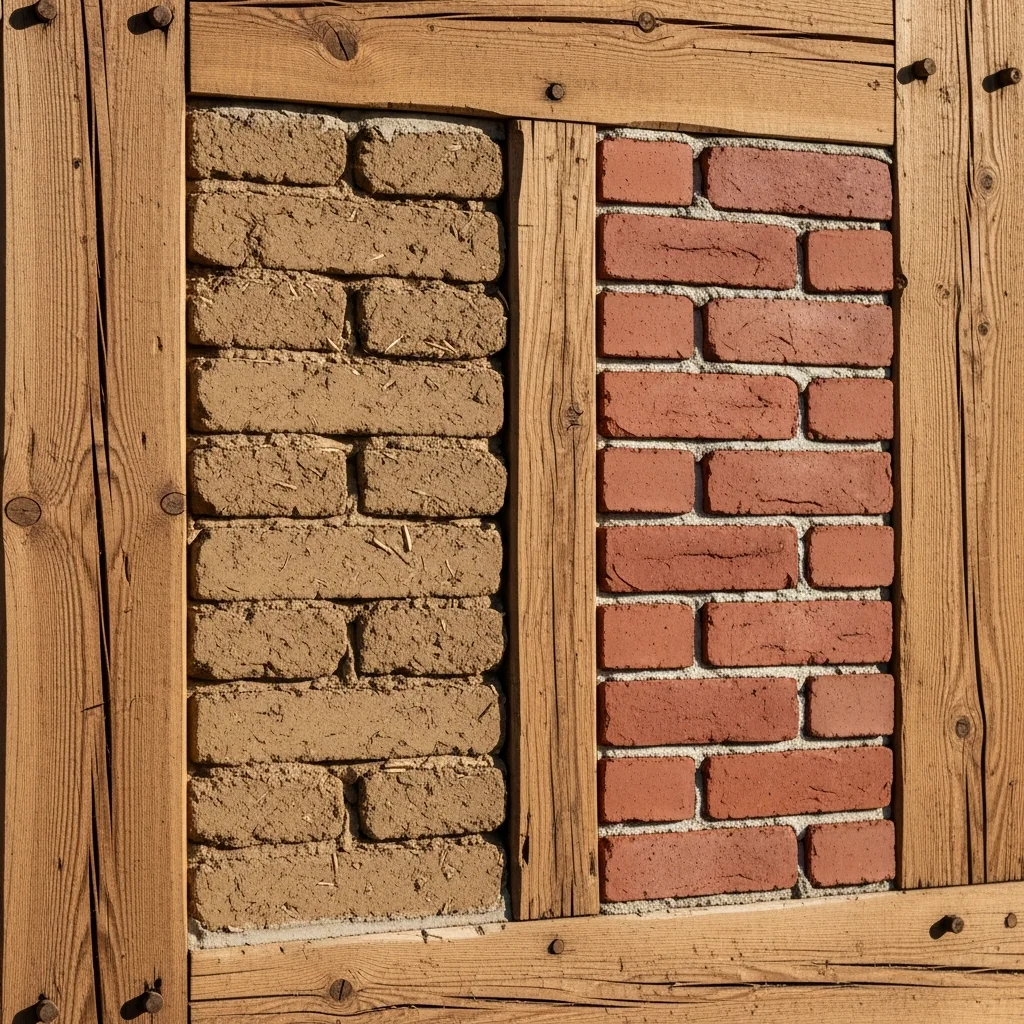
Clay vs. brick in timber framing: which material really suits the panels?

When you renovate or re-infill a timber frame house, the question inevitably arises: clay or brick? Both materials were used historically, and both work. The difference lies in how well they suit the timber frame system. Timber framing clearly separates two functions: the timber frame carries the load, the panels only fill. For this to work permanently, all materials must behave similarly to the timber: flexible, vapour-permeable and moisture-active.
Clay vs. brick in timber framing, direct comparison
Decision table for choosing the panel material in timber frame renovation
| Property | Clay | Brick (fired) | Recommendation |
|---|---|---|---|
| Vapour permeability (μ) | 5–10 (very high) | 5–25 depending on the block | Clay |
| Moisture regulation | active, capillary-active | passive | Clay |
| Thermal insulation | low, additional insulation needed | low to medium | similar |
| Heat storage | high (~1.800 kg/m³) | very high (~1.900 kg/m³) | Brick slightly better |
| Compressive strength | low (inner panel is enough) | high | Brick for load-bearing panels |
| Moisture resistance | outside only with lime plaster | suitable outdoors with lime | Brick outdoors |
| Historic suitability | original, first choice for old buildings | only if historically documented | Clay |
| Repairability | easy, without special tools | Lime mortar joint required | Clay |
| Life cycle assessment | very good | good | Clay |
Clay in timber framing: the original material
Clay is the original material in timber framing, not by chance, but because it meets the requirements of this construction method. It consists of natural components and remains permanently capillary-active.
Clay can absorb, store and release moisture. It does not react rigidly but in a balancing way. Timber moves; it changes with moisture, temperature and time. Clay can follow these movements. This prevents open joints, stress peaks and permanent cracking.
Moisture is absorbed, stored and released again. As a result there is no moisture build-up, the risk of mould falls and the timber structure remains protected. This is the central point when using clay in timber framing.
In addition: clay remains repairable and reworkable. Damage can be repaired locally without changing the entire system.
Bricks in timber framing: strength with limitations
Bricks are fired building materials, stable and dimensionally stable. They were also used historically in timber framing, regionally different and later than clay.
The fundamental problem: bricks are rigid, less moisture-active and considerably more compression-resistant than clay. They do not respond to movement but resist it.
Because timber moves and brick does not, stresses arise. These typically show as cracks at transitions, open joints and material separation. Bricks can only absorb and release moisture to a limited extent. Moisture stays in the system longer, drying slows down and adjoining components are put under more strain.
The critical points do not lie in the brick itself but at the connections: timber and brick react differently to moisture and temperature. In the long term this leads to leaks and cracking.
The real difference
The difference does not lie in which material is better. The difference lies in how the material behaves in the system.
Clay adapts, balances and works with the timber. Brick stays rigid, does not balance and creates stresses in the system.
In timber framing there is a clear requirement: the infill material must adapt to the system. The system is flexible, open to moisture and designed for balance. Clay meets these requirements directly, brick only to a limited extent.
When clay makes sense. When brick can be used
Clay fits almost all classic timber frame situations: renovating existing panels, restoring historic fabric, in interior fit-out and when building vapour-permeable wall constructions. It supports the system instead of changing it.
Brick can work if it is already part of the construction, the system is matched to it and the transitions are carefully resolved. But it does not replace the properties of clay.
Typical mistakes do not arise from the choice of material alone but from wrong combinations: cement plaster on timber framing, dense insulation, rigid coatings or mixed systems without a levelling layer. These interventions change the behaviour of the whole wall and lead to damage in the long term.
Classification for today's renovations
Much damage in timber framing today is caused not by age but by wrong materials. Dense build-ups, missing moisture balancing and rigid systems are the causes.
Clay has a stabilising effect here because it restores the original behaviour of the system. Anyone renovating a timber frame house today is best off working with materials that support the system and do not work against it.
Before deciding, it is worth first analysing the current wall build-up, assessing the moisture behaviour and recording the existing materials. The right solution follows from this.
| Property | Clay | Brick |
|---|---|---|
| Moisture regulation | high, absorb and release | low, limited buffer capacity |
| Vapour permeability | yes, permanently capillary-active | partly, less vapour-permeable |
| System flexibility | high. Follows timber movement | low, rigid, creates stresses |
| Risk of cracks at transitions | low if installed correctly | increased by different material behaviour |
| Repairability | locally repairable, no intervention in the system | Replacement requires more effort |
| System compatibility | high. Matches timber frame logic | partly, only with an adapted build-up |
| Historic use | original timber frame material | regional, historically younger than clay |
Clay or brick: the reality of decisions in northern German renovations
In Lower Saxony and in the Achim, Verden and Rotenburg (Wümme) area, timber framing shapes the townscape. Many houses have been renovated over generations with a wide variety of materials. Lehm-Revival at Danziger Str. 59, 28832 Achim advises homeowners and craft businesses on the choice of material and delivers all the clay materials needed for infill and plaster nationwide by parcel or haulier.
Frequently asked questions about clay and brick in timber framing
Can I replace bricks in timber framing with clay?
Basically yes, replacement is possible and in most cases improves the moisture behaviour of the wall. It is important to analyse the wall build-up beforehand and make sure that the plaster and connections suit the new material. For listed buildings, the intervention must be agreed with the monument protection authority in advance.
What to do if bricks and clay are present in the same wall?
Mixed systems are found in existing buildings. What matters is a careful levelling layer at the transitions and a continuously vapour-permeable plaster build-up. In this case, advice from a specialist company or expert is sensible in order to develop the right solution.
Sources and standards
Further links
Products in the shop
More items in Timber framing & wood
- Building physics for natural building materials: vapour diffusion, heat storage and dew point
- Timber frame wall build-up: layers, materials and structure fully explained
- Filling a timber frame panel: definition, materials and step-by-step guide
- Timber framing in central Germany: history, construction methods and regional features
- Timber framing in northern Germany: history, construction methods and regional features
- Renovating timber framing with clay: step by step to a healthy timber frame wall
- Timber framing in southern Germany: history, construction methods and regional features
- Historic roof windows in listed buildings: permit, models and installation
- Lime screed in a timber frame house: planning and professional execution on sandy ground
- Lime in timber frame construction: using NHL and alpine lime
- Clay in timber framing: infill, plaster and renovation
- Filling a panel: clay block or hemp block in timber framing
- Clay-wrapped staves in timber framing: historic restoration, reuse and professional new production
- What is timber framing? Structure, function and materials simply explained
- Reusing old bricks in timber framing: cleaning, triangular battens and professional reinstallation
To take away: the free clay building diary with drying log.
Download free of charge