
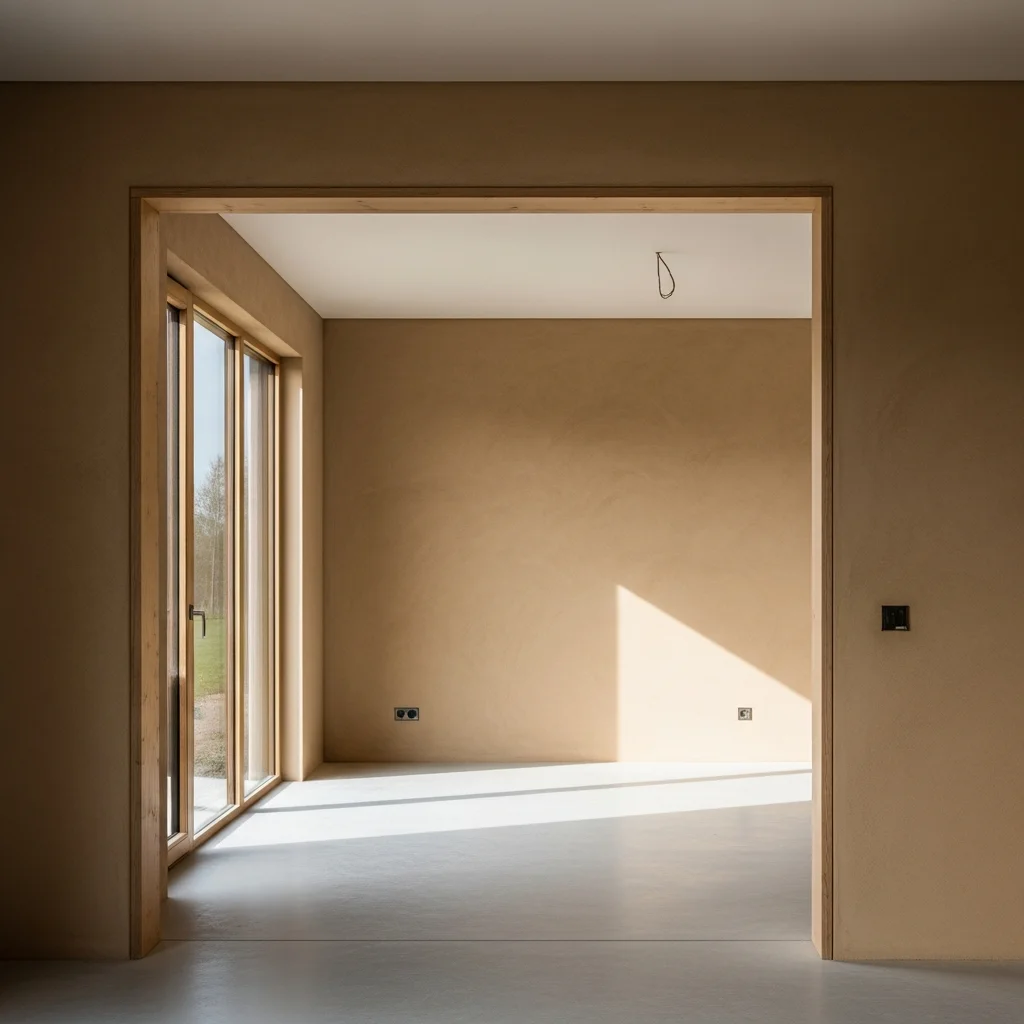
Clay in interior finishing: a healthy indoor climate with natural building materials

Clay is one of the most versatile materials in interior finishing. It can be used as clay plaster on masonry, as clay board in drywall construction or as clay paint on existing walls. The decisive advantage over gypsum or synthetic resin systems lies in the building physics: clay is vapour-permeable, capillary-active and free of synthetic binders or pollutants. It can absorb moisture from the room air and release it again when the air is dry. Studies and measurements show that rooms with clay surfaces have considerably more stable relative humidity than comparable rooms with plasterboard or synthetic resin bound plasters. Thicker clay plaster layers of about 15 to 20 mm can reduce humidity peaks by about 15 to 30 percent. This lowers the risk of mould and makes the indoor climate considerably more balanced. In old buildings, timber framing and sustainable interior finishing in particular, clay is therefore once again one of the preferred building materials today. At Lehm-Revival, mainly tested ClayTec clay building products are used, as they are manufactured and tested according to the current DIN standards.
System build-up: three routes to a clay room
In interior finishing there are three typical ways of creating clay surfaces. Which system makes sense depends on the substrate, the construction sequence and the desired indoor climate.
Route 1: clay plaster as a wet system
The classic build-up is a multi-layer clay plaster directly on the masonry. Typical build-up: clay base plaster about 10 to 20 mm, clay top plaster about 6 to 10 mm and optionally clay fine plaster about 2 to 3 mm or clay paint as a finish. The base plaster levels unevenness and forms the basis. The top plaster ensures an even surface. A fine plaster or clay paint forms the visible final layer.
Typical products are ClayTec coarse clay base plaster with straw, ClayTec clay plaster Mineral 20, ClayTec coarse clay top plaster with straw and ClayTec clay top plaster fine 06. The great advantage of this system is the high moisture buffering capacity of the whole wall surface. Solid clay plaster can absorb and release moisture particularly effectively.
Advantages of this system: very high moisture regulation, balanced indoor climate, construction in keeping with monument protection in timber framing. Disadvantages: longer drying times and higher labour compared with drywall solutions.
Route 2: drywall construction with clay boards
A faster solution in interior fit-out is clay boards according to DIN 18948. These boards are screwed to a metal or timber stud frame much like plasterboard, or bonded directly to solid walls. The joints are then filled and the surface thinly plastered or painted.
Typical products are ClayTec clay boards, ClayTec clay filling and surface filler and ClayTec clay top plaster or clay paint as the surface. Advantages: quick installation, clean site, hardly any drying time. Disadvantage: somewhat lower moisture buffering than solid clay plaster. Nevertheless, clay boards offer much better building physics properties than classic plasterboard systems.
Route 3: clay paint on existing walls
The simplest way to use clay indoors is clay paint. Clay paint can be applied to lime plaster, primed plasterboard, clay boards or existing mineral plasters. Two coats are enough for full coverage.
Thin clay paints contribute only to a limited extent to moisture buffering, but can already produce a measurable surface effect on the indoor climate. Particularly high-quality surfaces are created with ClayTec Yosima clay design plasters. These coloured clay plasters consist of natural clays and mineral pigments and offer over 140 natural shades. Yosima is applied thinly and creates a very calm, mineral surface.
Cost and economic efficiency
Material costs compared
A classic clay plaster system costs about 18 to 28 euros per square metre in material for base plaster, finishing plaster and fine plaster. A gypsum plaster system costs about 8 to 15 euros per square metre.
The extra cost of clay is put into perspective by several advantages: a better indoor climate, higher heat storage, long service life and easy repair. Clay boards are also more expensive than classic plasterboard, at about 34 to 40 euros per square metre. For a typical room with 15 square metres of wall area, this corresponds to about 150 to 300 euros of extra cost. Relative to service life and the gain in indoor climate, this difference is small.
Calculate material requirements and costs with the quantity calculator →
Funding and sustainability
Clay building materials are considered particularly ecological building materials. They contain no synthetic binders, need no energy-intensive firing and can be completely reused.
As part of energy-efficient renovations, clay building products can indirectly be part of a BEG renovation concept (Federal Funding for Efficient Buildings), for example when they are used in connection with interior insulation or comprehensive renovation measures. However, individual clay plasters are usually not directly eligible for funding. Eligibility should therefore be checked case by case with BAFA or KfW.
Regardless of funding options, clay building materials convince with their CO₂ balance. Producing clay plaster causes considerably less CO₂ than producing gypsum or cement. Anyone who chooses clay for interior fit-out therefore makes a decision that benefits both the indoor climate and the environment. Manufacturers such as ClayTec regularly publish environmental product declarations (EPD) that allow a precise assessment of environmental impact.
Clay vs. gypsum: a direct comparison
A key difference between clay and gypsum lies in the ability to regulate moisture. Clay plaster with a layer thickness of about 15 to 20 mm can typically absorb and release about 30 to 70 grams of moisture per square metre, depending on the clay content and the structure of the plaster. Gypsum is at about 6 to 12 grams per square metre. Synthetic resin plasters have practically no moisture buffering capacity.
Another advantage of clay is that it can be repaired. Damaged areas can simply be moistened and remodelled. With gypsum plaster, larger areas have to be renewed to achieve a uniform appearance.
Clay also has clear ecological advantages. It is fully recyclable, needs no energy-intensive firing like cement or gypsum and comes from regional sources of raw materials. Manufacturers such as ClayTec extract their clay regionally as the top layer from gravel and sand extraction and prepare it for clay construction in Viersen and near Ulm.
Clay in interior finishing at Lehm-Revival
At Lehm-Revival you will find a selection of high-quality products for interior finishing with clay, including ClayTec clay base coat and finishing plasters, ClayTec clay boards, ClayTec clay paints and ClayTec Yosima design plasters.
These systems enable vapour-permeable and sustainable interior fit-out with natural materials. For questions about system selection, quantity calculation or application, I am happy to help by email, phone or in person.
Clay combines traditional craftsmanship with modern building physics and creates interiors with a healthy indoor climate, natural surfaces and high sustainability. This applies to simply painting with clay paint as much as to elaborate wet plaster constructions in historic timber framing.
For projects in which ecological insulation and clay plaster are to be combined, Lehm-Revival offers, besides the clay plaster range, also Hemp insulation batts and Wood fibre insulation materials . This combination of hemp insulation and clay plaster as the final layer is considered one of the safest solutions in terms of building physics for interior walls of old buildings.
| System | Products | Layer thickness | Advantage |
|---|---|---|---|
| Wet plaster | Clay base coat, finishing plaster, fine plaster | 15–30 mm | maximum moisture buffering |
| Drywall construction | Clay boards, filler | 16–25 mm | fast, clean, hardly any drying time |
| Clay paint | Yosima, clay paint | up to 2 mm | easy on an existing substrate |
Regional context and use in practice
In the Achim region (28832) and the greater Bremen area, more and more homeowners and architects are choosing clay for interior fit-out as a contribution to healthy living and sustainable building. Lehm-Revival at Danziger Str. 59, 28832 Achim delivers clay plasters, clay boards and clay paints by parcel or haulier to the region and throughout Germany. For projects in Lower Saxony I offer personal on-site advice and help with system selection, quantity calculation and application technique.
Frequently asked questions
Clay plaster, clay board or clay paint: which route suits?
That depends on the substrate, the construction process and the desired effect. Clay plaster as wet plaster on masonry buffers the most moisture but needs longer drying times and more work. Clay boards according to DIN 18948 are quick to install, the site stays clean and there is hardly any drying time. Clay paint is the simplest way on existing mineral walls but contributes only to a limited extent to moisture buffering.
Is clay subsidised in interior finishing?
Individual clay plasters are usually not directly eligible for funding. As part of energy-efficient renovations, however, clay building products can be part of a BEG renovation concept, for example together with interior insulation. Whether this applies to your project is clarified case by case with BAFA or KfW.
Sources and standards
Further links
Products in the shop
Knowledge articles
More items in Clay building
- Monument protection and clay building: age line, permit and typical mistakes
- Buy hemp insulation: hemp insulation batts for interior insulation, rafters and timber framing
- Hempcrete: mixture, application and insulation values for wall, floor and roof
- Interior insulation costs per m², wood fibre with clay vs. calcium silicate vs. drywall
- Lime plaster: properties, use and application inside and outside
- When clay does not work: limits, mistakes and decision rules
- Clay, lime or cement: which binder is right for old buildings and timber framing?
- Advantages of clay building, healthy indoor climate, sustainability and building physics explained clearly
- Clay building: building and renovating with clay
- Clay boards in interior finishing: drywall construction with clay according to DIN 18948
- Buy fine clay plaster and YOSIMA design plaster: application, choice of colour and prices
- Clay paint on plasterboard: pre-treatment, consumption and painting
- Clay paint in interior finishing: mineral wall paint for a healthy indoor climate
- Clay mortar in clay building: masonry mortar and plastering mortar
- Clay plaster on concrete: preparation, primer and plaster thickness
- Clay plaster on gypsum plaster and old plaster: check, prime, plaster thinly
- Clay plaster on sand-lime brick and brick: plastering masonry correctly
- Clay plaster on Rigips and plasterboard: preparing the substrate correctly
- Applying clay plaster: the complete step-by-step guide
- Clay plaster costs per m², prices, material requirements and packs compared
- Renovating clay plaster: recognising types of damage, understanding causes and repairing correctly for the long term
- Clay plaster on different substrates: concrete, brick, wood and drywall
- Building up clay plaster: base coat, finishing coat and fine plaster
- Wall heating with clay: planning and installation step by step
To take away: the free clay building diary with drying log.
Download free of charge