
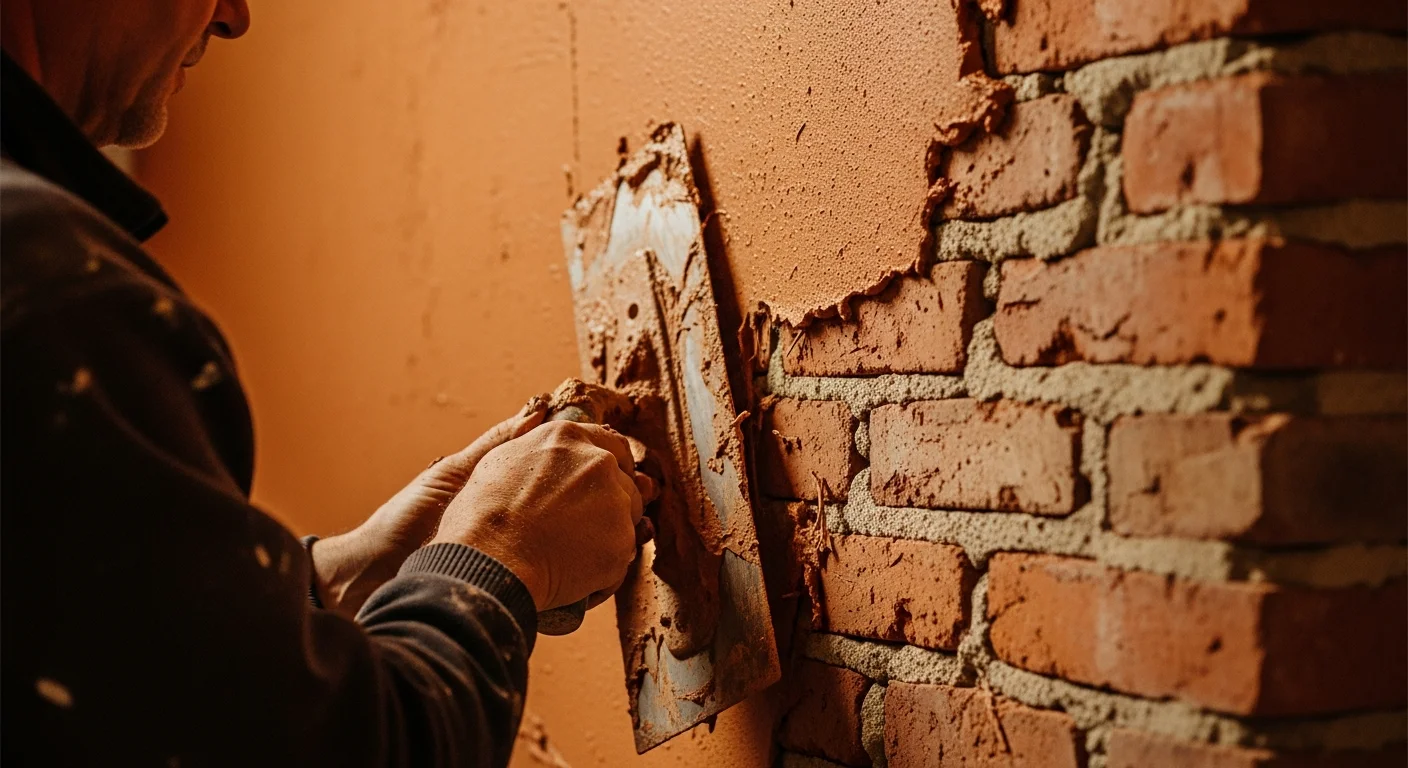
Clay plaster on different substrates: concrete, brick, wood and drywall

Clay plaster can be used on most building materials if the substrate is properly prepared. In old buildings you find brick masonry or timber framing, in new builds concrete, drywall or gypsum fibreboard. Clay dries purely physically and adheres mechanically to the substrate. That is why grip, absorbency and stability of the surface play a central role. This guide shows in practical terms how clay plaster is built up permanently on six different substrates.
Material for mineral substrates
On brick, Poroton or sand-lime brick, pre-wetting is usually enough, then this build-up follows. What concrete, wood or drywall need beforehand is in the article.
- Coarse clay base coat plaster with straw 15 × sacked goods 25kg302,25 €
- Clay finishing plaster FEIN 06 3 × 25 kg sack (item 10.113)69,09 €
- ClayTec clay paint pure white 1 × standard62,39 €
Total for 15 m²433,73 €
incl. VAT, plus shipping
Why substrate preparation is decisive for clay plaster
For clay plaster to hold permanently, the substrate must meet some basic requirements. It needs sufficient grip so that the plaster can bond mechanically with the surface. At the same time, absorbency should be as even as possible: if some areas absorb a lot of water and others hardly any, the plaster can dry unevenly and form stress cracks.
Load-bearing capacity also plays an important role: the substrate must be stable and must not move. If these requirements are not met, typical problems arise such as detachment, shrinkage cracks, blistering or an uneven surface. Careful preparation is therefore the most important step in any clay plastering work.
Clay plaster on brick and sand-lime brick, an ideal substrate
Solid mineral masonry is one of the best substrates for clay plaster. Brick, Poroton or sand-lime brick offer a stable, mineral surface with good natural adhesion. On well-cleaned masonry, pre-wetting is enough. This prevents the masonry from drawing water out of the fresh plaster too quickly.
Before plastering, the surface should be clean and dust-free, and loose mortar residues should be removed. On very smooth brick surfaces, a mineral bonding primer that provides additional grip can be sensible. On well-prepared brick masonry, the clay base plaster can then be applied, followed by the top plaster or a coloured design plaster.
Clay plaster on concrete, bonding bridge required
Concrete is one of the more difficult substrates for clay plaster. The surface is dense, smooth and only weakly absorbent. Direct application therefore leads to adhesion problems.
Before applying a bonding bridge, the concrete must be cleaned thoroughly. Formwork oil residues or release agents from concrete construction must be removed completely, as they severely impair adhesion. A coarse-grained bonding primer such as primer DIE ROTE then creates a rough surface on which the clay base plaster can be built up in several layers. For large areas or ceilings, an additional Reinforcement layer with glass fibre fabric.
Clay plaster on plasterboard and drywall
Drywalls with plasterboard (Rigips) or gypsum fibreboard (Fermacell) have a smooth and highly absorbent surface. Fresh clay plaster contains a lot of water and can soak the boards heavily. Direct application without preparation therefore leads to cracks or adhesion problems.
A safe build-up begins with a suitable fine-grained bonding primer such as the Primer DIE GELBE from ClayTec. It reduces absorbency and creates a grippy texture. Then a thin reinforcement layer is applied, in which a glass fibre mesh is embedded. After drying comes the actual top plaster. The article on clay plaster on Rigips describes a detailed step-by-step build-up specifically for drywall.
Clay plaster on wood, plaster base required
Wood is a living material and changes shape with temperature and humidity. That is why wood is not suitable as a direct plaster substrate. In traditional timber frame construction this problem was solved with plaster bases: the clay does not adhere directly to the wood but to a structure mounted on the wood.
Typical plaster bases are Reed mats, timber battens or special plaster base boards. Wood fibre boards can also serve as a substrate. The clay plaster is then built up on this carrier. This creates a stable bond, while movements of the timber are decoupled from the plaster. This method considerably reduces the risk of cracks and has been proven in timber frame construction for centuries.
Clay plaster on old plaster surfaces
In renovations you come across existing plaster layers of lime, cement or gypsum plaster. In principle, clay plaster can be applied on such surfaces if the existing plaster is completely stable.
Loose or damaged areas must be removed. The surface should then be cleaned thoroughly. On highly absorbent substrates a primer can be sensible, on very smooth surfaces a bonding bridge. A test area of about half a square metre helps to check adhesion before full application.
Clay plaster on clay boards, the ideal substrate
Clay boards are among the ideal substrates for clay plaster. They consist of clay and plant fibres and are mounted in a similar way to drywall boards. After mounting, gaps are closed with clay adhesive and reinforcing mortar, the surface is coated 3 mm thick with reinforcing mortar and embedded glass mesh, and then a thin clay top plaster is applied.
Because wall and plaster consist of the same material, a particularly stable bond is created. In addition, clay boards improve the heat storage and moisture regulation of the room, which is particularly valuable in bedrooms and children's rooms.
Typical layer build-up of clay plaster
Clay plaster is built up in several layers. The base plaster forms the supporting layer and is applied eight to fifteen millimetres thick. On critical substrates, a reinforcement layer with embedded glass fibre mesh follows, which balances stresses in the material. The top plaster forms the visible surface and is two to three millimetres thick as a fine plaster, six to ten millimetres as a coarse top plaster.
Several thin layers are more stable than one very thick layer. Sufficient drying time must be planned between the layers; as a guide, about one to two days per millimetre of plaster thickness.
Design options with clay surfaces
Clay offers not only building physics advantages but also a wide range of design options. Natural earth tones, matt surfaces and soft textures in the plaster are typical. The surface can be smoothed, felted or lightly textured; depending on the tool and technique, a completely different result emerges.
Particularly elegant surfaces are created with coloured design plasters such as the YOSIMA clay design plaster from ClayTec. It contains only natural pigments and creates very calm wall surfaces with mineral depth, without synthetic dyes and without fading. Such surfaces are particularly suitable for living rooms, bedrooms or workrooms.
Common mistakes in substrate preparation
Many problems with clay plaster are caused by inadequate substrate preparation. Surfaces that are too smooth without a bonding primer cause the plaster to detach later. On drywall or timber, missing reinforcement causes cracks at the joints.
Plaster layers that are too thick in one application increase the risk of stress cracks. Drying too quickly due to strong draughts or direct sunlight also causes damage. Anyone who observes these points from the start gets a stable and durable clay surface on any substrate.
| Substrate | Preparation | Bonding primer | Reinforcement |
|---|---|---|---|
| Brick / sand-lime brick | Clean, lightly pre-wet | optional on smooth surfaces | recommended for larger areas |
| Concrete | Clean thoroughly, remove formwork oil | mineral bonding bridge necessary | recommended, especially for ceilings |
| Plasterboard / Fermacell | Fill joints, clean the surface | DIE GELBE fine necessary | Glass fibre fabric necessary |
| Wood / timber framing | Fit the plaster base | not required | Plaster base (reed, lath) necessary |
| Old plaster | Remove loose areas, clean | on highly absorbent surfaces | recommended for cracks |
| Clay board | Reinforce and fill joints | not required | Glass fibre fabric 112 over the full area in 3 mm reinforcing mortar |
Regional context and use in practice
In the Achim area and the neighbouring area around Bremen, old buildings with brick or timber frame walls are regularly renovated. Lehm-Revival supplies craftsmen and homeowners in Lower Saxony and Bremen with the right ClayTec clay building materials for all common substrates, from bonding primer to reinforcing mesh and design plaster. For projects in the region I offer personal advice on choosing the right materials.
Which substrate needs which build-up is explained above in the article. You will find the matching primers, reinforcements and plasters together on the purchase page.
Buy clay plasterOpen questions
On which substrates does clay plaster adhere?
Clay plaster adheres to most building materials: brick, sand-lime brick, concrete, plasterboard, gypsum fibreboard, timber (with plaster base) and clay boards. Proper substrate preparation is always decisive; grip, even absorbency and stability are the most important prerequisites.
Do I always need a bonding primer before clay plaster?
Not always. On rough mineral masonry (brick, sand-lime brick), pre-wetting is enough. On smooth or unevenly absorbent substrates such as concrete or plasterboard, a mineral bonding primer is necessary to create a secure bond.
Can clay plaster be applied directly to concrete?
No. Concrete is dense, smooth and hardly absorbent. Clean it thoroughly, remove formwork oil residues and release agents completely and apply a coarse-grained bonding primer such as primer DIE ROTE. On this you build up the clay base plaster in several layers, with an additional reinforcement layer for large areas and ceilings.
Can I apply clay plaster directly to wood?
No. Wood changes shape with temperature and humidity, and clay plaster does not hold on it permanently. You need a plaster base, for example reed mats, timber battens or plaster base boards; wood fibre boards can also serve as a substrate. The clay then adheres to the carrier, and the movements of the wood remain decoupled from the plaster.
Sources and standards
Further links
Products in the shop
Knowledge articles
More items in Clay building
- Monument protection and clay building: age line, permit and typical mistakes
- Buy hemp insulation: hemp insulation batts for interior insulation, rafters and timber framing
- Hempcrete: mixture, application and insulation values for wall, floor and roof
- Interior insulation costs per m², wood fibre with clay vs. calcium silicate vs. drywall
- Lime plaster: properties, use and application inside and outside
- When clay does not work: limits, mistakes and decision rules
- Clay in interior finishing: a healthy indoor climate with natural building materials
- Clay, lime or cement: which binder is right for old buildings and timber framing?
- Advantages of clay building, healthy indoor climate, sustainability and building physics explained clearly
- Clay building: building and renovating with clay
- Clay boards in interior finishing: drywall construction with clay according to DIN 18948
- Buy fine clay plaster and YOSIMA design plaster: application, choice of colour and prices
- Clay paint on plasterboard: pre-treatment, consumption and painting
- Clay paint in interior finishing: mineral wall paint for a healthy indoor climate
- Clay mortar in clay building: masonry mortar and plastering mortar
- Clay plaster on concrete: preparation, primer and plaster thickness
- Clay plaster on gypsum plaster and old plaster: check, prime, plaster thinly
- Clay plaster on sand-lime brick and brick: plastering masonry correctly
- Clay plaster on Rigips and plasterboard: preparing the substrate correctly
- Applying clay plaster: the complete step-by-step guide
- Clay plaster costs per m², prices, material requirements and packs compared
- Renovating clay plaster: recognising types of damage, understanding causes and repairing correctly for the long term
- Building up clay plaster: base coat, finishing coat and fine plaster
- Wall heating with clay: planning and installation step by step
To take away: the free clay building diary with drying log.
Download free of charge