

Bestseller
fast delivery
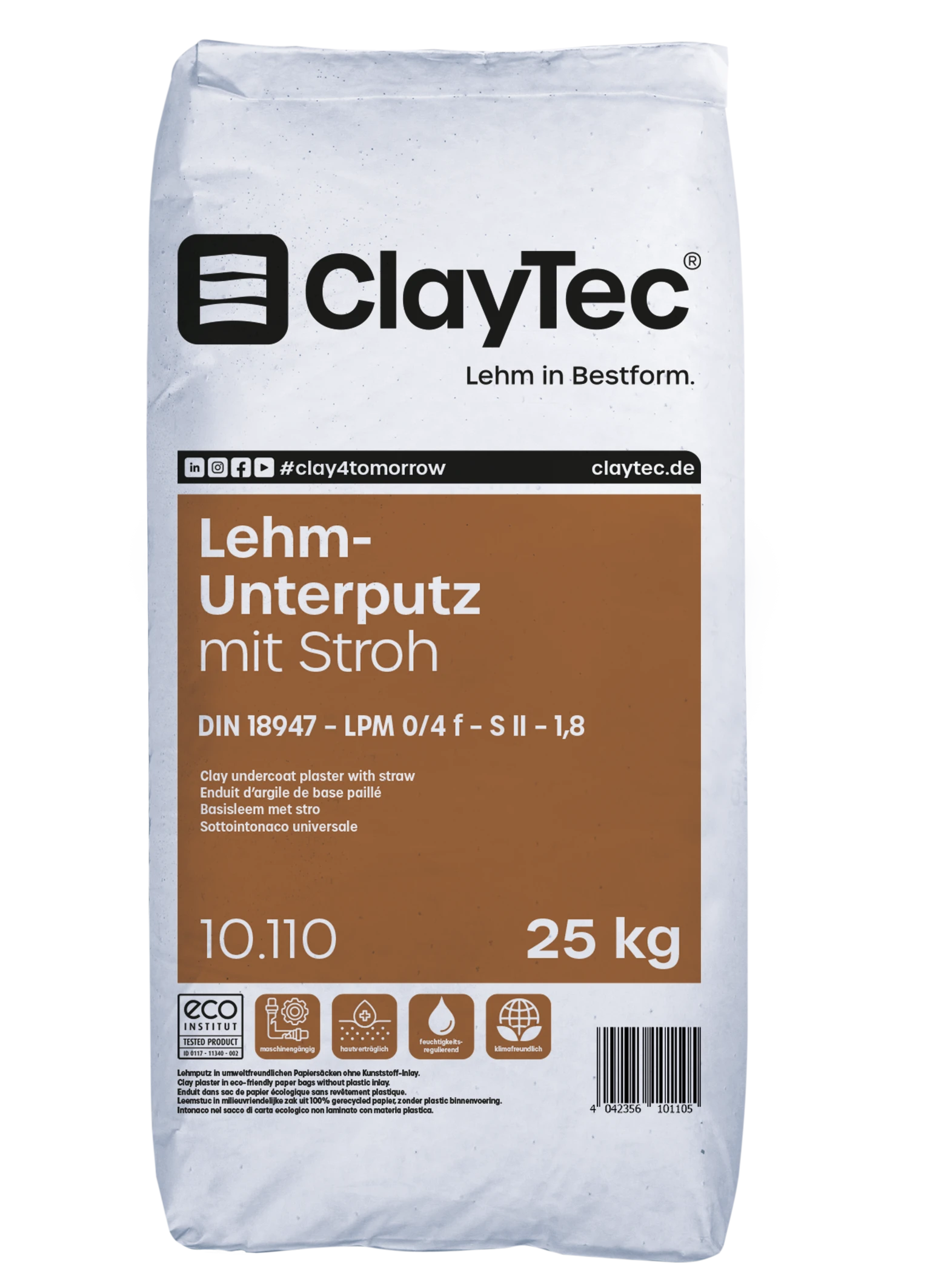
Coarse clay base coat plaster with straw
For 40 years the classic clay base plaster from ClayTec for thick layers, e.g. on unev…
from20,99 €
Rough, absorbent brick masonry is the simplest plaster base for clay: sweep, pre-wet sparingly, apply base plaster. Smooth blocks such as sand-lime elements or highly insulating bricks, on the other hand, need a primer with coarse grain. In both cases what matters is that the masonry is dry. Here I set out how I assess both types of block and how thickly they are plastered.
On rough brick the build-up starts with the base plaster. You only need DIE ROTE on smooth blocks.
For 40 years the classic clay base plaster from ClayTec for thick layers, e.g. on unev…
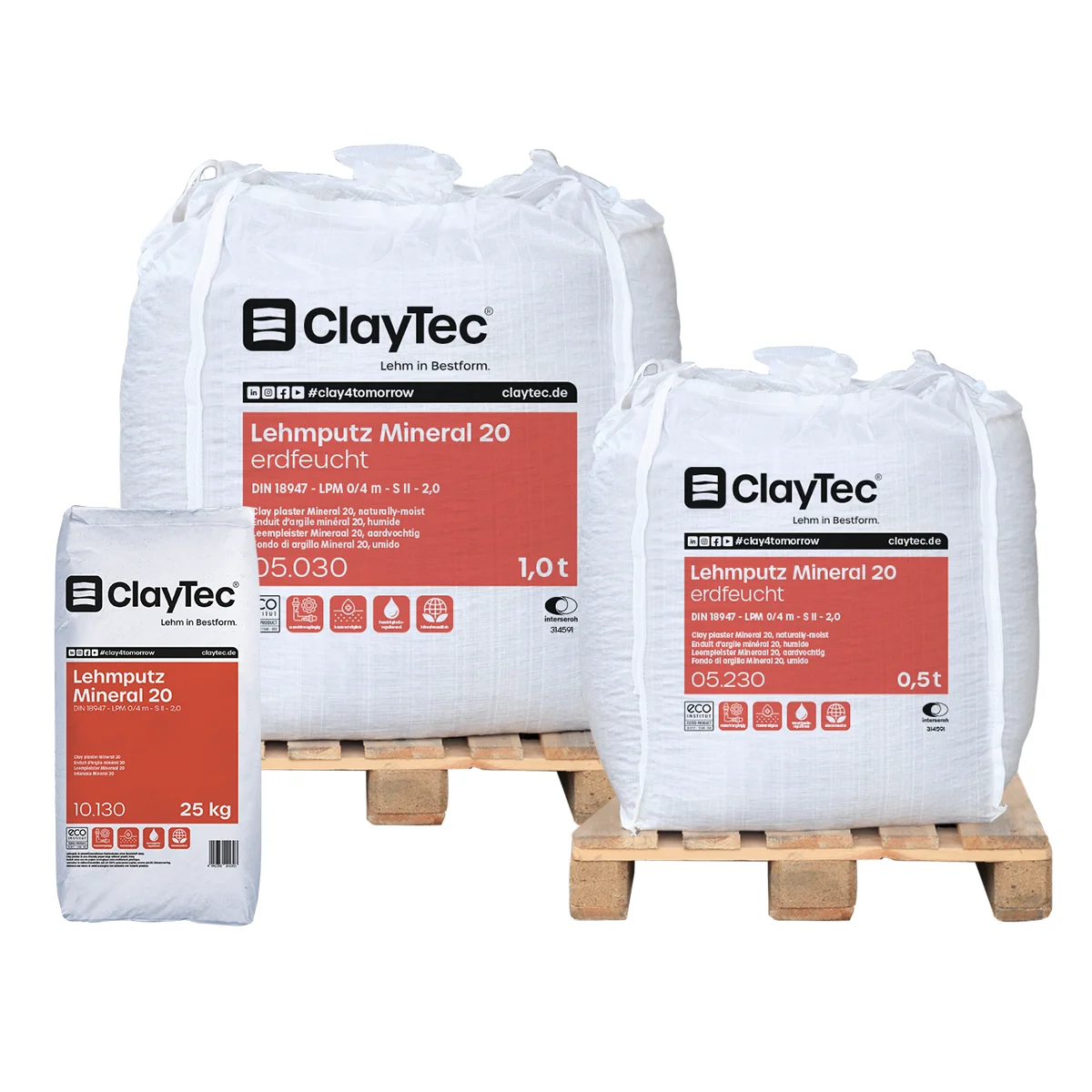
Mineral base and finishing plaster, dry, for maximum flexibility and unlimited stor…
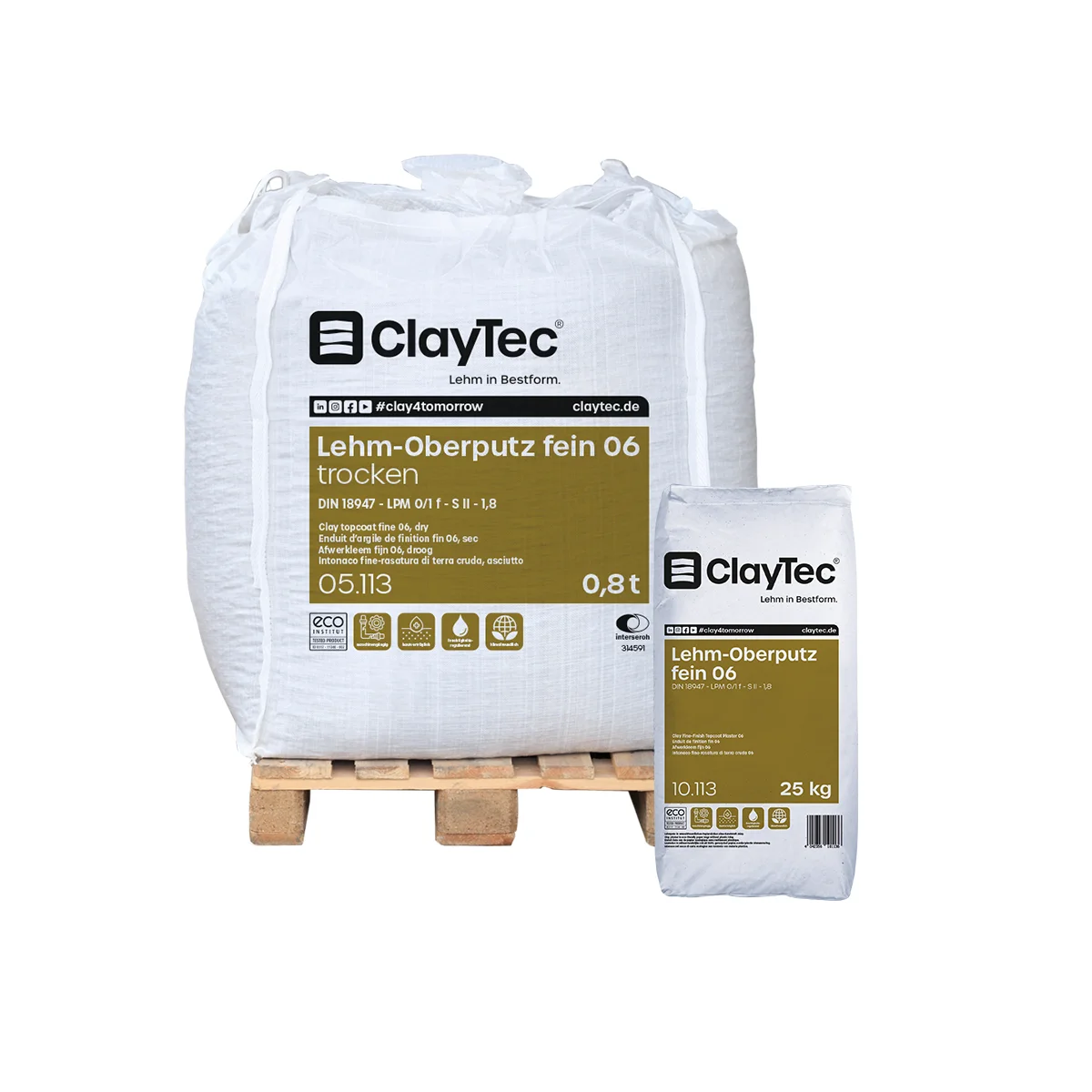
Fine thin-layer plaster for final coats 2–3 mm thick.
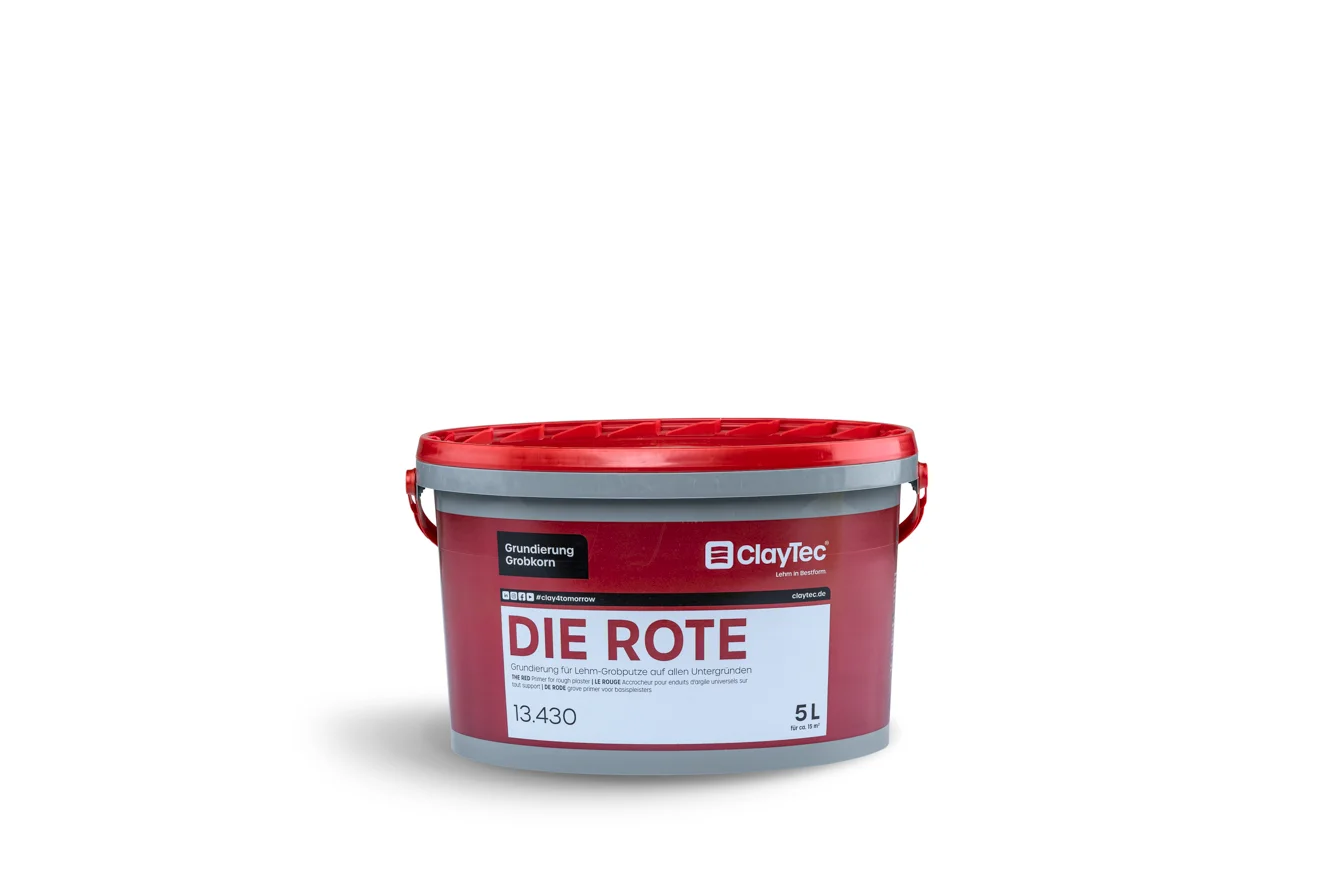
Coarse-grained bonding primer before coarse clay plaster mortars, for grip on smooth and…

For clay plaster, the surface matters more than the block. The ClayTec work sheet on clay plasters assigns masonry with mortar pockets and deep grooves to the coarse clay mortars, i.e. plasters with a grain from 1 mm. The mortar keys into grooves, pockets and rough joints without further help.
Bonded thin-joint masonry, on the other hand, has a level surface with thin joints. The work sheet lists it under the fine clay mortars. The manufacturer explicitly names sand-lime elements and highly insulating bricks as smooth or poorly absorbent surfaces on which the primer DIE ROTE provides grip and plaster adhesion.
Blocks that have become wet in storage or in the shell construction hold the water for a long time. The work sheet explicitly names brick, sand-lime brick and aerated concrete in connection with residual moisture. Otherwise the plaster only dries towards the room and stays soft for a long time.
I look particularly closely at the base of the wall. The dryness of the areas near the floor must be ensured. Permanently damp and therefore often salt-laden walls cannot be plastered with clay. An exception is sacrificial plaster: it absorbs salts from the masonry and is then removed again.
I sweep old brick masonry thoroughly and remove loose mortar residues. The plaster base should be clean and load-bearing. I rake out sanding joints until firm mortar appears.
Then pre-wet, sparingly, with a spray mist. This binds the dust and extends the time in which the mortar can be worked. Too much water does harm: if it stands in the pores of the surface, it hinders the bond and delays drying. The wall should be matt damp and not shiny.
Sooty areas permeated with tar on old chimney flues are a special case. Such sooted surfaces must be sealed before plastering, otherwise they bleed through.
Sand-lime brick is dense and smooth, large-format elements all the more so. Here I prime with DIE ROTE. It is applied generously with a short-pile roller or brush and must dry completely, at least 48 hours. A 10 l bucket covers about 25 m².
Fresh sand-lime brick is also strongly alkaline. If the wall is later to get a dark or strongly coloured clay design plaster or clay paint, the work sheet requires fluating, i.e. neutralising the surface. The work sheet links this requirement to dark and strong shades.
On level, coarse, grippy masonry, a single-layer plaster with coarse clay mortar is possible. You need two layers for defects and depressions, for unevenly absorbent substrates, when the necessary thickness cannot be achieved in one layer or when a mesh is embedded.
Clay base coat plaster with straw is usually applied at 8 to 15 mm per layer. Depending on the substrate, up to 35 mm per layer are possible according to the product sheet. Clay plaster Mineral 20 is applied as base plaster at 5 to 15 mm per layer. Always check the upper limit with a work sample on your wall.
It is different on primed surfaces: where DIE ROTE provides the grip, for example on sand-lime elements, the total plaster thickness is at most 10 mm. For plaster adhesion that is largely independent of the block, the work sheet provides for a plaster base, for example reed mesh. As a fine surface, clay top plaster fine 06 follows at 2 to 3 mm.
A concrete lintel in brick masonry, a ring beam, a bricked-up opening of a different stone: at every change of material, the building materials move differently. There and on mixed substrates, a reinforcing mesh belongs in the plaster. The same applies under thermal load, i.e. at stoves and with wall heating.
The fabric is placed on the still wet base plaster and worked in immediately. ClayTec states for this Glass fabric with 65 or 112 g/m² and jute fabric. The strips overlap at the joints.
For base plaster with straw, a 25 kg sack covers about 1,1 m² at 15 mm thickness. Mineral 20 as sacked goods gives about 1,35 m² at 10 mm. For larger areas the big bag is worthwhile; for base plaster with straw it is also available earth-moist.
On well-absorbing masonry under favourable conditions, a 1 cm thick layer can be worked further after about a week. Ensure air exchange during this time. The next layer only follows on a fully dried base coat.
| Masonry | Preparation | Plaster | Thickness |
|---|---|---|---|
| Bricks with a rough surface, grooves or mortar pockets | Sweep, pre-wet sparingly | Clay base coat plaster with straw | 8 to 15 mm per layer |
| High-insulation brick, smooth or poorly absorbent | DIE ROTE | Coarse clay plaster | at most 10 mm in total |
| Sand-lime brick elements | DIE ROTE; with a dark finish, fluate beforehand | Coarse clay plaster | at most 10 mm in total |
| Glued precision blocks, level | If needed, DIE GELBE | Clay finishing plaster fine 06 | 2 to 3 mm |
Between the Weser and the Elbe, a lot of masonry is built with brick and sand-lime brick, in old buildings as well as new ones. You can collect base plaster, primer and mesh at the specialist shop in Achim. The haulier delivers big bags directly to the building site.
You will find base plaster, finishing plaster and primer for your masonry together on the purchase page. There you calculate the quantity via area and plaster thickness.
Buy clay plasterOn rough, absorbent brick with grooves or open joints, usually not. There, sweeping and sparing pre-wetting are enough. Smooth or poorly absorbent high-insulation bricks are primed with DIE ROTE.
The manufacturer names sand-lime brick elements as a smooth, poorly absorbent surface on which DIE ROTE provides grip and plaster adhesion. That is why I always prime sand-lime brick.
Clay base coat plaster with straw usually 8 to 15 mm per layer. On surfaces primed with DIE ROTE, the total plaster thickness is at most 10 mm.
Too much water remains as standing water in the pores of the surface. This hinders the bond and delays drying. A spray mist that binds the dust is enough.
Products in the shop
Knowledge articles
To take away: the free clay building diary with drying log.
Download free of charge