


fast delivery
Clay filler and surface filler natural
Smooth surfaces with filler, naturally!
from40,99 €
SKU: 10.113| EAN: 4042356101136
Gross price incl. 19 % VAT(0,96 €/kg)
Fine thin-layer plaster for final coats 2,3 mm thick.
Volume discount for full pallets
Deducted automatically in the basket.
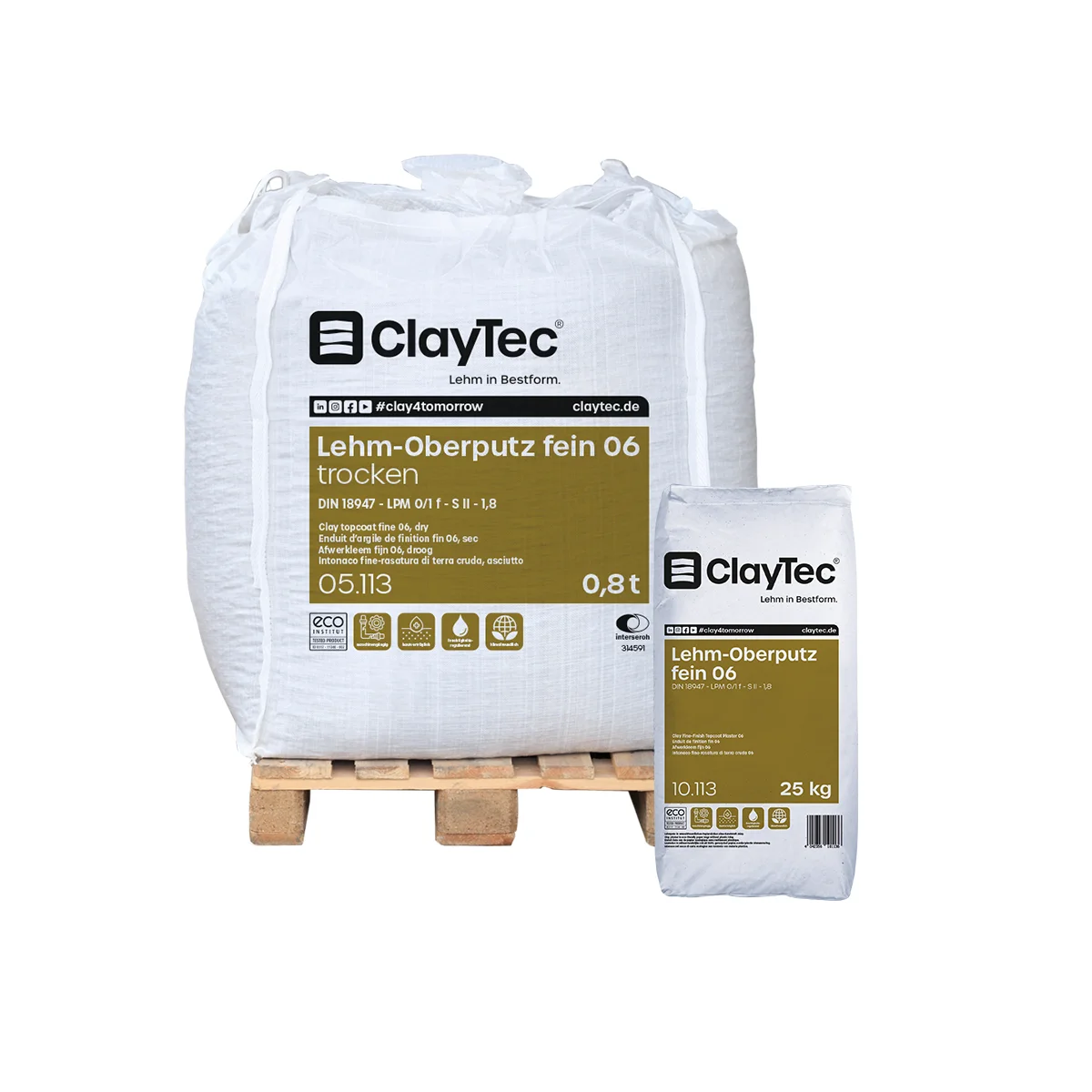
Dry: 800 kg big bag (item 05.113) or 25 kg sack (item 10.113)
Prepare the mortar with approx. 20–23 % water added (5–6 l per 25 kg sack) with a power whisk or by hand, in large quantities with a free-fall, pan or trough forced-action mixer. Draw on with the trowel or spray on with the plastering machine. Application thickness 2–3 mm. The texture becomes finer the more the mortar has set during working; rubbed surfaces with a sponge, plastic or wooden float, smooth ones with the smoother. As no chemical setting process takes place, it stays workable for several days when covered. Clay plasters adhere only mechanically. The substrate must be load-bearing, frost-free, dry, clean, free of salt contamination, sufficiently rough and absorbent. If necessary, primer DIE GELBE for fine clay plasters (ClayTec 13.425-.420). Clay base plaster must be thoroughly dry. Pre-wetting with a spray mist extends the working time. Suitable on ClayTec clay base plaster, clay boards and other sufficiently level surfaces of suitable building materials.
Further plastering, e.g. with YOSIMA clay design plaster, takes place after the previous layer has dried completely, at the earliest once any shrinkage cracking has ended. Thin-layer applications 2–3 mm thick dry in approx. 24–48 hours. During application and surface finishing, avoid heating air and draughts, otherwise areas dry at different speeds.
Can be stored dry indefinitely.
25 kg sack (10.113): makes 17 l of plaster mortar for approx. 5,7 m² at 3 mm. 0,8 t big bag (05.113): makes 544 l of plaster mortar, approx. 182 m² at 3 mm. Approx. 1,47 kg/m² per mm of plaster thickness. Coverage at 2 mm: 25 kg sack approx. 8,5 m², 0,8 t big bag approx. 272,0 m².
Values for the selected variant: Sacked goods 25kg
| Grain size | 0/1 mm (oversize < 2 mm) |
| Fibres | Natural fibres (cellulose) |
| Coverage per sack | 5,7 m² |
| Reference layer thickness for consumption | 3 mm |
| Consumption at 1 mm | 1,47 kg/m² |
| Maximum layer thickness | 3 mm |
| Minimum layer thickness | 2 mm |
| Recommended layer thickness | 3 mm |
| Abrasion | 0,4 g |
| Bond strength | 0,10 N/mm² |
| Flexural strength | 0,9 N/mm² |
| Compressive strength | 2,0 N/mm² |
| Strength class | S II |
| Fire behaviour (EN 13501) | A1 |
| Thermal conductivity λ | 0,91 W/mK |
| Water vapour diffusion resistance μ | 5/10 |
| Sorption class (water vapour) | WS III |
| Application thickness | 2–3 mm |
| DIN standards | DIN 18947 – LPM 0/1 f – S II – 1,8 |
| Bulk density class | 1,8 |
| Shrinkage | 4,0 % |
| Material composition | Building clay, mixed-grain washed sand 0–0,6 mm, fine fibres (cellulose fibres) |
| Special notes | A coat is usual, also for surface consolidation, with ready-to-use ClayTec clay paint (13.005) or the ClayFix clay paint system; because of the natural raw materials, colour accuracy cannot be guaranteed. For YOSIMA clay colour filler (0,1–0,2 mm), clay top plaster fine 06 is pre-treated with primer DIE WEISSE. Check substrate suitability, application thickness and surface effect on a sufficiently large work sample. |
| Application | Hand or machine plaster |
| Water addition | approx. 20–23 % (5–6 l per 25 kg sack) |
| Units per Euro pallet | 48/Euro pallet |
To go with it: my free clay building diary with drying log.
Download free of chargeFurther expert knowledge
Finishing plaster in the clay plaster system, application and layers are explained in the article Building up clay plaster: base coat, finishing coat and fine plaster.
Clay plaster in interior finishing, its use and effect are explained in the article Clay in interior finishing: a healthy indoor climate with natural building materials.