

Bestseller
fast delivery
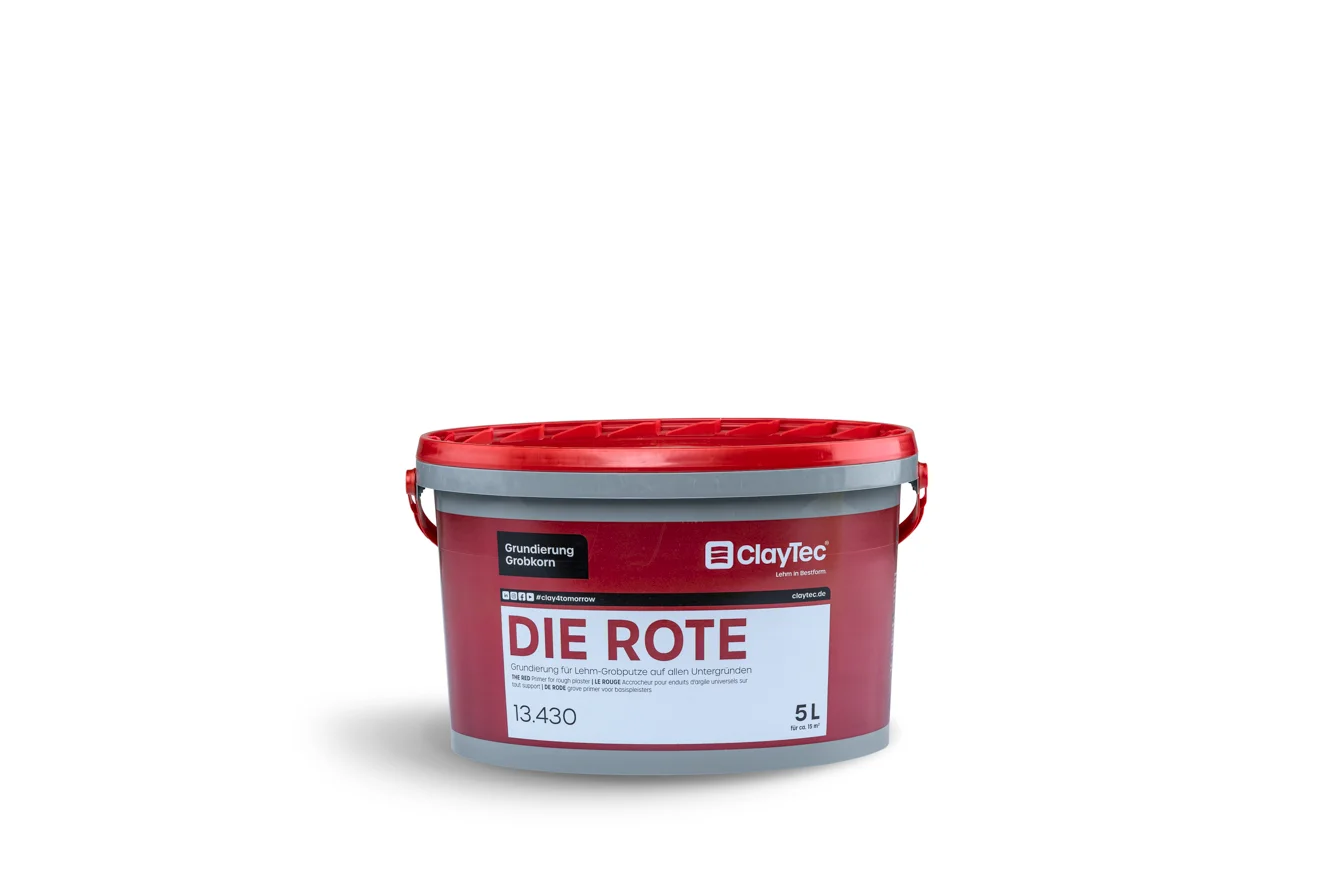
Primer DIE ROTE coarse
Coarse-grained bonding primer before coarse clay plaster mortars, for grip on smooth and…
from49,99 €
Clay plaster holds on concrete if three things are right: the concrete has dried through, the surface is free of formwork oil and sinter skin, and a grained primer gives the mortar grip. Then it is plastered thinly. The manufacturer limits the application on concrete to 6 or 10 mm depending on the mortar. I show you how I prepare concrete walls and concrete ceilings and which build-up suits them.
First the primer with grain, then the plaster in the thickness that concrete allows. DIE ROTE for coarse plasters, DIE GELBE for the thin fine plaster.
Coarse-grained bonding primer before coarse clay plaster mortars, for grip on smooth and…
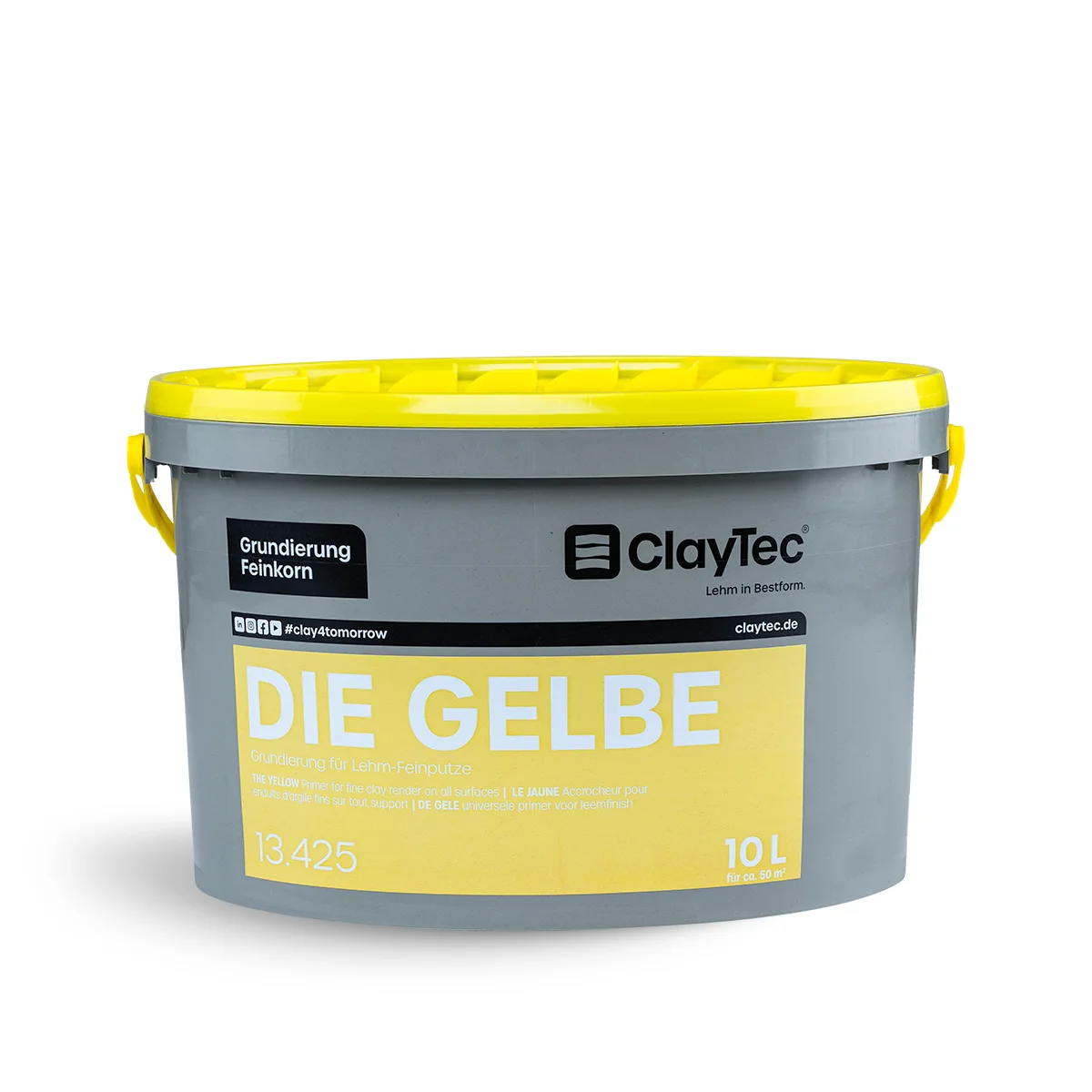
Fine-grained bonding primer before fine clay plasters and YOSIMA clay design plaster, the bind…
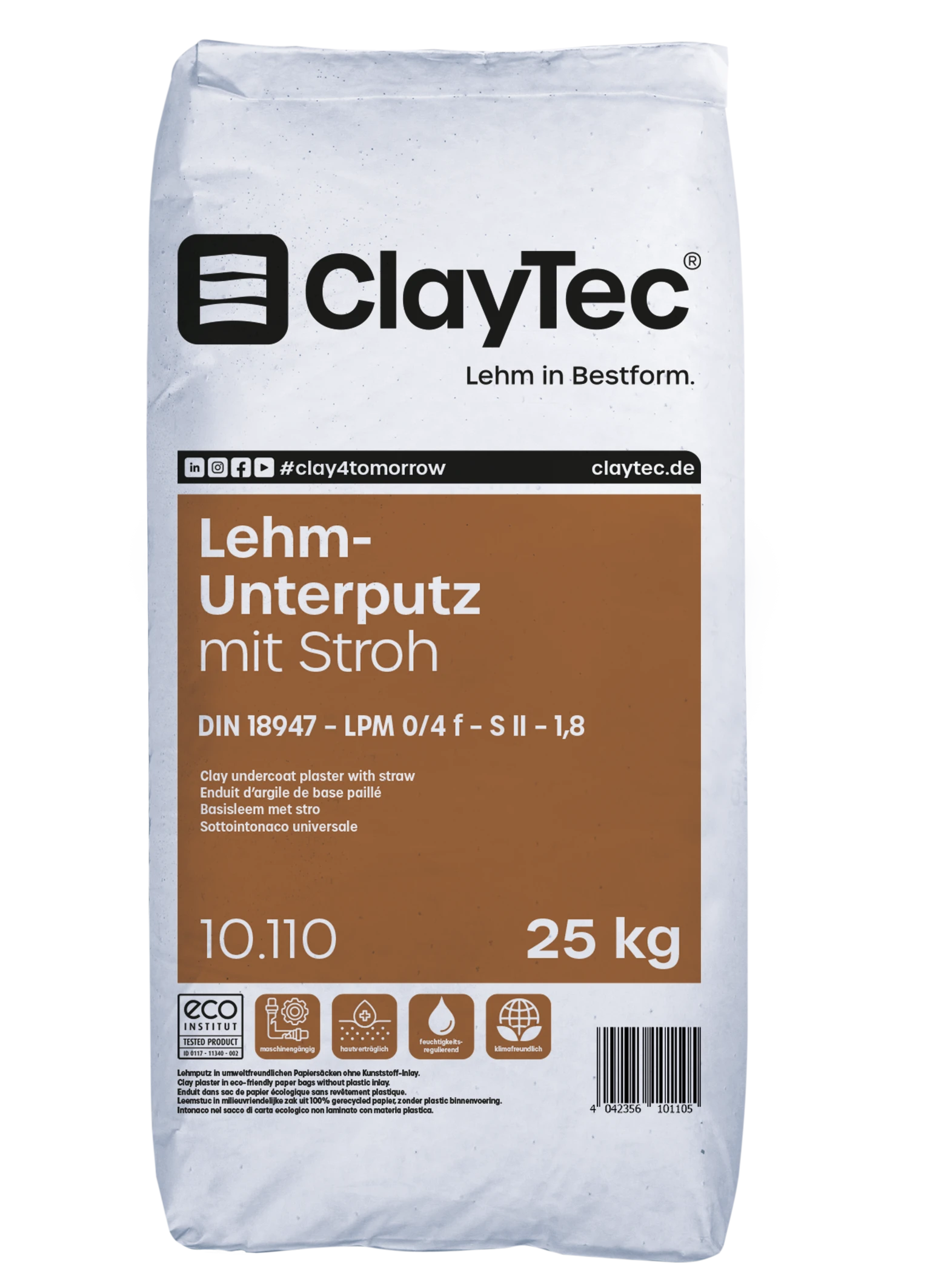
For 40 years the classic clay base plaster from ClayTec for thick layers, e.g. on unev…
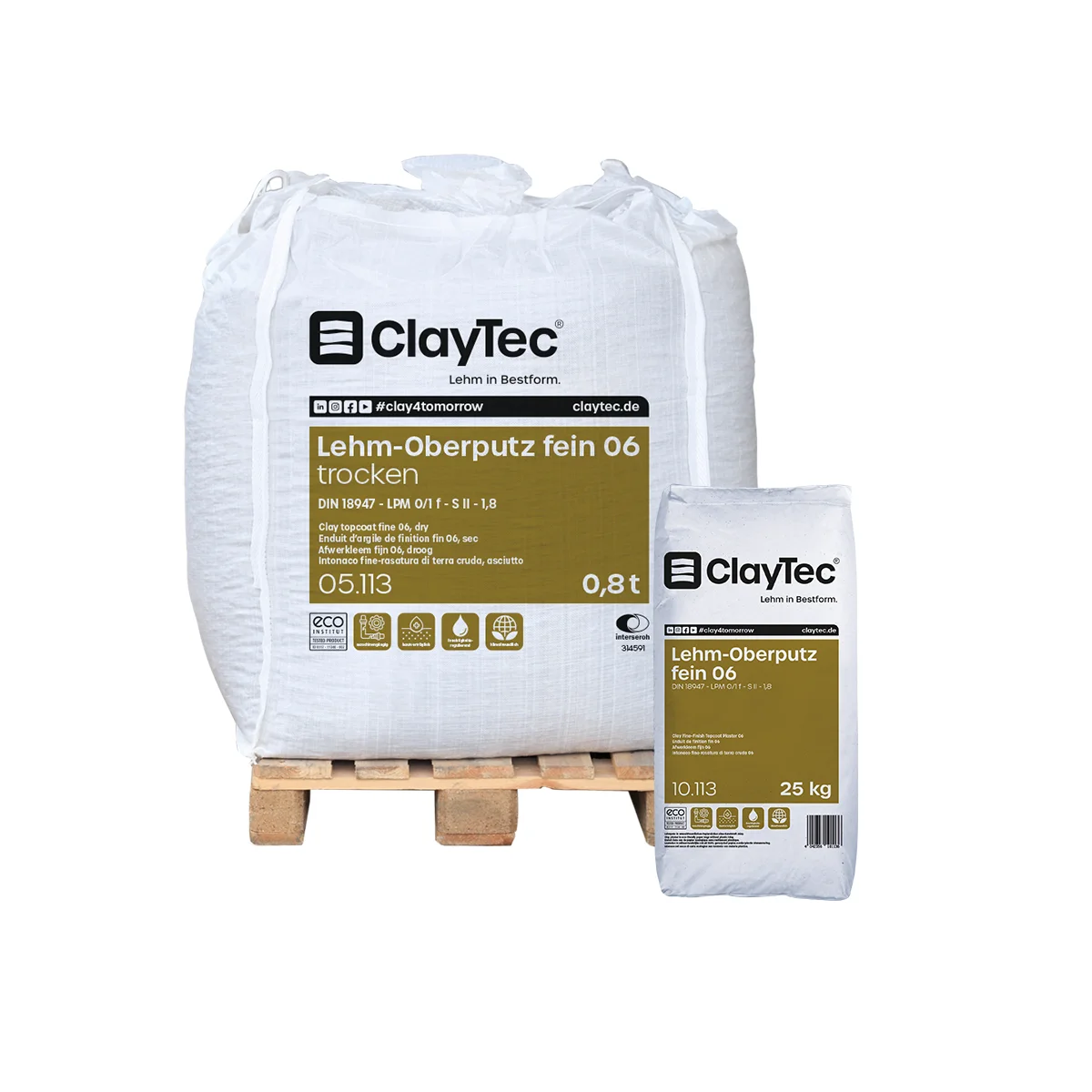
Fine thin-layer plaster for final coats 2–3 mm thick.

Clay plaster does not set chemically. It dries out and holds on in the pores and irregularities of the wall. A formed concrete surface offers little of this: it is smooth, dense and absorbs hardly any water.
ClayTec therefore lists concrete among the smooth and poorly absorbent surfaces for which a primer with grain is intended. The work sheet on clay plasters explicitly names „concrete primed with coarse grain“ as a suitable plaster base for coarse clay mortars. Without this grain the mortar lacks grip.
The manufacturer's basic rule applies to every plaster base: load-bearing, frost-free, dry, clean, sufficiently rough and absorbent. With concrete, dryness is the main factor. Residual moisture in the component must not delay the drying of the plaster, and the work sheet names concrete first here.
Movement and shrinkage of the component must be complete. Permanently damp components, which often also carry salts, cannot be plastered with clay. This applies above all to cellar walls in contact with the ground. There is nothing against a dry living room wall or a concrete floor slab.
Residues of formwork oil must be washed off, otherwise a separating film lies between concrete and primer. Fresh concrete surfaces also often carry a sinter skin, a thin, dense layer on the surface. The product data sheet on primers counts them among the strongly alkaline surfaces that must be properly fluated, i.e. neutralised.
Alkalinity also matters for colour. If you are planning a dark or strongly coloured clay design plaster or clay paint as the surface, the work sheet requires fluating fresh concrete in every case. Both requirements refer to fresh concrete. With old concrete surfaces in existing buildings, check above all for dust, paint residues and loose areas.
The grain of the primer depends on the plaster that follows. For coarse clay plasters such as the base plaster with straw or Mineral 20 I use the Primer DIE ROTE from ClayTec. DIE GELBE is intended for fine clay plasters with a grain below 1 mm and for YOSIMA clay design plaster.
Both are stirred thoroughly and applied generously and over the full surface with a short-pile roller or brush. Stir again during work so that the grain is distributed evenly. Up to 5 % water may be added. The concrete should be between 5 and 25 °C.
A 10 l bucket of DIE ROTE covers about 25 m², the 5 l bucket about 12,5 m². DIE GELBE goes further: 10 l for about 55 m², 5 l for about 27,5 m². Plastering only begins once the primer is completely dry, no earlier than after 48 hours. Important for planning: the primers do not consolidate and do not seal anything. They provide grip only.
Tighter limits apply on concrete than on masonry. Clay base coat plaster with straw, which otherwise tolerates 8 to 15 mm per layer, may only be 10 mm thick on concrete. For clay plaster Mineral 20, the product sheet states on concrete only 6 mm. In addition, for all surfaces prepared with DIE ROTE: the total plaster thickness is at most 10 mm.
In practice this means: on concrete you do not level out large unevenness with clay. If the surface is even, the thin route is often enough. Then on DIE GELBE comes a layer Clay finishing plaster fine 06 from 2 to 3 mm. One 25 kg sack covers about 5,7 m².
For base plaster with straw, allow about 1,5 kg of sacked goods per square metre and millimetre, i.e. about 10 kg/m² at 15 mm. Mineral 20 as sacked goods needs about 1,85 kg per square metre and millimetre, a good 6 kg/m² at 11 mm.
Overhead, the same upper limits apply as on concrete in general: 10 mm for the base plaster with straw, 6 mm for Mineral 20. The work sheet also recommends plastering ceilings preferably thinly.
On a level concrete ceiling, the thin build-up of DIE GELBE and top plaster fine 06 is therefore usually the better choice. It puts little weight on the ceiling and dries quickly. With filigree slabs with visible joints between the panels, you should clarify beforehand whether the joints are firmly filled and no longer move.
As a guide, ClayTec states: a 1 cm thick layer on a well-absorbing substrate can be worked further after about a week under favourable conditions; thin layers of 2 to 3 mm dry in about 24 to 48 hours. Concrete hardly absorbs. The water has to escape almost entirely via the indoor air, so plan more time and ventilate well.
Before the whole surface, make a sample with exactly the build-up of primer and plaster that you will use later. The manufacturer requires this work sample in every case, and on concrete it shows most quickly whether adhesion and thickness are right. It should be large enough for you to tap it and check the edges after drying.
| Build-up | Primer | Plaster | Thickness on concrete |
|---|---|---|---|
| Thin, for even surfaces and ceilings | DIE GELBE | Clay finishing plaster fine 06 | 2 to 3 mm in one layer |
| Coarse, with straw content | DIE ROTE | Clay base coat plaster with straw | at most 10 mm |
| Coarse, mineral | DIE ROTE | Clay plaster Mineral 20 | at most 6 mm |
The primers and clay plasters for concrete surfaces are ready in my specialist shop in Achim near Bremen. If you are unsure whether your concrete wall is dry enough, bring a photo and the key data on the year of construction, and we will look at the build-up together.
With concrete a lot depends on residual moisture and the surface. If you tell me the year of construction, area and desired surface, I'll tell you which of the two build-ups suits your wall.
Request a consultationFor coarse clay plasters the primer DIE ROTE, for fine clay plasters under 1 mm grain and for YOSIMA clay design plaster DIE GELBE. Both give smooth concrete a granular, grippy surface.
Clay base coat plaster with straw at most 10 mm, clay plaster Mineral 20 at most 6 mm. On surfaces primed with DIE ROTE, the total plaster thickness is at most 10 mm.
Yes, with a granular primer and thin application. The manufacturer recommends plastering ceilings preferably thinly. DIE GELBE with 2 to 3 mm of clay finishing plaster fine 06 has proven itself.
According to the manufacturer, fresh concrete surfaces with a sinter skin must be fluated. This also applies if a dark or strongly coloured clay design plaster or clay coating is planned on fresh concrete.
Products in the shop
Knowledge articles
To take away: the free clay building diary with drying log.
Download free of charge