
When clay does not work: limits, mistakes and decision rules

Clay is one of the highest-performing building materials indoors, and at the same time one of the most uncompromising. It works excellently, but only in certain areas of use. Using it outside these limits risks cracks, loss of adhesion or system failure. This article shows where clay is clearly suitable, where it only works under conditions and where it will certainly fail, with a matrix by area of use, the building physics reasons and specific decision rules for practice.
Suitability matrix: five check questions before every clay plaster project
All five questions must be answered with yes. Otherwise clay plaster is not suitable
| Test question | Yes: clay possible | No: no clay | Alternative |
|---|---|---|---|
| Is the substrate permanently dry? | Dry masonry, no water damage | Rising damp, active water damage | Renovation plaster, drainage protection first |
| Not a wet area (bathroom, shower)? | Living rooms, bedrooms, hallways | Direct splash water zone | Lime plaster or tiles |
| Is the substrate absorbent? | Brick, clay plaster, wood with plaster base | Glass, metal, loose old coatings | Bonding bridge or change of material |
| No permanent contact with the outside? | Complete interior | Unprotected exterior wall, balcony | Lime plaster or cladding |
| Layer thickness realistic (max. 35 mm per layer)? | Multi-layer, with drying times | Applied all at once | Multi-layer with reinforcing mesh |
| Area of use | Suitability | Requirements | Exclusion criterion if not met |
|---|---|---|---|
| Interior plaster on absorbent, dry masonry | Clearly suitable | Permanently dry substrate | Rising damp → plaster becomes soft and falls off |
| Interior plaster on plasterboard | Partly suitable | Special clay primer + plaster base | No hold without primer, shrinkage stresses cause detachment |
| Interior plaster on concrete (smooth) | Partly suitable | Bonding primer DIE ROTE coarse mandatory | On smooth concrete, no keying is possible without preparation |
| Bathroom (outside the wet zone, well ventilated) | Possible to a limited extent | Away from splash water, active ventilation | Poor ventilation → permanent moisture → loss of adhesion |
| Bathroom wet zone / shower | Unsuitable | – | Direct contact with water dissolves the clay structure |
| Cellar with rising damp | Unsuitable | – | Persistent supply of moisture destroys plaster over time |
| Exterior wall without roof overhang | Unsuitable | – | Driving rain and driving rain suction, no weather resistance |
| Exterior wall with roof overhang > 60 cm (historic) | Historically possible, not recommended today | Protected location, regional tradition | In the modern standard: lime plaster or silicate plaster preferable |
| Over emulsion paint | Partly suitable | Remove loose paint, pre-treat firm coatings with primer DIE ROTE coarse | Vapour-retarding layer: no hold, no diffusion possible |
The basic physical rule: what clay can and cannot do
Clay is vapour-permeable, capillary-active and water-soluble. This means it can absorb moisture and release it again. But it must not remain permanently damp. This is exactly the decisive limit that determines every use of clay.
Vapour permeability is clay's strength: water vapour from the indoor climate is absorbed and released again when the air is dry. This regulates the relative humidity in the room. But this property only works if the clay can also get rid of the moisture it has absorbed.
Capillary activity means that clay transports moisture through fine pores. This is a property that makes it the ideal building material for historic masonry. At the same time, it makes clay vulnerable to permanent moisture loads: it absorbs water and releases it, but if more water is added than can be released, it loses its strength.
Where clay is clearly suitable: the clear areas of use
Interior plaster on absorbent, dry masonry is clay's core territory. Brick masonry, sand-lime brick, clay construction and natural stone with sufficient absorbency offer optimal adhesion conditions. The substrate must be permanently dry. No rising damp, no condensation, no soaking from driving rain outside. When these conditions are met, clay plaster outperforms many conventional systems: it regulates humidity, absorbs odours and pollutants and can be repaired almost indefinitely.
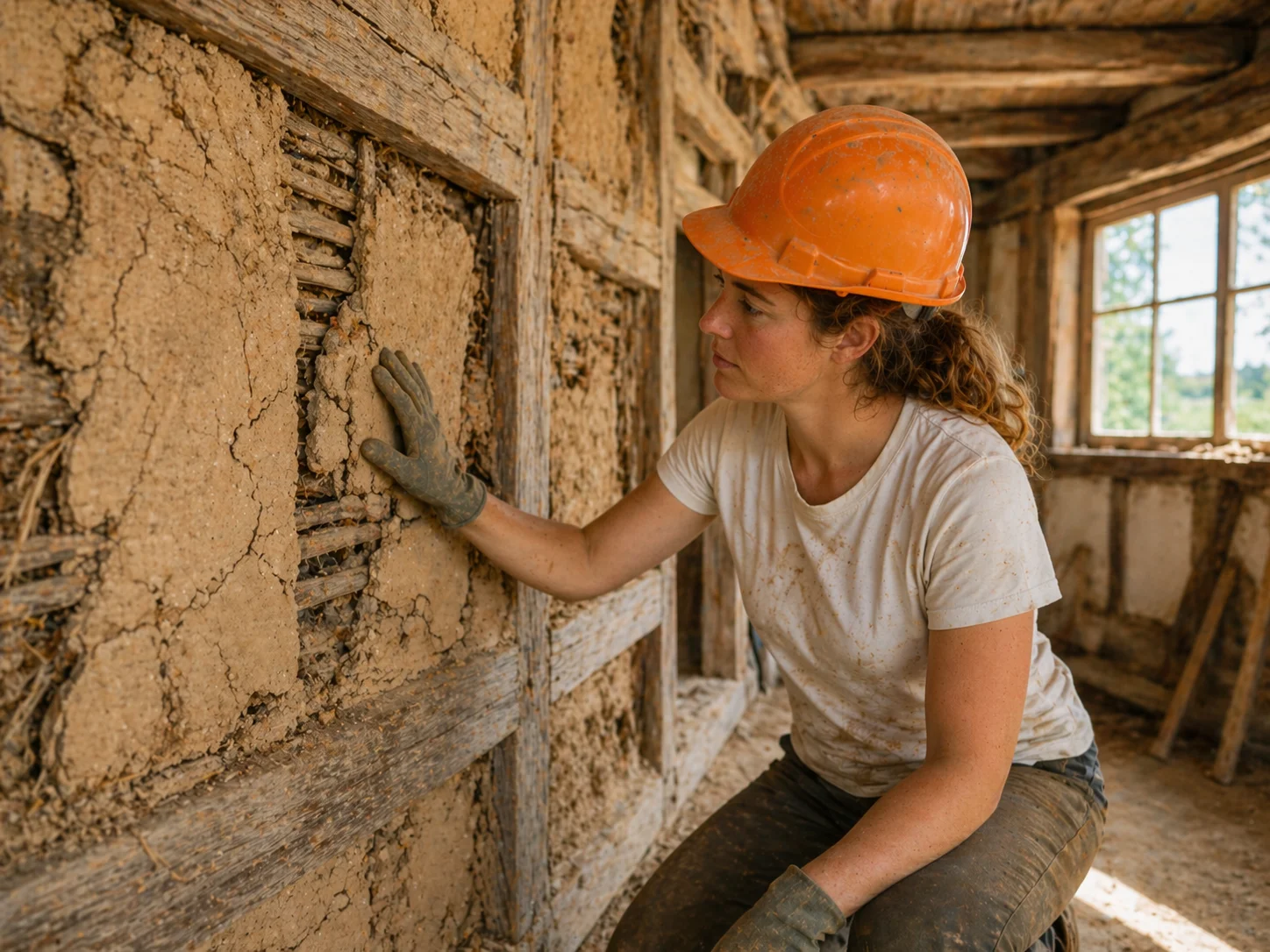
Finishing plaster and fine plaster in living rooms, bedrooms and children's rooms, on walls not directly adjacent to moisture loads, are ideal applications. The same applies to historic timber frame buildings, where clay suits the structure in terms of building physics: vapour-permeable like the timber, capillary-active like the historic panel materials, without vapour barriers or retarders that disturb the building's moisture system.
Clay is also clearly suitable as clay mortar for panel infills in timber framing, as Rammed clay for floor coverings in dry rooms and as spray clay as a plaster base on prepared substrates. These applications are tested in terms of building physics, anchored in the DVL clay building rules and proven in practice for centuries.
Clay, lime and cement compared: properties and system compatibility →
Decision guide: five check questions before every clay plaster project
Before a clay plaster project starts, five concrete check questions are worthwhile. Each one can fundamentally influence the project.
First: is the substrate permanently dry? Rising damp, condensation or soaking from driving rain rule out clay. The cause must be eliminated first. Second: how absorbent is the substrate? Smooth concrete, tiles and emulsion paint require system preparation (bonding primer such as DIE ROTE coarse, plaster base if needed), otherwise clay will not adhere. Third: is there splash water? Wet zones, plinth areas and entrance areas without protective measures rule out clay plaster. Fourth: are there material transitions? At transitions between timber and masonry, or between concrete and brick, I consider Reinforcing mesh mandatory, otherwise cracks arise exactly at these points. Fifth: can sufficient drying time be planned? Heating operation, winter and time pressure considerably increase the risk of cracks.
If all five check questions can be answered positively (dry substrate, suitable surface, no splash water, transitions reinforced, sufficient drying time), clay is the right building material. It lasts for decades, can be repaired, measurably improves the indoor climate and is harmless in terms of building biology.
Exclusion criterion 1: permanent moisture in the wall
Rising damp in old buildings, wet cellar walls and leaking external walls are situations in which clay must not be used. If the substrate keeps supplying moisture, clay plaster loses its strength over time and becomes soft and unstable. A typical example: an old building from 1920 with brick masonry without a functioning horizontal damp-proof course permanently draws ground moisture into the wall. If this wall is plastered with clay, the plaster crumbles after months.
The solution lies in the substrate, not in the plaster: first the cause of the moisture must be eliminated, with a new horizontal damp-proof course, drainage or technical drying. Only when the substrate is permanently dry is clay plaster a suitable option.
Exclusion criterion 2: direct contact with water
Clay in the shower area, in the plinth area outside or in the entrance area without splash protection reliably leads to failure of the plaster. On direct contact with water, the clay structure dissolves. This also applies to unprotected outdoor areas: driving rain and standing moisture are permanently damaging for clay plaster without a far-projecting roof overhang.
In the bathroom, clay is possible on wall surfaces outside the wet zones if the room is well ventilated. Clear zoning applies: the shower area and permanently wet surfaces get lime or tiles. The remaining wall area can be finished with clay plaster.
Exclusion criterion 3: unprepared dense substrates
Smooth concrete surfaces, surfaces with emulsion paint, tiles and unprimed plasterboard are substrates on which clay plaster does not adhere without preparation. Adhesion between clay and substrate results from mechanical keying and from similar absorbency.
On a dense, non-absorbent substrate, clay cannot build up this mechanical bond. It only lies on the surface and detaches after a short time due to shrinkage stresses during drying.
The solution for these substrates is a defined system build-up: applying a grained bonding primer such as DIE ROTE coarse, if necessary a plaster base of reed mesh, and only then the plaster system. On plasterboard a special clay primer is also necessary. Without this build-up, using clay is not advisable.
Cracks: the most common symptom and its causes
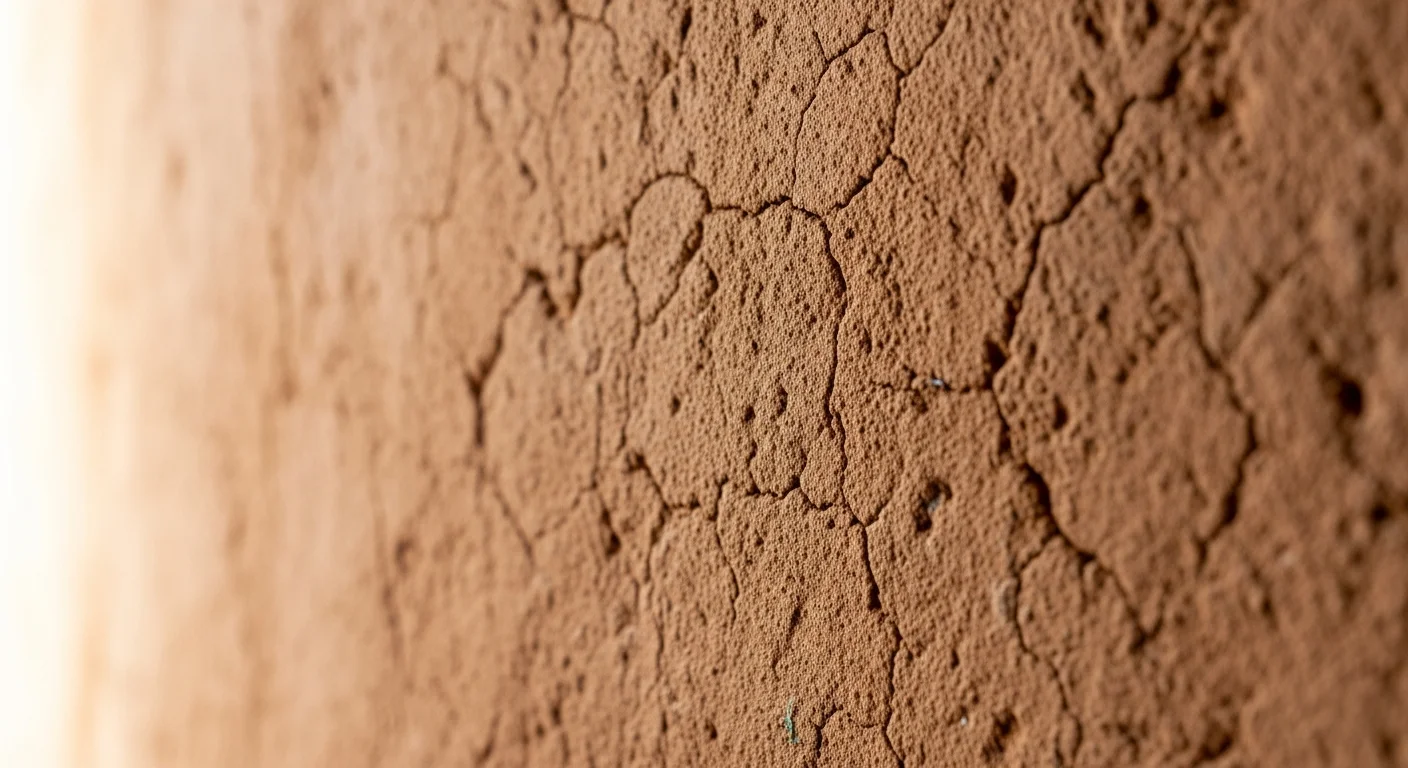
Cracks in clay plaster are the most common reason why the material is classed as problematic. However, the cause almost never lies in the material but in the system build-up or the application.
Clay shrinks as it dries; that is a physical property of clay minerals. If this drying process is not controlled, stresses arise in the plaster that show as cracks. Drying too quickly due to direct sunlight, draughts or too high a heating temperature makes the surface dry faster than the layer beneath. The resulting stresses are unavoidable.
Layers that are too thick in one application lead to uneven drying and deep stress cracks. As a guide, at most 35 millimetres per application apply to coarse clay base plaster with straw, and at most 10 millimetres to top plaster. Missing reinforcement at transitions between different materials, for example between timber beams and masonry, does not allow stresses to be distributed. The cracks then appear exactly where two materials meet.
Fine hairline cracks on the surface are normal and not a quality defect. They can be reworked with a clay slurry or fine plaster. Wide, continuous cracks and cracks at material transitions, on the other hand, are signs of a system error that must be corrected at the cause.
Clay and modern building materials: incompatible combinations
Clay works best in open, vapour-permeable systems. Many modern building materials are the opposite: dense, diffusion-inhibiting layers that block moisture transport.
A common combination with serious consequences is clay plaster under emulsion paint. The emulsion paint forms a vapour-tight film on the surface. The clay can no longer release the moisture it has absorbed. The moisture builds up in the plaster system, the indoor climate deteriorates and the risk of mould rises, even though clay as a building material is naturally more mould-resistant than conventional plaster.
Cement plaster as a substrate for clay plaster is also problematic. Cement is much denser than clay, has different elasticity properties and releases moisture differently. Stresses arise at the boundary layer that lead to the clay plaster detaching. Lime and silicate are the main plaster and paint partners that suit clay.
Incorrect drying: an underestimated system error
Clay dries physically, not chemically. This means the mixing water must escape from the plaster completely by evaporation. This process needs time and even conditions.
A common mistake on site: to speed up progress, the heating is turned up or heating starts before the plaster has dried through completely. The result is a layer that is dry on the outside while the deeper areas are still damp. When the damp layer finally dries, it contracts, and the outer layer, which is already firm, can no longer follow this movement. The result is deep stress cracks.
The right approach: let it dry slowly and evenly, ventilate regularly without creating a draught, and do not aim any direct heat source at the fresh plaster. These conditions are particularly hard to maintain in the cold season, which makes clay plastering more demanding in winter.
Typical planning errors in the Achim and Bremen area
In the Achim, Bremen and Verden area a recurring pattern can be seen: old buildings with surviving remnants of clay plaster are renovated without first clarifying the causes of moisture. Rising damp due to a missing horizontal damp-proof course, uninsulated cellar walls at risk of condensation and mixed substrates from renovation waves of different decades are the most common reasons why clay plaster does not work in the long term in these buildings. The region also has a comparatively high level of driving rain and partly sandy soils with high capillary transport. Anyone planning clay here must know the substrate, not only by visual inspection but by moisture measurement and, if necessary, drilling.
Frequently asked questions about uses and limits of clay
Can I use clay plaster in the cellar?
Only if the cellar is permanently dry and there is no rising damp. Clay is not suitable in cellars with moisture problems. Here an analysis of the cause and structural measures against the moisture are recommended first. After that, clay can be used once the cause of the moisture has been permanently eliminated.
Why is my clay plaster cracking although I used a ready-made product?
Ready-mixed clay plasters reduce mixing errors but do not protect against errors in the build-up. The most common causes: a layer too thick in one application (over 35 mm with coarse clay base plaster with straw, over 10 mm with top plaster), drying too quickly due to heating, sun or draughts, and missing reinforcement at transitions, for example between timber and masonry. Fine hairline cracks are normal and can be reworked with clay slurry or fine plaster.
Can I apply clay plaster over emulsion paint?
Yes, if the paint is firm. Loose or chalking emulsion paint must come off first. Firm, porous emulsion coatings may stay and are roughly pre-treated with the primer DIE ROTE; its coarse grain keys into the clay plaster and creates adhesion.
Sources and standards
Further links
Products in the shop
Knowledge articles
More items in Clay building
- Monument protection and clay building: age line, permit and typical mistakes
- Buy hemp insulation: hemp insulation batts for interior insulation, rafters and timber framing
- Hempcrete: mixture, application and insulation values for wall, floor and roof
- Interior insulation costs per m², wood fibre with clay vs. calcium silicate vs. drywall
- Lime plaster: properties, use and application inside and outside
- Clay in interior finishing: a healthy indoor climate with natural building materials
- Clay, lime or cement: which binder is right for old buildings and timber framing?
- Advantages of clay building, healthy indoor climate, sustainability and building physics explained clearly
- Clay building: building and renovating with clay
- Clay boards in interior finishing: drywall construction with clay according to DIN 18948
- Buy fine clay plaster and YOSIMA design plaster: application, choice of colour and prices
- Clay paint on plasterboard: pre-treatment, consumption and painting
- Clay paint in interior finishing: mineral wall paint for a healthy indoor climate
- Clay mortar in clay building: masonry mortar and plastering mortar
- Clay plaster on concrete: preparation, primer and plaster thickness
- Clay plaster on gypsum plaster and old plaster: check, prime, plaster thinly
- Clay plaster on sand-lime brick and brick: plastering masonry correctly
- Clay plaster on Rigips and plasterboard: preparing the substrate correctly
- Applying clay plaster: the complete step-by-step guide
- Clay plaster costs per m², prices, material requirements and packs compared
- Renovating clay plaster: recognising types of damage, understanding causes and repairing correctly for the long term
- Clay plaster on different substrates: concrete, brick, wood and drywall
- Building up clay plaster: base coat, finishing coat and fine plaster
- Wall heating with clay: planning and installation step by step
To take away: the free clay building diary with drying log.
Download free of charge