

Bestseller
fast delivery
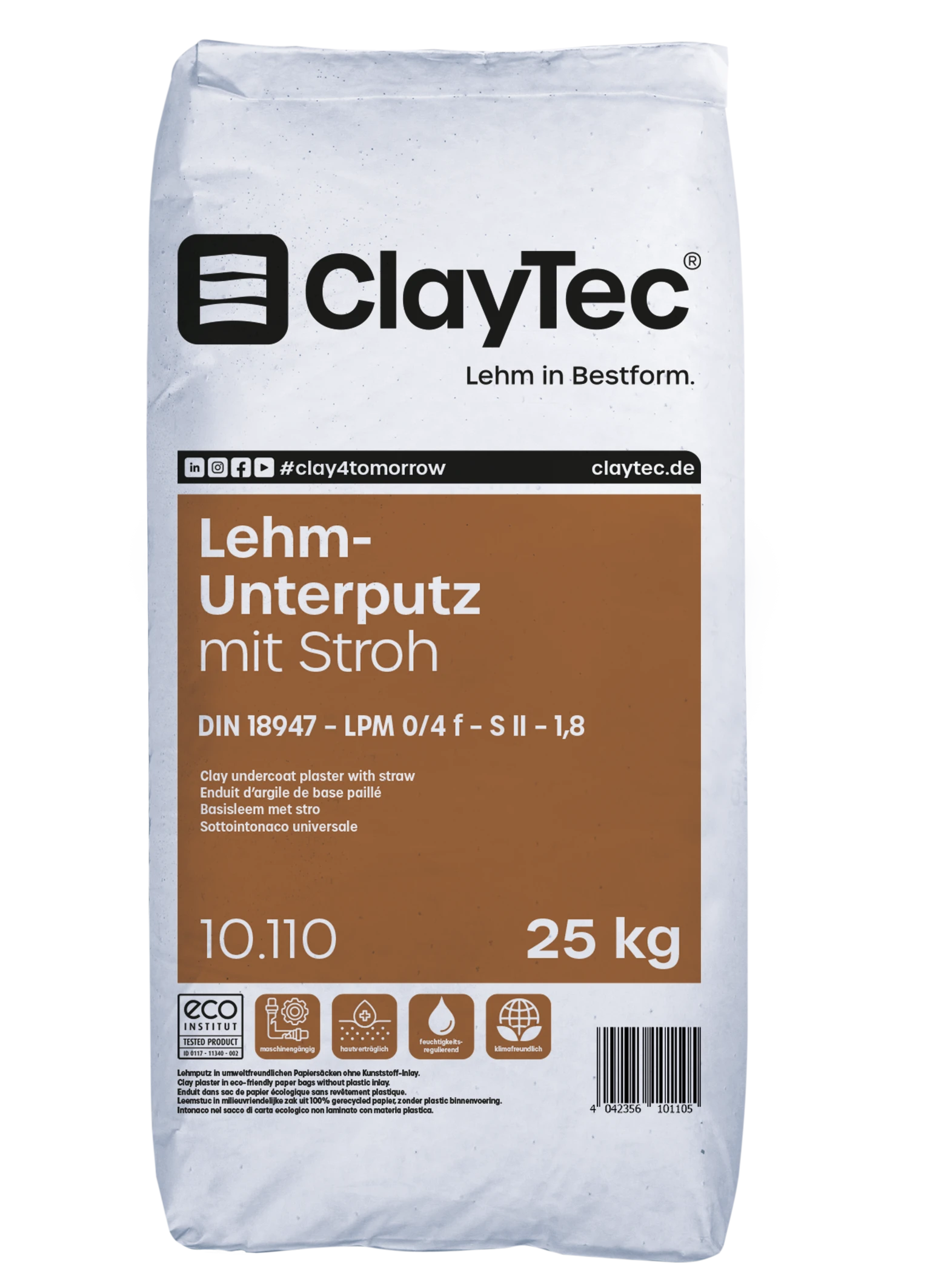
Coarse clay base coat plaster with straw
For 40 years the classic clay base plaster from ClayTec for thick layers, e.g. on unev…
from20,99 €
Anyone who wants to renovate or newly plaster a wall with clay plaster soon faces the question: what does it cost per square metre? There is no blanket answer, because clay plaster has to be calculated very differently depending on system, layer thickness and substrate. This article gives realistic material prices for base and top plaster, explains the difference between sacked goods and big bags, shows how DIYers and professionals calculate material requirements and gives typical total costs for different project categories.
Instead of average values: enter your area and see which sacks you need and what the material costs in total, including waste.
Total for 15 m²433,73 €
incl. VAT, plus shipping
Typical material prices and total costs, incl. base and finishing plaster
| Cost type | Area | Remark |
|---|---|---|
| Clay base coat plaster (sack 25 kg) | 16 to 20 €/sack | Sufficient for approx. 1,35 to 1,7 m² at 10 mm |
| Clay base coat plaster (big bag 1000 kg) | 210 to 525 €/big bag | More economical from approx. 35 m² |
| Clay finishing plaster / fine plaster | 4 to 17 €/m² | Dry mortar, to be mixed with water |
| Application by tradespeople | 25 to 55 €/m² | depending on substrate and region |
| Total cost for DIYers | 12 to 22 €/m² | Material costs only |
| Total cost with a tradesperson | 40 to 80 €/m² | Depends on system and substrate |
| Reinforcing mesh | 2 to 5 €/m² | For cracks or critical substrates |
Clay base coat plaster and clay finishing plaster as a sack or big bag; you choose the pack size on the product page. The quantity calculator works out how much you need for your area.
For 40 years the classic clay base plaster from ClayTec for thick layers, e.g. on unev…
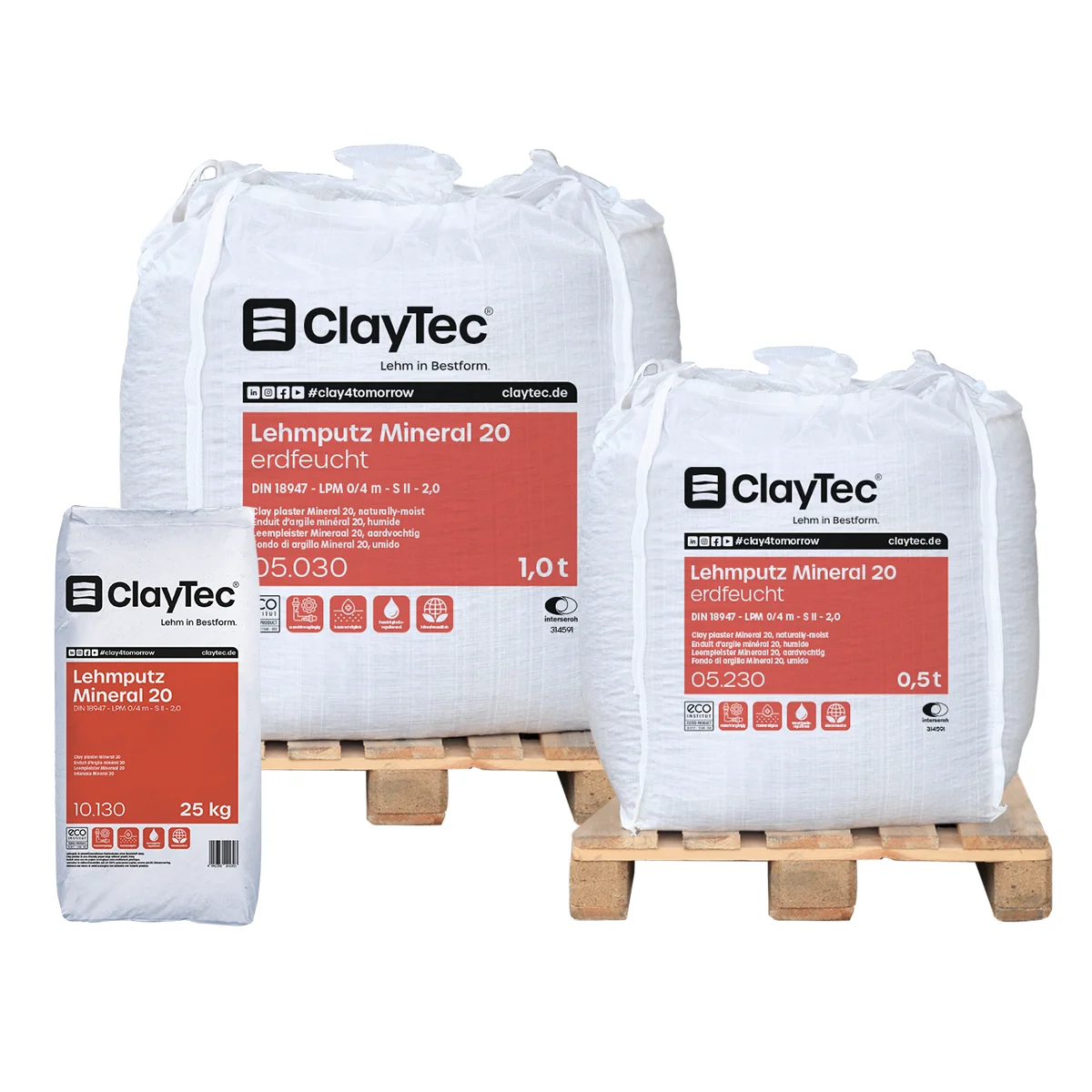
Mineral base and finishing plaster, dry, for maximum flexibility and unlimited stor…
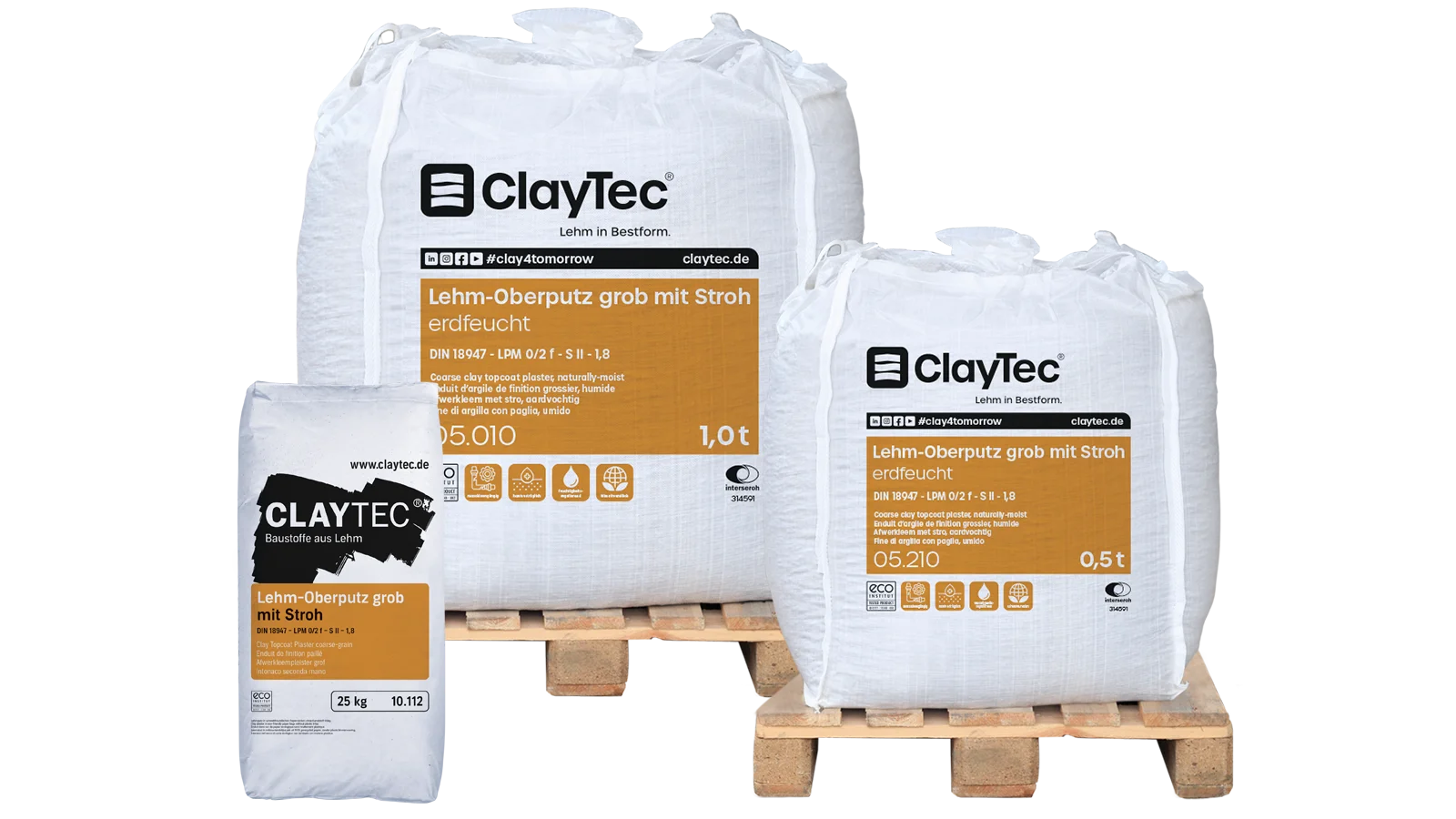
The classic clay finishing plaster from CLAYTEC, from rustic to finely smoothed, on clay base…
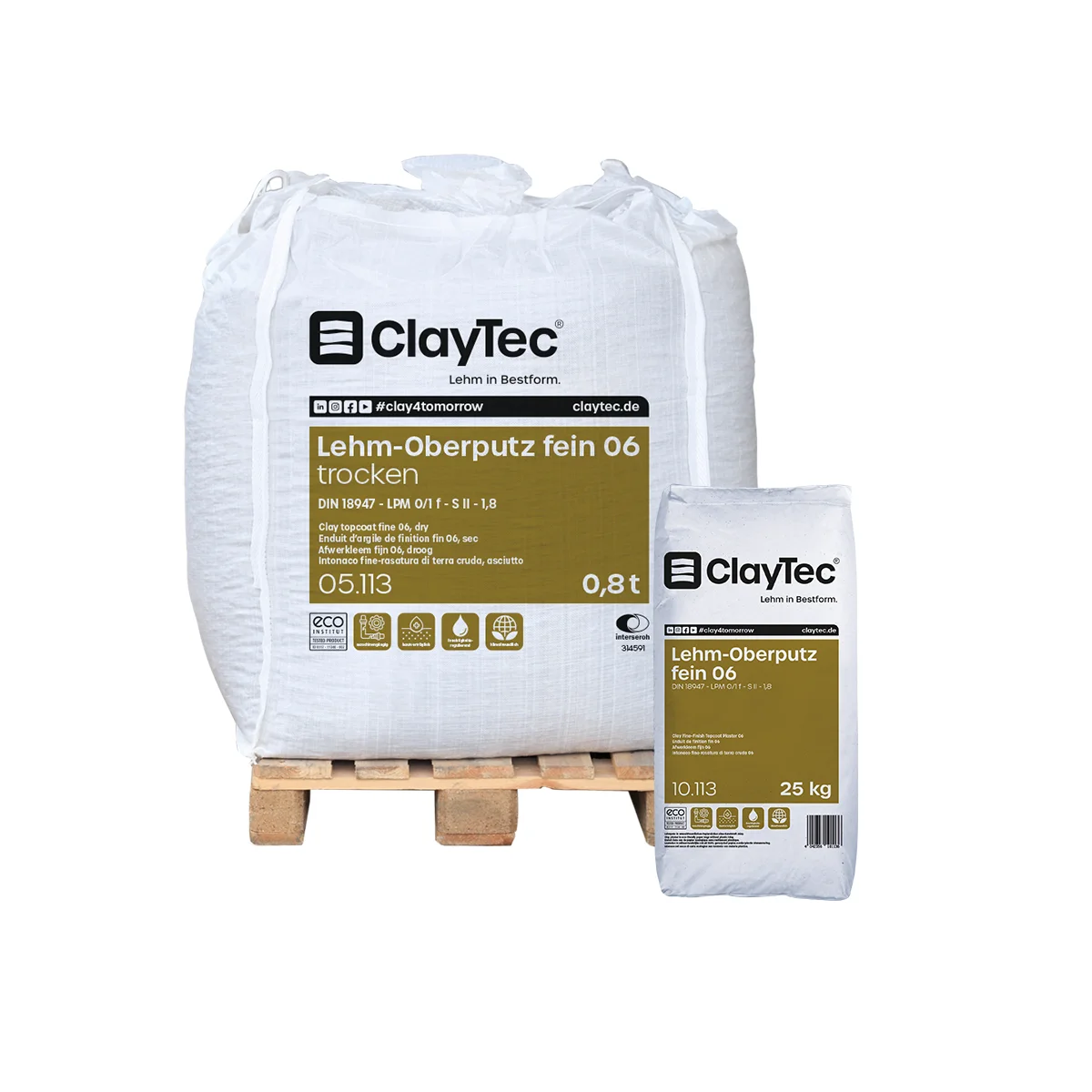
Fine thin-layer plaster for final coats 2–3 mm thick.
The most important cost factor is the number of plaster layers. A single-layer system with a clay base plaster is much cheaper than a three-layer full system with bonding plaster, base plaster and fine plaster. Which system makes sense depends on the substrate, the desired surface quality and the aim of the renovation.
Another factor is layer thickness. In interior insulation, clay plaster is applied thinly, about 8 to 15 mm. When renovating timber frame walls with uneven substrates, on the other hand, 20 to 40 mm may be needed, which increases the material requirement accordingly. Every additional millimetre is reflected directly in the quantity and therefore the price.
Finally, labour and substrate quality play a role. A smooth concrete substrate is plastered faster than an uneven timber frame wall with many connections, edges and corners. With professional execution, the effort is reflected in the hourly rate.
Clay base plaster is the material used in the largest quantities in any plastering project. It is available in 25 kg sacks and in big bags of 1000 kg. Prices per kilogram differ considerably. A 25 kg sack costs between 16 and 20 euros depending on product and supplier, i.e. 65 to 77 cents per kilogram. A big bag of the same quality costs around 210 euros earth-moist to 520 euros dry depending on the product, i.e. 21 to 52 cents per kilogram.
For small areas up to about 15 to 20 square metres, sacked goods are more practical because transport and storage are easier. From about 30 to 40 square metres of wall area at normal layer thickness, a big bag pays off economically. Anyone wanting to plaster a whole house with clay can save 20 to 35 percent of material costs by ordering big bags.
Another advantage of the big bag is batch consistency. For large wall areas that are to be plastered completely in one shade, it is important that all sacks come from the same batch. When reordering, the colour can vary slightly. Big bags from one batch, on the other hand, deliver a homogeneous colour across the entire quantity ordered.
The basic formula for material requirements is: wall area in m² times layer thickness in mm times 1,6 kg per litre. With a layer thickness of 10 mm and a wall area of 20 m², this gives: 20 times 10 times 1,6 divided by 1000 equals 0,32 tonnes of wet material. As clay plaster is supplied as dry mortar, the mixing ratio must be taken into account. Typically, 100 kg of dry mortar makes about 55 to 65 litres of ready-to-use plaster.
For practice, I recommend the following rule of thumb: for 1 mm layer thickness on 1 m² you need around 1,5 to 1,8 kg of clay base plaster as dry mortar. At 15 mm layer thickness and 20 m² area, that gives 20 times 15 times 1,65, i.e. around 495 kg of dry mortar. That corresponds to just under 20 sacks of 25 kg or just under half a big bag.
For exact quantity calculation, Lehm-Revival offers its own quantity calculator, which determines the quantity and suitable pack sizes from wall area and layer thickness. This gives builders and craftsmen a reliable order quantity without laborious manual calculation.
The simplest system is a single-layer clay base plaster on a prepared substrate, which is then smoothed. This solution is suitable for utility rooms, cellars or surfaces that do not need a demanding look. Material costs are about 8 to 12 euros per square metre.
The full system for living rooms consists of a clay bonding plaster or reinforcing coat, a clay base plaster in one or two layers and a clay top plaster or clay finishing plaster as the finish. This system offers the best surface quality and is the right choice for visible wall surfaces in living rooms and bedrooms. Material costs are 16 to 26 euros per square metre.
Between these extremes there are many combinations. A clay base plaster with a high-quality felted finish, for example, is cheaper than a full system with finishing plaster but considerably more attractive than an untreated rough plaster. For renovation projects in living areas, this middle solution is the best compromise between cost and result.
Clay plaster can easily be applied yourself. The material is non-toxic, forgiving and can still be corrected when fresh if mistakes are made. For DIYers without experience, it is advisable to start with a smaller wall area, for example in a storeroom or a wall in the cellar, before tackling the living room.
The first time, DIYers take three times as long as experienced craftsmen. A practised clay builder manages 15 to 25 m² of clay base plaster per day, a DIYer five to ten. This means anyone who wants to plaster a whole house with clay should either plan well or hand part of the work over to professionals.
Depending on region and substrate quality, professional craftsmen charge between 25 and 55 euros per square metre in labour for clay plastering. On top of that come the material and a usual mark-up by the craftsman on the material order. Total prices of 40 to 80 euros per square metre for finished plastered wall surfaces in living rooms are realistic.
The substrate determines whether additional preparatory work and therefore additional costs arise. On old clay walls hardly any preparation is needed, because the new material is chemically and physically compatible with the existing one. A light coat of clay slurry as a bonding bridge is enough.
On plasterboard, a special bonding coat or clay bonding plaster must be applied. This costs about two euros extra per square metre and an additional work step. On old lime plaster, tapping for hollow spots and removing loose areas is necessary, which increases the time required.
The most demanding are substrates with strong relief, such as old timber frame sills, reed or uneven existing plaster. Several layers may be necessary here, and Reinforcing mesh must be inserted to prevent cracks. This extra effort is clearly reflected in the total costs.
Besides the classic base plasters, there are specialised products for particular applications. Clay fillers for thin coatings on plasterboard or concrete cost a little more than simple base plasters but offer a very smooth surface without grain. Typical prices are 6 to 18 euros per square metre of material, depending on a thickness of 1 to 3 mm.
Clay design plasters such as YOSIMA cost 12,50 to 16,70 euros per square metre in material. They are applied on a prepared base plaster and require careful application, which has a positive effect on the result. Professional application is particularly worthwhile here, because mistakes weigh more heavily with an expensive product.
Renovating timber frame panels with a clay-wound stave substructure involves higher material costs, because the infill material must be placed first. The total costs of such a system including substructure, bonding plaster and fair-faced plaster can be 60 to 120 euros per square metre, depending on the execution.
Reinforcing mesh of glass fibre or Jute fabric should be installed at cracks, connections and transitions between different substrates. Material costs for reinforcing mesh are two to five euros per square metre. Embedding the mesh increases the time required by about 20 to 30 percent.
Clay primers and bonding coats cost between 1,70 and 4,30 euros per square metre in material and are indispensable on certain substrates. For clay plaster on plasterboard or concrete, the bonding coat is not optional but mandatory for a permanently adhering layer.
Deductions for windows and doors are forgotten in practice. Typically, the area actually plastered is 85 to 92 percent of the measured gross area. An order without this deduction leads to surplus material. In the quantity calculator you deduct openings from the area beforehand.
In pure material costs, clay plaster is somewhat higher than industrial gypsum plaster. Gypsum base plasters cost six to ten euros per square metre as sacked goods, clay base plasters eight to 14 euros. The premium is therefore about 20 to 40 percent on the material.
This premium is a good investment for several reasons. Unlike gypsum plaster, clay plaster does not have to be covered with a vapour-retarding paint, which saves costs. Repairs are easier and cheaper to carry out. And over the life of the building, the maintenance costs of clay plaster are much lower than those of plasterboard or cement plaster systems.
Looking at total costs over 30 to 40 years, clay plaster comes out more favourably than cheaper system solutions that need renovating more often. This applies especially in old buildings, where the building physics suitability of clay plaster prevents further moisture damage.
In some funding programmes, clay plaster can count as an ecological building material. The Federal Funding for Efficient Buildings (BEG) supports energy-efficient renovations, which can include interior insulation with natural materials. Whether clay plaster is eligible for funding in a specific project depends on the overall concept and must be clarified with the responsible energy consultant.
Some federal states have their own funding programmes for ecological building materials or for renovating listed buildings. In Lower Saxony, for example, there are funding programmes for owners of listed buildings who prefer nature-friendly building materials. Lehm-Revival advises builders on possible funding options for their renovation project.
At municipal level there is also occasional support for ecological measures. It is worth asking the responsible municipal administration or the State Office for Monument Preservation before starting work.
An example from practice illustrates the cost structure: living room with 40 m² of wall area, old plasterboard lining removed, new full clay plaster system on the existing aerated concrete walls. Required: clay bonding coat for the whole area (40 m² times 3 euros equals 120 euros), clay base plaster 15 mm for 40 m² (40 m² times 15 mm times 1,5 kg, i.e. 900 kg of dry mortar, corresponding to 36 sacks of 25 kg, material price about 694 euros) and clay top plaster fine 06 for 40 m² at 3 mm (around 176 kg, i.e. 8 sacks of 25 kg, material price around 185 euros).
Total material costs in this example: about 1.000 euros for 40 m² of wall area, i.e. around 25 euros per square metre. With professional application at 35 euros per m² labour, total costs come to 60 euros per square metre, around 2.400 euros for the whole room.
This calculation shows: in terms of total cost, clay plaster is a competitive system which, depending on the project, can even be cheaper than elaborate drywall systems once the lower maintenance effort is taken into account.
In northern Germany, clay plaster has been common in timber frame houses for centuries. Renovating old clay plaster surfaces in the region around Achim, Verden and Lower Saxony is cheaper than comparable work in urban areas with higher craftsmen's wages.
Especially for listed buildings, clay plaster is often the only solution accepted by the monument protection office. The additional costs compared with modern plaster systems are well accepted by owners in the region, because protecting the historic appearance is desired.
Lehm-Revival delivers clay plasters and accessories throughout the northern German region. For larger projects, pallet and big bag deliveries directly to the building site are possible. The quantity calculator helps you determine exact requirements before ordering.
In northern Germany, especially around Achim, Verden and Bremen, clay plaster is the first choice for renovating historic buildings. Lehm-Revival at Danziger Str. 59, 28832 Achim delivers clay plasters, base plasters and finishing plasters with a big bag option directly to the building site and helps determine quantities with its own quantity calculator.
The calculation becomes concrete as soon as the prices per sack are shown next to it. On the purchase page you see price and yield per pack and can work out the costs per square metre directly.
Buy clay plasterFor small areas, sacked goods are more practical because transport and storage are easier. For large areas, the big bag delivers the whole quantity from one batch, which keeps the colour even across large wall areas. You can see from which quantity the big bag pays off from the price per kilo of both pack sizes on the product page.
The quantity results from wall area and layer thickness. Measure the area and deduct windows and doors; the area actually plastered is usually 85 to 92 percent of the measured gross area. My quantity calculator determines the quantity and the suitable pack sizes from area and layer thickness.
Depending on region, substrate quality and system complexity, the labour cost is between 25 and 55 euros per square metre. Total prices for professionally plastered surfaces in living rooms are 40 to 80 euros per square metre including material.
The first time, about three times as long as an experienced craftsman: a practised clay builder manages 15 to 25 m² of clay base plaster a day, a DIYer five to ten. For a whole house it is worth handing part of the work over to professionals.
Products in the shop
Knowledge articles
To take away: the free clay building diary with drying log.
Download free of charge