
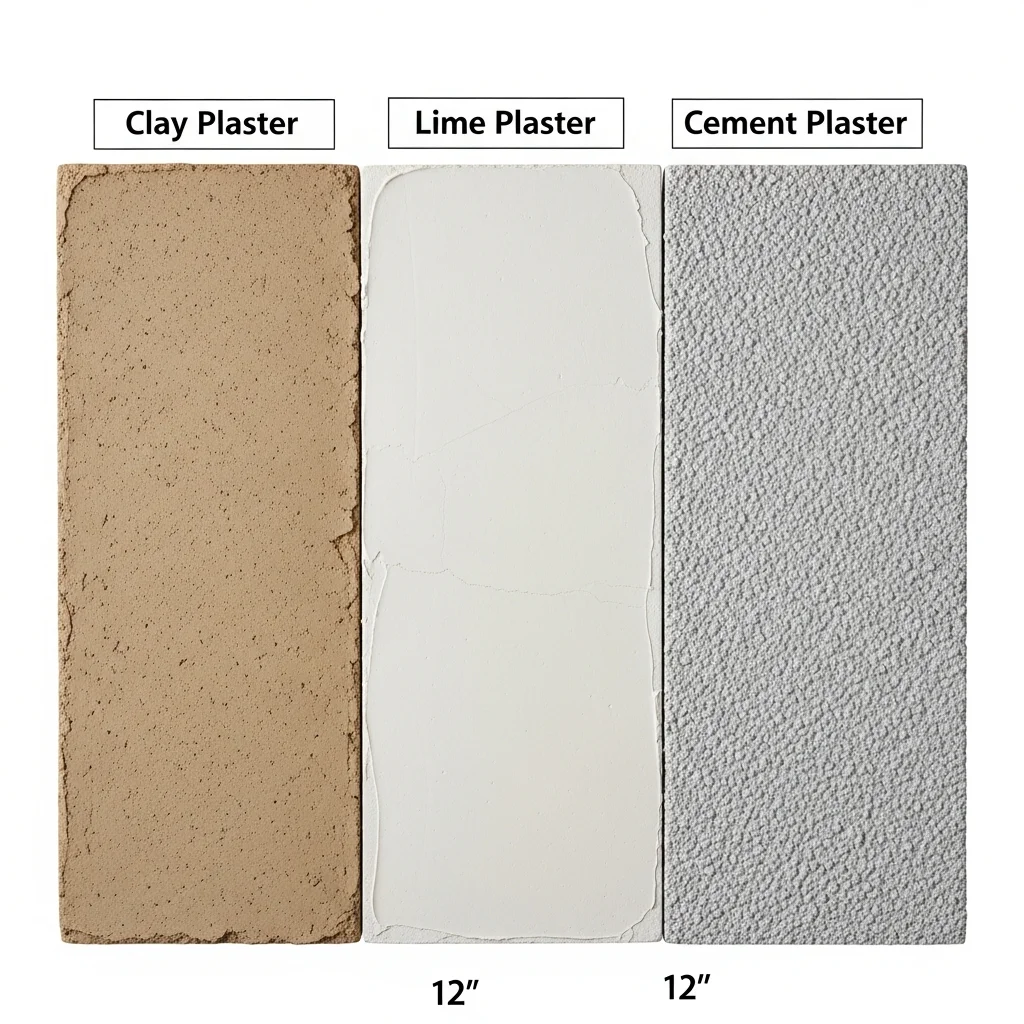
Clay, lime or cement: which binder is right for old buildings and timber framing?

Anyone renovating an old building or a timber frame house sooner or later faces a fundamental question: clay, lime or cement? All three differ fundamentally in their building physics effect and their influence on the building fabric. Much damage to historic buildings is caused not by age but by unsuitable building materials in later renovations. The proven rule of practice is: clay inside, lime outside, cement only where it is structurally essential. The following comparison shows the decisive differences.
Clay, lime and cement in direct comparison
Decision table for choosing building materials in old buildings and timber framing
| Property | Clay | Lime | Cement |
|---|---|---|---|
| Vapour permeability (μ) | 5–10 | 10–25 | 15–35 |
| Moisture regulation | very active (capillary-active) | active | passive to sealing |
| Compressive strength | low | medium | very high |
| Reversibility | complete (water-soluble) | largely | not reversible |
| Life cycle assessment | very good (no firing) | good (lime burning) | poor (high CO₂ emissions) |
| Indoor climate | very good (sorption) | good | neutral to negative |
| Indoor use | ideal | good | partly suitable |
| Outdoor use | not suitable | ideal | suitable |
| Use in cellars / damp | not suitable | with restrictions | suitable |
| Workability | very easy, mouldable | more demanding | easy to demanding |
The three binders at a glance
Clay, lime and cement differ not only in their properties but also in their origin and production. Clay is not fired. It is a natural sedimentary material that is only processed mechanically. Lime is produced by firing limestone at about 900 to 1000 degrees Celsius. Cement requires even higher temperatures of around 1450 degrees Celsius and is the most energy-intensive of the three binders.
In practice, a combination has proven itself for renovating historic buildings: ClayTec clay building products indoors and Saint Astier natural lime outdoors. Cement remains reserved for foundations, floor slabs and constructions exposed to water.
Clay: the natural building material for interiors
Clay is a natural sedimentary material made of a mixture of clay minerals, silt and sand. Unlike lime or cement, clay is not fired but only processed mechanically and dried. The binding behaviour of clay is based on a physical process: clay hardens by drying, not by a chemical reaction. If clay is moistened with water again, it can become plastic again. This property makes clay a fully reversible building material that can be reused almost indefinitely.
Typical properties of clay: bulk density about 1600 to 2000 kg/m³, thermal conductivity about 0,7 to 1,0 W/(m·K), diffusion resistance μ about 5 to 10, very high sorption capacity, fully recyclable. Modern clay construction uses industrially tested building materials. ClayTec produces standard-compliant building materials according to the German clay construction DIN standards: DIN 18945 (clay blocks), DIN 18946 (clay masonry mortar), DIN 18947 (clay plaster mortar) and DIN 18948 (clay boards).
Typical ClayTec products are ClayTec clay base coat plaster with straw, ClayTec clay finishing plaster, ClayTec clay boards as well as ClayTec clay paint and Yosima design plasters. These products are used mainly indoors and considerably improve the indoor climate.
Sorption capacity and indoor climate
A special property of clay is its high sorption capacity. This means the ability of a material to absorb moisture from the indoor air and release it again later. This ability is based on the microporous structure of the clay minerals.
Studies by, among others, the Fraunhofer Institute, TU Munich and the clay construction research of Ziegert and Holl show that a clay plaster 15 to 20 mm thick can typically absorb about 20 to 60 grams of moisture per square metre when the humidity changes. With optimally composed clays, values of up to about 70 grams per square metre can also be reached. This buffering effect significantly stabilises the relative humidity in the room and reduces humidity peaks. This also lowers the risk of mould.
Lime: the classic building material for facades
Lime is one of the oldest artificially produced binders in building history. It is made by firing limestone at temperatures of about 900 to 1000 degrees Celsius. In the process, calcium carbonate is burnt into calcium oxide. Adding water produces calcium hydroxide. Lime mortar hardens through a chemical reaction with carbon dioxide from the air, a process called carbonation. This produces calcium carbonate again, i.e. essentially limestone once more.
Typical properties of lime: bulk density about 1200 to 1600 kg/m³, diffusion resistance μ about 10 to 25, alkaline pH value about 12, mould-inhibiting effect through alkalinity, good elasticity. For historic buildings today, natural hydraulic limes (NHL) are mainly used. An internationally recognised manufacturer is Saint Astier, a French family company with a long tradition in producing natural limes. Typical products are Saint Astier NHL 2, NHL 3.5 and NHL 5. In particular, Saint Astier NHL 3.5 is considered a universal facade lime for historic buildings and combines sufficient strength with good vapour permeability.
Cement: the building material of modern industry
Cement is an industrially produced hydraulic binder. Portland cement is made by firing a mixture of limestone and clay at about 1450 degrees Celsius. This produces so-called clinker minerals, which later react with water. This process is called hydration. As a result, cement has very high compressive strength and is permanently water-resistant.
Typical properties: very high compressive strength, high diffusion resistance, very low elasticity, not reversible. Typical diffusion resistances are μ 15 to 35. In historic buildings, cement can therefore be problematic because it strongly slows moisture.
Diffusion and moisture transport
The most important building physics difference between clay, lime and cement lies in their vapour permeability. Typical μ values: clay about 5 to 10, lime about 10 to 25, cement about 15 to 35. The lower this value, the more easily water vapour can diffuse through a material.
Historic buildings were built without modern vapour barriers. The construction works through an open moisture transport structure. Moisture must be able to escape again through the wall and plaster. If a dense cement plaster is applied to a historic wall or timber framing, it blocks this moisture transport. The consequences can be timber rot in the framing, salt efflorescence, flaking plaster and mould.
Besides diffusion, convection also plays an important role. Air flows can transport considerably larger amounts of moisture than diffusion alone. That is why good airtightness of the building envelope is also decisive.
Life cycle assessment of the three building materials
Clay needs no thermal treatment. The raw material is merely extracted, sieved, mixed and dried. This produces only minimal CO₂ emissions. Clay is therefore considered one of the most ecological building materials of all.
Lime needs firing temperatures of about 900 to 1000 degrees Celsius. CO₂ is released during firing. During later carbonation, however, lime reabsorbs part of this CO₂. Over its entire life cycle, lime can therefore be low in CO₂.
Cement requires very high firing temperatures of about 1450 degrees Celsius. Its production causes about 0,8 to 0,9 kilograms of CO₂ per kilogram of cement. Global cement production today causes about 8 percent of worldwide CO₂ emissions.
Deconstructability and circular economy
Clay is fully circular. Clay plaster can be dissolved again with water and reprocessed. Clay blocks can also be crushed and reused. Practically no construction waste is produced.
Lime is also easy to recycle. Old lime mortar can be crushed and serves as a mineral aggregate or soil improver. Cement-bound building materials, on the other hand, can hardly be recycled. Concrete is only crushed mechanically and used as recycled material in road construction.
When which material makes sense
Clay is particularly suitable for interior plasters, interior walls, timber frame infills, clay boards and clay paints. Typical products are ClayTec clay base coat plaster, ClayTec clay finishing plaster, ClayTec clay boards and ClayTec Yosima design plasters. However, clay should not be used with permanent soaking, direct exposure to water or in plinth zones outdoors.
Lime is ideal for exterior plasters, facades of historic buildings, joint repairs and plinth plasters. Typical products are Saint Astier NHL 2, NHL 3.5 and NHL 5. Saint Astier natural lime in particular is used worldwide in restoration and monument protection projects.
Cement makes sense for foundations, floor slabs, waterproof concrete and load-bearing components. Cement is unsuitable for historic timber frame houses. For the renovation of historic buildings, the simple building practice therefore applies: clay inside, lime outside, cement only where it is structurally unavoidable.
| Property | Clay | Lime | Cement |
|---|---|---|---|
| Vapour permeability | very high (μ 5–10) | high (μ 10–25) | low (μ 15–35) |
| Moisture regulation | very good | moderate | hardly |
| CO₂ balance | very low | moderate | very high |
| Weather resistance | low | good | very high |
| Ease of dismantling | complete | good | low |
| Use in timber framing | ideal indoors | ideal outdoors | unsuitable |
Choice of building materials in renovation practice: northern German experience
Lehm-Revival at Danziger Str. 59, 28832 Achim advises builders and craftsmen in the Lower Saxony region on choosing the right binders for old building and timber frame renovations. I deliver ClayTec clay building products and Saint Astier natural lime by parcel or haulier throughout Germany and offer personal on-site advice for projects in the greater Bremen area and the Verden district.
Frequently asked questions about comparing clay, lime and cement
Why is cement problematic in historic timber frame houses?
Cement has a high diffusion resistance (μ 15–35) and blocks natural moisture transport in historic building constructions. Historic timber frame houses were built without vapour barriers and work through open moisture transport structures. Cement plasters can trap moisture in the masonry and lead to timber rot, salt efflorescence and flaking plaster.
Where is cement right in the renovation of an old building?
For foundations, floor slabs, watertight concrete and load-bearing components where high compressive strength and permanent water resistance are required. Cement is unsuitable for historic timber frame houses.
Sources and standards
Further links
Products in the shop
More items in Clay building
- Monument protection and clay building: age line, permit and typical mistakes
- Buy hemp insulation: hemp insulation batts for interior insulation, rafters and timber framing
- Hempcrete: mixture, application and insulation values for wall, floor and roof
- Interior insulation costs per m², wood fibre with clay vs. calcium silicate vs. drywall
- Lime plaster: properties, use and application inside and outside
- When clay does not work: limits, mistakes and decision rules
- Clay in interior finishing: a healthy indoor climate with natural building materials
- Advantages of clay building, healthy indoor climate, sustainability and building physics explained clearly
- Clay building: building and renovating with clay
- Clay boards in interior finishing: drywall construction with clay according to DIN 18948
- Buy fine clay plaster and YOSIMA design plaster: application, choice of colour and prices
- Clay paint on plasterboard: pre-treatment, consumption and painting
- Clay paint in interior finishing: mineral wall paint for a healthy indoor climate
- Clay mortar in clay building: masonry mortar and plastering mortar
- Clay plaster on concrete: preparation, primer and plaster thickness
- Clay plaster on gypsum plaster and old plaster: check, prime, plaster thinly
- Clay plaster on sand-lime brick and brick: plastering masonry correctly
- Clay plaster on Rigips and plasterboard: preparing the substrate correctly
- Applying clay plaster: the complete step-by-step guide
- Clay plaster costs per m², prices, material requirements and packs compared
- Renovating clay plaster: recognising types of damage, understanding causes and repairing correctly for the long term
- Clay plaster on different substrates: concrete, brick, wood and drywall
- Building up clay plaster: base coat, finishing coat and fine plaster
- Wall heating with clay: planning and installation step by step
To take away: the free clay building diary with drying log.
Download free of charge