
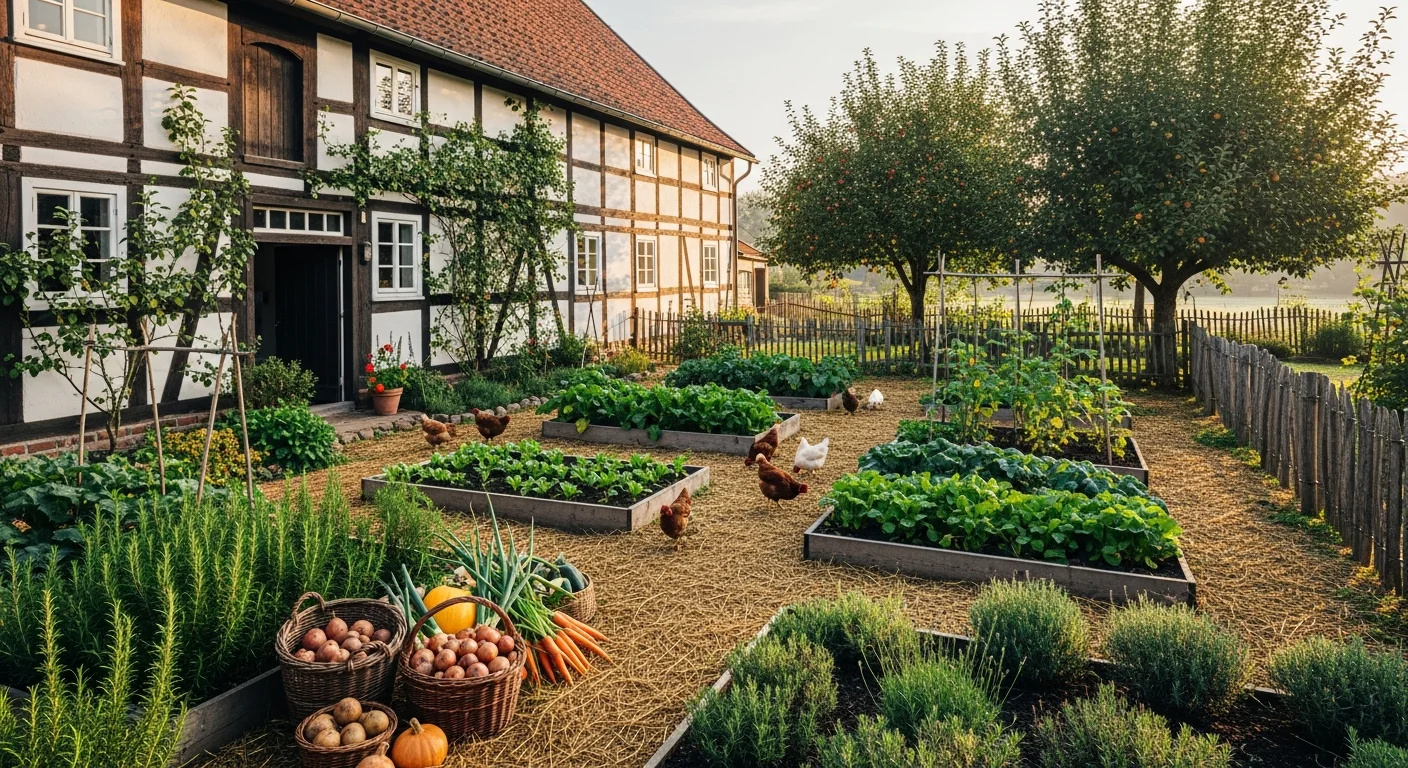
Self-sufficiency on a historic farm in northern Germany
Anyone wanting to use a historic farm in northern Germany for self-sufficiency faces a planning question, not a lifestyle question. The decisions made in the first twelve months (which areas are used, which animals are kept, how storage is organised) determine whether the system holds or collapses. This article shows specifically which farm models work under northern German conditions, where typical planning mistakes arise and which start is realistic for your own situation.
Farm models for northern German self-sufficiency at a glance
Realistic planning framework for beginners and advanced users in northern Germany
| Farm model | Minimum area | Effort/week | Degree of self-sufficiency | Suitable for |
|---|---|---|---|---|
| Allotment self-sufficiency | 200–500 m² | 5–10 h | 15–25 % (vegetables) | Working people, beginners |
| Kitchen garden + small animals | 800–2.000 m² | 15–25 h | 30–50 % (vegetables + eggs) | Families, part-time |
| Smallholding (vegetables + fruit + 1 animal) | 3.000–8.000 m² | 30–45 h | 50–70 % | Full-time commitment |
| Self-sufficient farm (complete) | from 1 ha | Full-time | 70–90 % | Main occupation, experienced |
| Community farm (several families) | from 2 ha | each 20–30 h | 60–80 % per household | Groups, cooperatives |
Farm logic before garden planning
On such a farm, self-sufficiency does not begin with a raised bed, nor with the question of which chicken breed looks the prettiest. It begins with farm logic. Where are the short routes? Where is it sheltered from the wind? Where is there light in the morning, and where does water stand in winter? Where can tools be stored dry? Where can harvest, processing and storage follow each other sensibly? A farm becomes strong when daily routines work without friction. Everything that is used, checked and harvested must be close and within reach.
It is not the area that decides but the organisation of use. Anyone growing thirty species on twenty beds without clear zones and crop rotations mainly produces chaos. Anyone farming a small area with well-thought-out zoning, on the other hand, gets further. Self-sufficiency needs no romantic conviction; it needs a system.
Timber framing in northern Germany: construction and regional features →
| Farm model | Minimum area | Effort/week | Degree of self-sufficiency (realistic) | Animal husbandry |
|---|---|---|---|---|
| Garden model (crops only) | 200–500 m² garden | 5–10 hrs | 15–25 % (vegetables, herbs) | Not necessary |
| Smallholding with small animals | 800–2.000 m² | 15–25 hrs | 30–50 % (vegetables, eggs) | 6–12 hens, possibly rabbits |
| Semi-self-sufficient farm with grassland | 3.000–8.000 m² | 30–45 hrs | 50–70 % (vegetables, fruit, livestock) | Poultry, possibly goats |
| Full farm with arable farming | from 1 ha | 50+ hrs | 70–90 % (incl. grain, meat) | Several animal species, stable building needed |
The house as part of the supply system
On historic farms in particular, clay and timber framing fit this logic not only visually but in practical building terms. Interiors work better in the long term if materials can absorb and release moisture instead of needlessly sealing surfaces. The German Environment Agency emphasises that a healthy indoor climate needs as many breathable surfaces as possible and that the materials used should be able to absorb and release moisture to help regulate the indoor climate. Clay plaster on the interior walls of a self-sufficient farm is therefore not a question of style but a contribution to the house's fitness for use.
That is why the house on a self-sufficient farm is never just living space. It is part of the supply system. A pantry, a cool storeroom, dry storage for seeds, tools and feed, a place to dry herbs and facilities for preserving, fermenting and interim storage are more valuable than another piece of garden. Many farms fail not because of too little land but because of poor organisation of use. Anyone who harvests a lot in summer but has no suitable storage loses a considerable part of the harvest again.
Home garden and microclimate in northern Germany
The right start is almost always the kitchen garden. Not because it delivers the largest quantity, but because it brings the most regularity into everyday life. The crops that need to be harvested, observed and tended are right by the house. Herbs, salads, pick-and-come-again vegetables, early carrots, radishes, chard, chives, parsley, thyme or strawberries belong within sight. This is not a question of convenience but an operational decision. Proximity increases attention. Attention increases harvest.
On northern German farms, the microclimate is decisive. Wind, driving rain, cold springs and wet soils make more of a difference than you see on paper. Hedges, copses, orchards and cleverly placed margins are therefore not only beautiful but functional. A current BLE practice leaflet states that hedges, copses and orchards in agricultural landscapes create both food and nesting habitats and also protect against erosion and weather extremes. Anyone with hedges and copses on the farm protects not only bees and insects but also beds, soil and microclimate.
Growing vegetables in zones, crop rotation and soil care
Vegetable growing works best on a farm in clear zones. First, the kitchen garden by the house. Second, the main beds for storable and space-relevant crops such as potatoes, cabbage, onions, beans, squash or carrots. Third, special areas for berries, compost, young plants, rhubarb or later expansion. Spreading everything everywhere produces unnecessary walking, unclear crop rotations and more maintenance chaos than yield.
Especially in smaller farm gardens, crop rotation is not a theoretical gardening topic but one of the most important rules for stability. The BZL puts it clearly: plants of the same family should not grow in the same place one after the other. A well-thought-out crop rotation reduces disease and weed pressure, makes better use of nutrients and maintains soil fertility permanently. Anyone who repeats the same crops in the same place year after year builds weaknesses into the soil that eventually show up as crop failures.
Soil care is just as central. In the organic garden, the soil is at the centre. The BZL names compost, gentle cultivation, mulching, diverse crop rotations and mixed cropping as key measures for maintaining and increasing soil fertility. This suits a historic farm exactly. Security of supply does not come from maximum area but from a healthy soil. A small, humus-rich, well-organised garden almost always beats a large, depleted area with a lot of maintenance.
Keeping chickens as a closed cycle
Anyone keeping chickens should see them as part of the cycle and not as a folkloric addition. They provide eggs, use some suitable leftovers, scratch, eat insects and produce valuable manure. At the same time they come with clear requirements. A run is not simply a green area but a sensitive zone of use. The Chamber of Agriculture of North Rhine-Westphalia explicitly names land use and nutrient input from chicken droppings as issues for laying hen runs. Ignoring this overuses the run and creates bare, nitrate-laden zones that no longer recover.
That is why a small flock is wiser than immediate size. Six to twelve hens are a sensible size on many historic farmsteads: enough for noticeable self-production but still manageable enough for barn hygiene, feeding, winter routine and manure management to stay clean. Only when these routines are established is expansion worthwhile.
Manure itself is not waste on the farm but a raw material, but only in the right form. Fresh chicken manure does not belong indiscriminately in vegetable beds. Only through rotting, mixing with structurally rich material and sensible compost management does it become a good fertiliser. This closes the cycle that historic farms always knew: plant remains and feed become manure, manure becomes soil fertility, soil fertility becomes harvest again.
Fruit, orchards and smart choice of area
Fruit belongs on a northern German farm almost as a matter of course, not as edge decoration but as a second level of supply. Orchards and shrubs are ecologically valuable and practical at the same time. They provide shade, create structure, support pollinators and bring harvests that can be used fresh, dried, preserved or stored. The BLE practice leaflet emphasises the importance of orchards and woody structures for pollinators, and the NLWKN shows how closely orchards are linked with the historic cultural landscape of Lower Saxony.
What always matters is choosing varieties and areas by use rather than by appearance. A good farm apple does not just have to look nice in September. It should keep well or be suitable for purée, juice or dried fruit. A meadow does not have to look like a lawn. It may be a working meadow, flowering space, hay source, run or buffer zone. A field, in turn, should only be cultivated if it really fits into the work rhythm. For many smaller farms, well-kept grassland with orchards and hedges is more stable in the long term than a field that demands more work than it delivers.
Moisture management in historic buildings
Clay and timber framing also play an indirect role outdoors. Where livestock, garden and farm use are close to historic building fabric, moisture management must be right. Plinths, eaves areas, paths, splash zones, roof drainage and ground connections are not minor matters. Anyone who thinks of a farm as a cycle must also place the house in this cycle.
Dry plinths, functioning drainage and materially appropriate repairs are just as important in the long run as bed planning and compost. A historic timber frame building with a permanently damp plinth slowly loses its structural integrity, long before the damage becomes visible. Regular visual checks of the timber beams and the clay and lime plaster are therefore part of looking after the farm.
Clay plaster on interior walls also supports storage and pantry rooms: it regulates humidity in rooms where seeds, herbs and preserves are stored. Stable humidity conditions between 45 and 65 percent relative humidity measurably extend the shelf life of stored supplies and reduce the risk of mould.
Typical misconceptions about the self-sufficient farm
The most common misconception: more area means more security of supply. The opposite is true. A large, poorly organised area produces more maintenance and harvest pressure than yield. A small, clearly structured system with good soil and short routes almost always outperforms a disorganised area three times the size. Northern German microclimate conditions (wind, cold springs, wet phases) reinforce this effect: anyone who wants too much at once loses control exactly when the weather does not forgive mistakes.
Second misconception: keeping animals immediately brings more security of supply. Animals, especially poultry, considerably increase the daily workload and tie up barn care, feeding, winter routine and manure management. Anyone who has first built up a solid vegetable and storage system can integrate livestock sensibly. Anyone who buys chickens before the garden is working creates effort that exceeds the yield.
Third misconception: complete self-sufficiency is the goal. For almost every starter farm in northern Germany, this is unrealistic and unnecessary. A self-supply rate of 30 to 60 percent for staple foods is an easily achievable and sensible target for most farm models. Anything beyond that requires considerably more land, labour and specific knowledge, and for many it is not an attractive ratio of effort to result.
A realistic start: where to begin
The safest start is zoning the kitchen garden. Not with as many crops as possible, but with three to five vegetables that work well on the farm: potatoes, cabbage, beans, carrots and squash as the first storable level of supply. Plus herbs and salads right by the house for daily needs. This is not a compromise but a deliberate decision for manageability.
In the second year, crop rotation, a compost system and the first structural elements such as hedges and orchards are added. Only when the basic system has run stably for a year is it worth deciding on livestock and expanding the area. Historic farms were not built in one season. They developed over generations through observation, adaptation and reduction. Those who respect this reach their goal faster than those who want everything at once.
Practice on northern German farms: what really counts
Between the Elbe and the Flensburg Fjord, in the Weser marsh and in western Mecklenburg there are historic farmsteads that are underestimated as self-sufficiency sites. The Atlantic-influenced season starts on average three weeks later than in Bavaria. In some years late frost is possible into May. Barns, cottages and farm buildings of timber frame with clay plaster offer storage conditions that modern constructions cannot easily reproduce: stable humidity, good thermal inertia, no condensation problems in the stores. Mistakes almost always happen where concepts are adopted without adapting to the climate. Regional sources such as NLWKN and BLE leaflets on field vegetables and free-range husbandry reflect these conditions, and show what actually works under northern German conditions.
Clay plaster regulates moisture in storage, pantry and living rooms. And it is part of the everyday equipment of the house on a self-sufficient farm. Lehm-Revival stocks ClayTec clay plasters in the shop, deliverable throughout Germany by parcel or haulier.
Clay plaster for the self-sufficient farmFrequent practical and planning questions
Which entry into self-sufficiency is realistic on a northern German farm?
The garden model or a small farm with small livestock. With 200 to 2.000 square metres of well-organised area and 5 to 25 hours per week, a self-supply rate of 15 to 50 percent for staple foods can be achieved. Start by zoning the kitchen garden: three to five storable vegetables such as potatoes, cabbage, beans, carrots and squash, plus herbs and salads right by the house. Crop rotation, a compost system and hedges are added in the second year, livestock only once the basic system is running stably.
How many chickens are advisable on a historic farm?
Six to twelve hens are a sensible size on many historic farmsteads. This flock provides noticeable self-production but is still manageable enough for clean barn hygiene, feeding routine and manure management. More important than the number of animals is whether the garden is already running stably. Chickens increase the daily workload and only belong in the second phase.
What role does clay play on a self-sufficient farm?
Clay plaster on the interior walls regulates the humidity in living, storage and pantry rooms by absorbing and releasing moisture. Seeds, herbs and preserved supplies need stable humidity conditions between 45 and 65 percent relative humidity. This makes clay plaster part of the everyday equipment of the house on a self-sufficient farm.
Sources and standards
- Umweltbundesamt, Gesund und umweltfreundlich renovieren
- BZL / landwirtschaft.de, Eine gute Fruchtfolge fördert die Bodenqualität
- BZL / landwirtschaft.de, Ökologisch Gärtnern: was heißt das eigentlich?
- NLWKN Niedersachsen, Kulturlandschaftsräume und historische Kulturlandschaften landesweiter Bedeutung
- BLE. Hecken in der Agrarlandschaft erhalten und fördern
- Landwirtschaftskammer NRW, Legehennen (Haus Düsse)
- Landwirtschaftskammer Niederösterreich: Erdäpfel, Ruhe im Lager wichtig (top agrar)
Further links
Products in the shop
Knowledge articles
More items in Sustainable living
- Healthy living and a natural indoor climate: why building materials are decisive
- Beekeeping in the natural garden: keeping bees sustainably and harvesting real garden honey
- Kreuz ohne Haken: diversity on the farm, in the village and on the building site
- Clay in the bedroom: a healthy indoor climate, better sleep and a mindful start to the day
- Natural garden in northern Germany, herbs, field plants and natural cycles
- Wild bees, bumblebees and honey bees in the natural garden: promoting biodiversity and building a stable ecosystem