
Beekeeping in the natural garden: keeping bees sustainably and harvesting real garden honey
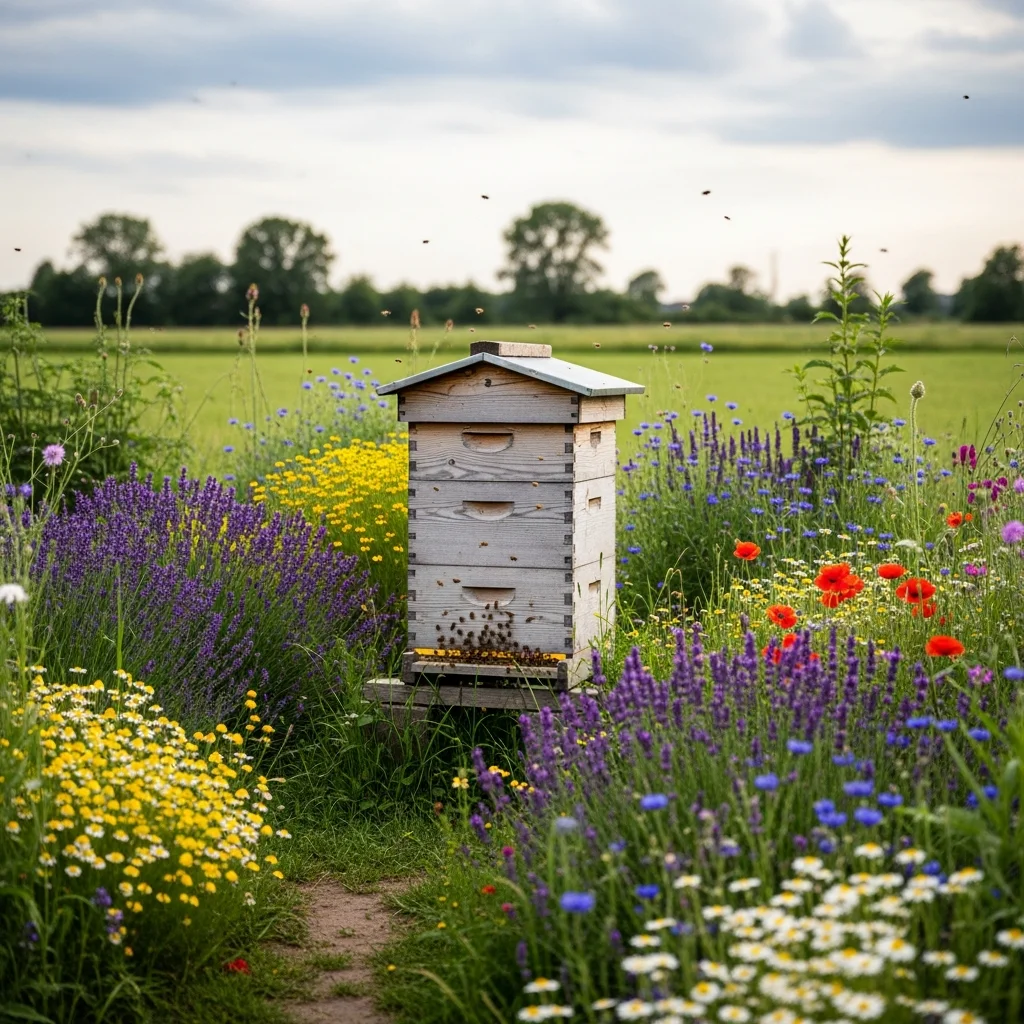
Beekeeping in a natural garden combines self-determined living with a functioning ecosystem. Bees do not only produce honey; they secure yields, stabilise plant stocks and actively promote biodiversity. Keeping bees does not mean interfering with nature but becoming part of an existing cycle. For Lehm-Revival this results in a clear line: build naturally, live naturally and strengthen natural systems. Beekeeping is not an add-on but a consistent extension of this approach.
Beekeeping calendar: bee activity and tasks in the natural garden
Monthly overview for beginner beekeepers in the northern German natural garden
| Season | Bee activity | Beekeeping tasks | Important forage plants |
|---|---|---|---|
| January / February | Winter grape, very low | Check from outside, check mouse protection | Snowdrop, hazel |
| March | Brood begins, first flights | Initial inspection, check winter feed | Willow, coltsfoot, crocus |
| April | Strong brood, first swarming mood | Swarm prevention, expansion | Fruit blossom, dandelion, sage |
| May | Swarming season, highest activity | Catching swarms, making splits | Rapeseed, fruit blossom, phacelia |
| June | Foraging season, honey harvest | Check the supers, first honey extraction | Lime tree, clover, oregano |
| July / August | The colony gets smaller, winter bees emerge | Varroa treatment, preparing for winter | Cornflower, chicory, phacelia |
| September / October | Colony withdraws | Winter feeding, entrance reducer | Ivy, goldenrod, heather |
| November / December | Winter rest | Insulate hive, fit mouse guard | — |
Why beekeeping works particularly well in the natural garden
A natural garden is not a decorative space but a living system. Native plants, perennial flowering areas, shrubs and trees, dead wood and structurally rich areas create stable ecological conditions. For bees this means continuous food from early spring into late autumn, a high variety of pollen and nectar, stable microclimates, less stress and better colony development.
Early bloomers such as willow, hazel or cornelian cherry secure the start of the year. Summer plants such as viper's bugloss, sage and thyme carry the colony through the main phase. Late bloomers such as ivy and asters secure wintering. A natural garden thus provides not only food but stability. That is exactly the basis for healthy bee colonies.
This difference shows measurably in colony development: colonies next to structurally rich natural gardens show, in practice, earlier spring development, fewer summer gaps and a longer foraging period. Fewer stress factors also mean less varroa pressure. A direct advantage for the overall stability of the colony.
Sustainable beekeeping, bees as an independent system
Sustainable beekeeping means understanding the bee colony as an organism. The focus is not on maximum yield but on stability, health and adaptation. Central principles are the use of natural materials, especially wooden hives, reducing interventions to what is necessary and following the natural course of the year.
Added to this is actively encouraging the swarming instinct and comb renewal, and consistently refraining from yield-focused thinking at the expense of colony health. This approach corresponds to species-appropriate beekeeping and fits directly with Lehm-Revival's philosophy: less intervention, more observation, more cycles.
Which beehive suits a natural garden
The choice of hive influences the whole system. It determines the intensity of intervention, the way of working and the development of the colonies. Frame hives such as Zander, Dadant or German Normal Measure are standardised systems with high efficiency. They are ideal for beginners, as they are easy to handle and easy to expand. Interventions are more frequent with this system, and the honey yield is high.
The top bar hive is very close to nature, as the bees build their combs freely. Fewer interventions, calmer work and a lower honey yield characterise this type. It is particularly suited to nature-oriented concepts. Warré hives or horizontal single-box hives offer a good middle way between control and naturalness.
For Lehm-Revival, solid wooden hives made of regional material, untreated or treated with an ecological oil glaze, are recommended. They fit into the overall picture, create a balanced climate in the hive and follow the principle of consistently using natural materials.
Beekeeping in a small garden
Beekeeping is also possible on a small area. The flight radius of bees is several kilometres, so your own garden is only part of the food base. A garden of about 300 square metres or more can be enough if there is a continuous supply of flowers, access to water and the site is sheltered from wind, sunny and quiet.
More important than the area is the quality of the surroundings. A structurally rich natural garden has a stronger effect than a large, monotonous area. Little disturbance from people and animals and a clear flight path to the south or south-east complete the site requirements. Neighbours should be informed early to avoid conflicts.
Beekeeping for self-sufficiency, more than honey
Beekeeping is a key building block in a functioning self-sufficiency system. Besides honey, the colony provides beeswax, propolis and pollen. In the garden, fruit and vegetables benefit from much better pollination, higher yields and more stable plant development.
Integration into orchards, the link with permaculture areas and the use of wax for candles and natural products make beekeeping a connecting element between garden, food and craft. The bee colony thus becomes not only a source of food but an active part of a closed system.
Beeswax is an underestimated by-product. It can be used for candles, leather oil, chopping board care and furniture finishes. Propolis, the bees' resin, has antimicrobial properties and is used in natural medicine and the home medicine cabinet. Integrating these by-products into the farm cycle makes sensible use of every part of the bees' work.
Beekeeping without chemicals, a realistic approach
Doing without intervention entirely is possible but demanding. A realistic approach combines natural processes with targeted support. Choosing robust bee lines, regular comb renewal and promoting colony strength are just as important as targeted, minimally invasive measures against varroa.
The aim is not dogmatic renunciation but a stable, healthy system. Those who understand the colony as an organism and know its annual rhythms can reduce interventions to a necessary minimum and still keep bees successfully and sustainably.
Starting beekeeping, step by step
Before bees move in, the course of the year should be clear. Spring development, swarming season, honey harvest and wintering determine all the work in the year. Those who understand this rhythm have an advantage from the start. Courses at regional beekeeping associations are the safest way to begin.
The site should be sunny, sheltered and quiet, ideally with a clear flight path to the south or south-east. When choosing a hive, it is advisable to stick consistently to one system: Zander or Dadant for beginners, single-box hives or top bar hives for nature-oriented approaches. The bee colony is best obtained from regional beekeepers or associations. Nucleus colonies are more robust than production colonies.
The first season serves above all for observing and learning. Interventions should be deliberately reduced. Those who understand the system automatically make fewer mistakes and need no pronounced routine to achieve good results.
Starting beekeeping, a realistic look at costs
A solid start is possible with a manageable budget. A wooden hive costs between 180 and 450 euros depending on model and quality. Protective clothing costs 90 to 220 euros, tools 60 to 180 euros. A bee colony costs 160 to 280 euros.
For two colonies, a realistic starting budget is about 830 to 1.860 euros. In the long term, this investment pays for itself through honey, wax and significantly increased yields in the garden. Anyone who has already created a structurally rich natural garden benefits from a better starting position for the colonies from the outset.
The right plants for bees in the natural garden
A functioning natural garden is based on continuous flowering. In spring, willow, hazel, lungwort and cornelian cherry provide the first food. In summer, viper's bugloss, sage, thyme and ox-eye daisy take over. In late summer and autumn, asters, goldenrod, ivy and stonecrop secure the colonies' preparation for winter.
Shrubs and trees such as elder, blackthorn, wild apple and lime complement the offering over longer periods. Horsetail is not a classic nectar source, but as a decoction for strengthening plants it has an indirect benefit for the whole garden ecology, an aspect that natural gardeners have valued for generations. This diversity ensures stable colonies and continuous development throughout the year.
Your own honey, quality from your own garden
Honey from your own beekeeping is a natural product without industrial processing and without blending of different origins. The enzymes are fully preserved, the taste is individual and reflects the location. Every plant, every blossom shapes the result.
Garden honey from a natural garden in northern Germany tastes different from forest blossom honey from the Black Forest or lavender honey from Provence. And that is exactly what makes it valuable. Those who harvest their own honey know every plant in it.
The honey harvest should be gentle: in spring and summer surplus combs can be taken, but always with the focus on sufficient winter stores. A medium-strength colony needs 15 to 20 kilograms of honey as winter stores. Harvesting modestly secures colony strength and winter survival rate, and in the long term gives more honey, not less.
Beekeeping and permaculture, a closed cycle
Beekeeping develops its full effect in interaction with other systems. Plants provide nectar, bees pollinate plants, plants bear fruit, honey and wax are used. A cycle emerges that stabilises and develops itself.
In the permaculture garden, the bee colony fits in seamlessly: it enlivens fruit trees, supports vegetable beds and closes the cycle between soil, plant and people. Solid wood hives made of regional material suit the permaculture approach just as well as consistently thinking in systems rather than individual measures.
Typical mistakes when starting beekeeping
Many beginners open the hive too often, choose an unfavourable location or lack sufficient understanding of the bees' annual cycles. Another typical mistake is focusing on honey yield instead of stability and colony health.
The most important approach is observation. Anyone who regularly watches the bees at the entrance, knows the weight of the hive and understands the course of the year automatically reduces mistakes. No app and no book replaces direct experience of the colony over at least one full season.
Beekeeping in the Achim and Bremen region: what beginner beekeepers need to know
In the Achim region and the area around Bremen, the structurally rich landscape with orchards, hedges and natural gardens offers ideal conditions for beekeeping. Lehm-Revival at Danziger Str. 59, 28832 Achim combines natural building with nature-oriented living. Beekeeping in your own natural garden is a consistent continuation of this approach, from natural building materials in the house to your own honey from the garden.
For the natural garden around your bees: in the shop you will find the hedgehog house made of natural wood as well as sage and bay leaves from the natural garden.
Garden & herbs in the shopFrequently asked questions about beekeeping in the natural garden
Can you keep bees in your own garden?
Yes, beekeeping is also possible on small areas from about 300 square metres. The bees' flight radius is several kilometres, so your own garden only makes up part of the food supply. What matters is a sheltered, sunny site with a clear flight path, access to water and ideally a continuous supply of flowers from spring into autumn.
How much does it cost to start beekeeping?
For two colonies, a realistic budget is 830 to 1.860 euros. This includes wooden hives (180–450 euros each), protective clothing (90–220 euros), tools (60–180 euros) and the bee colonies themselves (160–280 euros per colony). In the long term, the investment pays for itself through honey, wax and higher garden yields from better pollination.
Which beehive suits a natural garden?
Frame hives such as Zander or Dadant are easy for beginners to handle and expandable, with more frequent interventions and higher honey yield. In the top bar hive the bees build their combs freely; you intervene less and harvest less honey; Warré and single-box hives lie in between. I recommend solid wooden hives made of regional material, untreated or with an ecological oil glaze, and advise sticking to a system once chosen.
Sources and standards
Further links
Products in the shop
Knowledge articles
Videos & external links
More items in Sustainable living
- Healthy living and a natural indoor climate: why building materials are decisive
- Kreuz ohne Haken: diversity on the farm, in the village and on the building site
- Clay in the bedroom: a healthy indoor climate, better sleep and a mindful start to the day
- Natural garden in northern Germany, herbs, field plants and natural cycles
- Self-sufficiency on a historic farm in northern Germany
- Wild bees, bumblebees and honey bees in the natural garden: promoting biodiversity and building a stable ecosystem