fast delivery
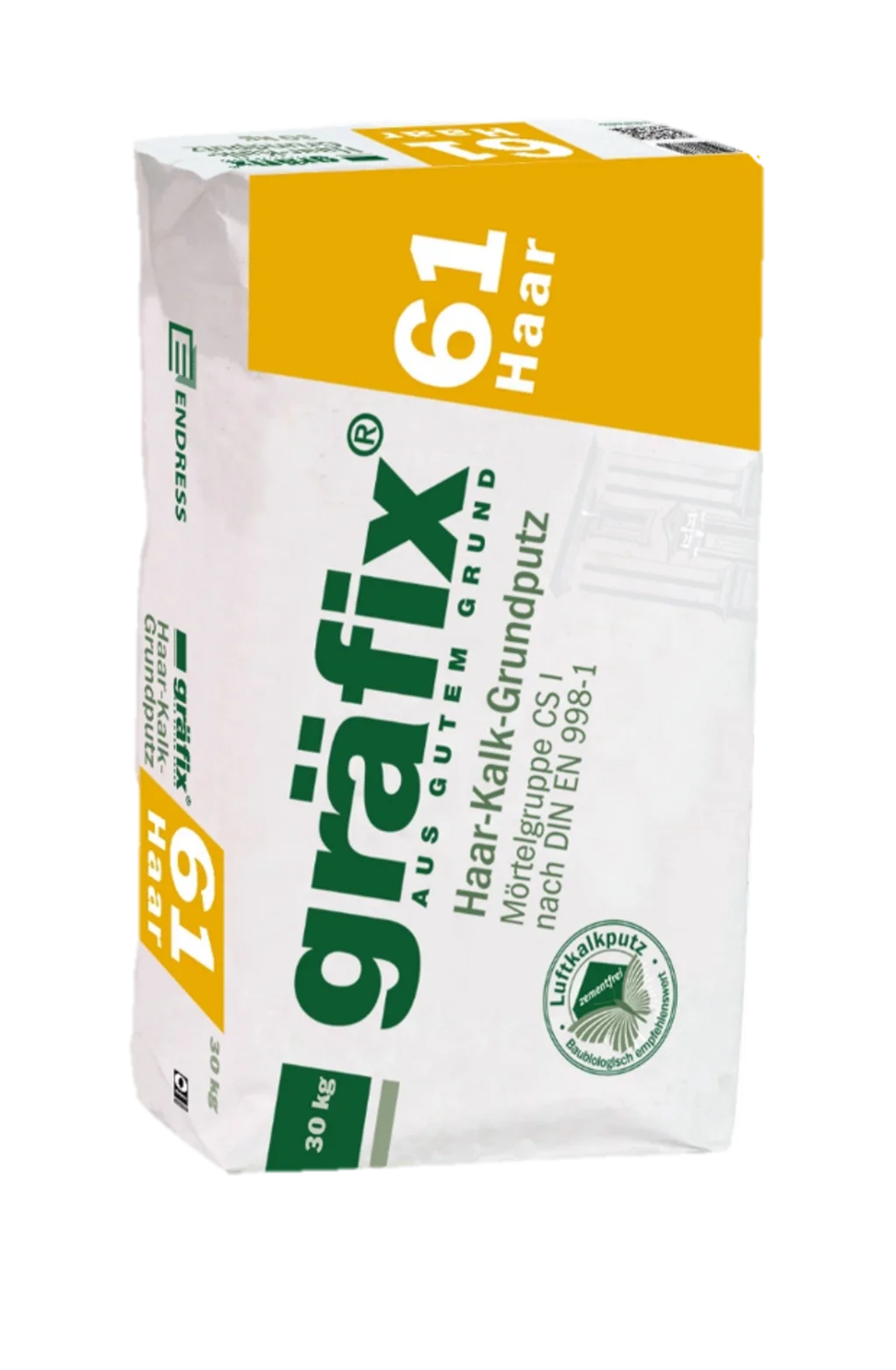
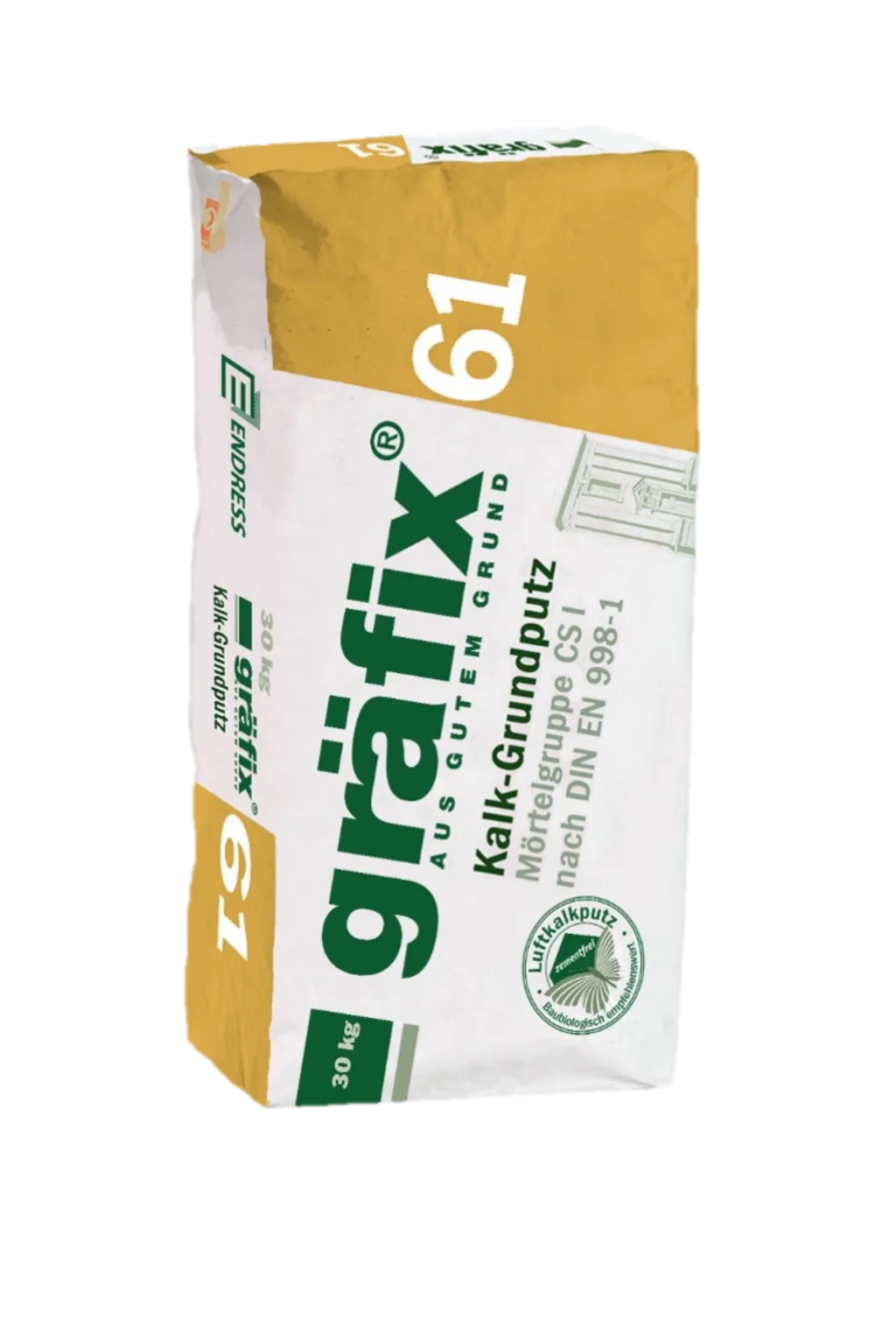
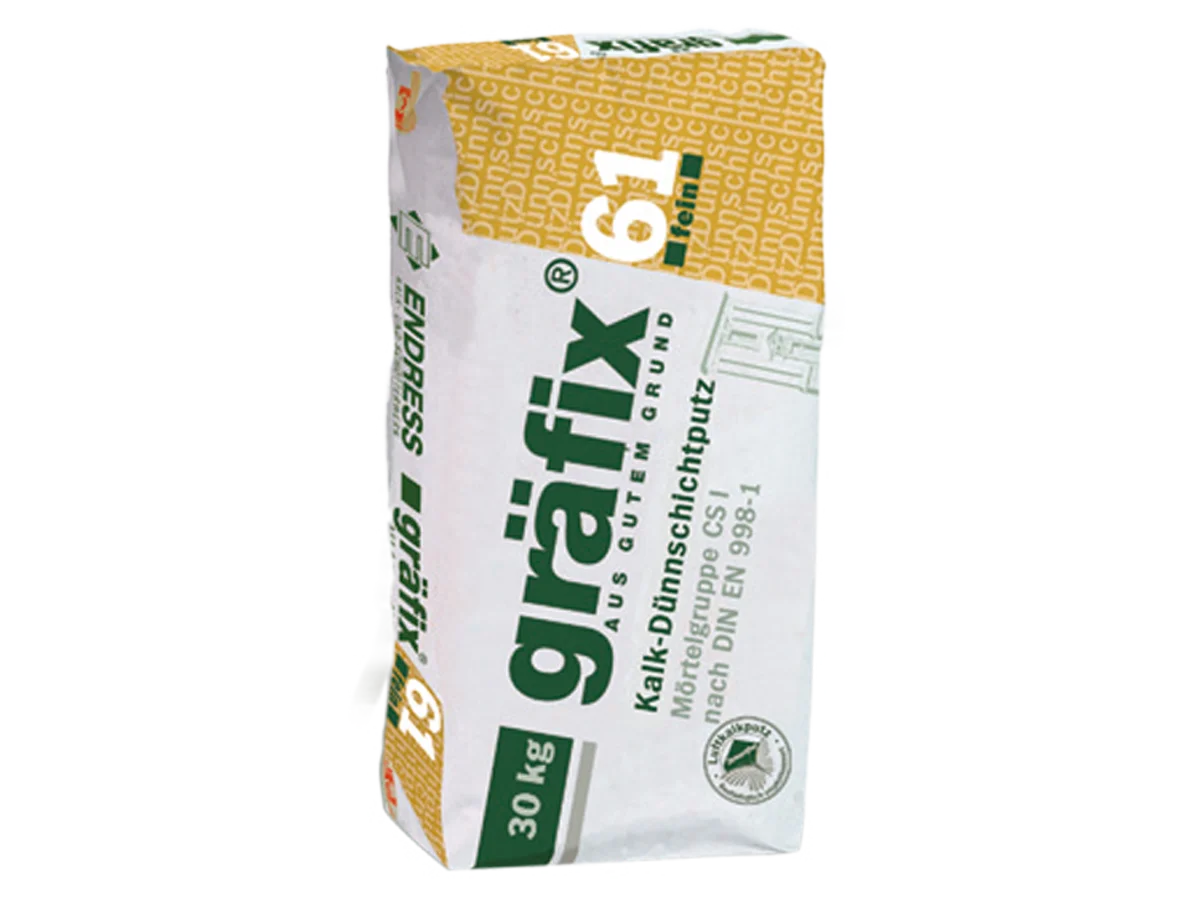
Gräfix 61 lime base plaster
Lime base plaster based on air lime without synthetic resins, for interior plaster and for exterior plaster with a…
26,99 €
SKU: 21.350| EAN: 4042356213501
Gross price incl. 19 % VAT(1,05 €/kg)
Cement-free air lime mortar for monument conservation and timber frame renovation, the fine finishing plaster on clay and lime.
Volume discount for full pallets
Deducted automatically in the basket.
30 kg sack (moisture-protected)
Mix with a power whisk, larger quantities in a free-fall, pan or trough forced-action mixer; also by machine with a mixing pump. Clay base plaster and old clay infills completely dry, dust-free, level and sufficiently rough; lime base plaster must have set. Outside, pre-wet the lime base coat panel by panel; inside, pre-wet the clay base plaster gently until the surface is uniformly dark. Draw on with a Japanese trowel or stainless smoother, ideally 2–3 mm, at most 3–5 mm. Work from the edge of the panel into the surface, trowel cut 2–3 mm at the beam, no chamfer. Plaster build-ups: fine as single-coat plaster on intact clay infills or as a finishing layer on 61 coarse lime base plaster with hair; very fine additionally with 66 K lime finishing plaster. Indoors, a slurry of hydrated white lime and fine sand can be worked thoroughly into the clay with a stiff brush as preparation. The surface is usually floated; the grading curve allows fine felted textures; the more level the substrate, the smoother the surface. Check the suitability of the layer build-up on a work sample.
To stop the plaster from drying out too fast, keep it moist in heat and wind during the first days, e.g. with a garden sprayer (fine mist).
Dry on a pallet or wooden grid.
24 l plastering mortar per 30 kg sack, 8 m² area at 3 mm application thickness. Consumption approx. 1,25 kg/m² per mm of plaster thickness.
| Grain size | 0 to 0,8 mm |
| Cement-free | yes (without cement and synthetic resins) |
| Additives | Surfactants, cellulose, methylcellulose < 0,5 % |
| Layer thickness | ideally 2–3 mm, at most 3–5 mm (e.g. as a single-coat plaster on old clay infills in existing buildings) |
| Consumption at 1 mm | 1,25 kg/m² |
| Maximum layer thickness | 5 mm |
| Minimum layer thickness | 2 mm |
| Recommended layer thickness | 3 mm |
| Strength | CS I according to DIN EN 998-1 |
| Bulk density | 1.350 kg/m³ |
| Max. working temperature | 25 °C |
| Min. working temperature | 5 °C |
| Working time | at most 3–4 hours (depending on temperature, plaster thickness and absorbency of the substrate) |
| DIN standards | DIN EN 998-1 (CS I) |
| Material composition | Lime, crushed limestone sand 0–0,8 mm, workability-enhancing additives (surfactants, cellulose and methylcellulose in total < 0,5 %) |
| Special notes | To protect against frost, for adequate weather protection and for colour homogenisation, paint the plaster vapour-permeably: fresco on the still damp plaster or lime paint (21.525) on the dry surfaces, and for exterior plasters with heavier weathering, silicate facade paint. |
| Storability | 6 months |
To go with it: my free clay building diary with drying log.
Download free of chargeFurther expert knowledge
Lime plaster in timber frame construction, its use and the choice of mortar are explained in the article Lime in timber frame construction: using NHL and alpine lime.
Clay, lime and cement compared as plastering materials are explained in the article Clay, lime or cement: which binder is right for old buildings and timber framing?.