fast delivery
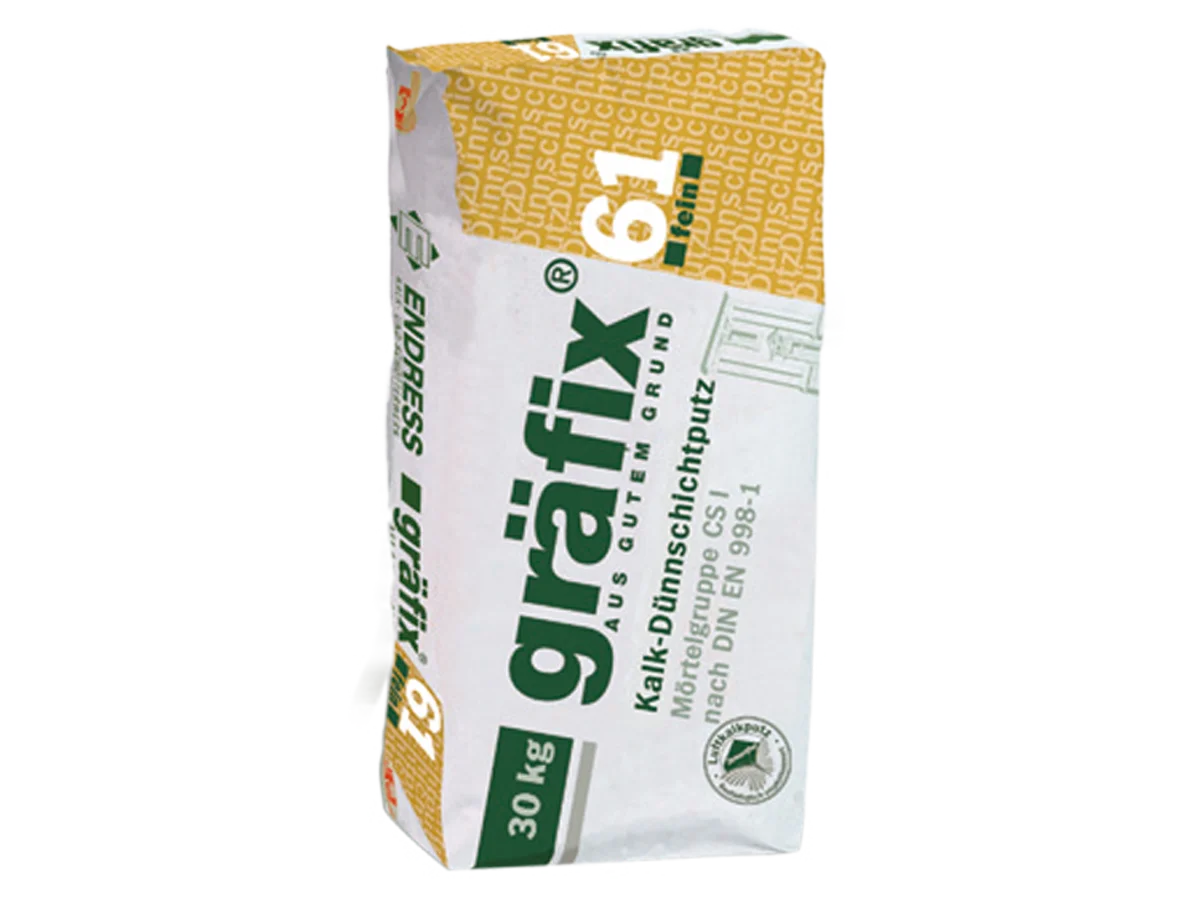
Gräfix 61 lime thin-coat plaster FEIN
Cement-free air lime mortar for monument conservation and timber frame renovation, the fine finishing plaster…
31,49 €
SKU: 21.525| EAN: 4042356215253
Gross price incl. 19 % VAT(14,00 €/L)
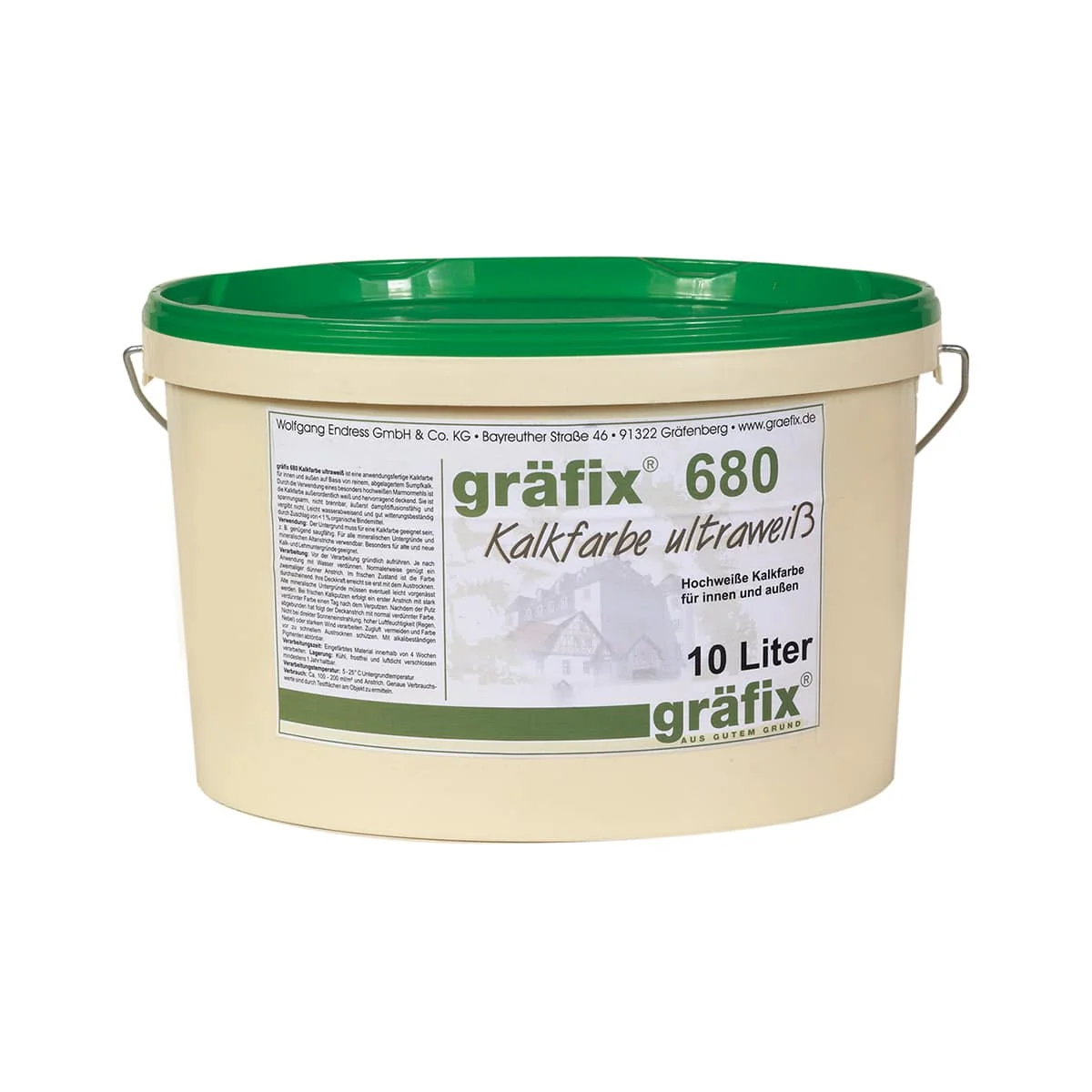
High-quality Gräfix 680 lime paint based on lime putty for naturally white, breathable coatings inside and outside. Alkaline, mould-resistant and vapour-permeable.
Volume discount for full pallets
Deducted automatically in the basket.
10 l oval lidded bucket
Substrate frost-free, load-bearing, clean and evenly absorbent. Pre-wet cured lime plaster surfaces thoroughly 1–2 days before painting and again immediately before each coat (spray mist) so that the coat does not dry out too fast through loss of water. Moisten ClayTec clay plasters carefully (spray mist). For substrates other than gräfix lime plasters or ClayTec clay plasters, obtain separate information. Check the suitability of the layer build-up on a work sample.
Drying time between coats approx. 1 day each. With fresco application, the first coat is applied the day after plastering and cures together with the plaster. For sufficient carbonation, keep the surfaces slightly damp afterwards in heat and wind (fine spray mist).
Store in closed packs dry and cool (frost-free!). Keeps for at least 1 year. Close opened packs tightly again.
A 10 l bucket is enough for approx. 22 m² with three coats, depending on the substrate. Usually 2–4 coats are necessary, opaque after 3–4 coats.
| Product type | Lime paint (lime putty base) |
| Coverage | 22 m² |
| Coatings | usually 2–4 coats necessary, opaque after 3–4 coats |
| Field of application | Lime paint for exterior coatings on gräfix lime plasters in timber frame renovation |
| Preparation / water addition | Add 10–30 % water and whisk thoroughly; depending on the intended use, more water can be added. Adjust the water to the absorbency of the substrate: the coat should stand wet on the surface for at least 10 minutes. On ClayTec clay plasters: approx. 25 % water on smoothed, 15–20 % on felted clay plasters. |
| Application | Best applied with a brush (wide brush, flat brush); a roller is also possible. Always work wet on wet to avoid laps. Keep paint layers as thin as possible, slightly thicker on felted substrates than on smooth ones; adjust the consistency to the absorbency of the substrate. The fresh coat is largely transparent; colour coverage only develops as it dries and sets. Opaque after 3–4 coats. |
| Suitable substrates | Lime base plaster coarse with hair (CLAYTEC 21.200), lime base plaster (CLAYTEC 21.300), lime thin-layer plaster (CLAYTEC 21.350), lime plaster smoothing coat (CLAYTEC 21.400); must be frost-free, load-bearing, clean and evenly absorbent. Also possible on CLAYTEC clay plasters. |
| Working time | at most 3–4 hours (depending on temperature and absorbency of the substrate) |
| Areas of application | Exterior coating on gräfix lime plasters in timber frame renovation · weather protection of lime exterior plasters · also for ClayTec clay interior plasters · traditional limewash |
| Suitable for timber frame construction | Yes |
| Suitable for outdoor use | Yes |
| Material composition | Seasoned and matured lime putty, marble powder, dispersion < 1 %, methylcellulose < 1 % |
| Safety notes | Contact with skin or eyes may cause burns. Rinse eyes with plenty of water and consult a doctor immediately. Store and use out of the reach of children. |
| Notes | Can be tinted with alkali-resistant, binder-free pigments; with strong shades check sufficient binding by the lime paint. Properly applied lime paint chalks only slightly. Heavy chalking indicates a coat that dried too fast; remove the damaged layer before repainting. More heavily weathered surfaces usually need repainting after 3–5 years; alternatively use more weather-resistant silicate facade paint. |
| Storability (years) | 1 years |
To go with it: my free clay building diary with drying log.
Download free of chargeFurther expert knowledge
Lime paint in timber frame construction, its use and effect are explained in the article Lime in timber frame construction: using NHL and alpine lime.
Timber frame renovation: painting and surface treatment are explained in the article Renovating timber framing with clay: step by step to a healthy timber frame wall.