
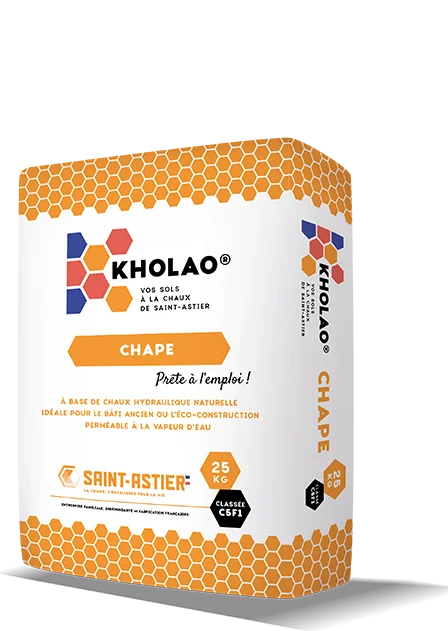
Saint-Astier® KHOLAO® Chape lime screed
SKU: LR-LL-SA-KHOLAO-CHAPE
Gross price incl. 19 % VAT(0,67 €/kg)
Ready-to-use screed mortar made of natural hydraulic lime from Saint-Astier® for screeds indoors, in old buildings and in ecological building. Vapour-permeable, layer thickness 3,10 cm, class C5F1 according to NF EN 13813.
Tiered price
Applies to every unit as soon as the quantity is reached. Calculated automatically in the basket.
Volume discount for full pallets
Deducted automatically in the basket.
Product details
Scope of delivery
25 kg sack
Application
Put water into the mixer, add KHOLAO® Chape while stirring and mix homogeneously for about 5 minutes (forced-action mixer, concrete mixer or screed pump). Consistency like wet sand: very little water, neither plastic nor flowable; pressed in the hand, the mortar keeps its shape. Do not add more water than the stated amount. Place in sections, spread, compact, level to height marks and float with a float or trowel. Work through quickly without construction joints. Suitable substrates: lime concrete, load-bearing old concrete, lime-hemp floor slab; others after consultation. Screed bonded or decoupled on a sand bed, thickness 3–10 cm. Check the substrate, clean it, remove dust and moisten it before placing without puddles, re-wet if necessary. Prime poorly absorbent or watertight substrates beforehand. Fit edge insulation strips. Limit screed bays with joints to at most 25 m². Flatness according to the rules of the trade and applicable standards.
Drying and standing times
Open time about 3 h. Initial set 4 h (±1 h), final set 7 h (±1 h). Light foot traffic after 3 days. Laying in a mortar bed (powder or slurry) no later than 24 h after installation; laying with KHOLAO® Colle no earlier than after 7 days. Keep slightly damp in the first 3–7 days and protect from rapid drying, direct sun and draughts; covering with damp jute or light film is possible.
Delivery and storage
1 year from date of manufacture · store dry and unopened · protect from moisture
Other
Underfloor heating (manufacturer's guide): lay insulation boards level and without joints, fix heating pipes with corrosion-resistant holders. Screed at least 4 cm above the pipes (guide heading: at least 5 cm); for this, add water gradually to a slightly more fluid consistency without segregation. Apply at 8–30 °C. Whether this application is permitted under local standards must be checked in each country.
Technical data
Dimensions
| Grain size | 0 to 2,5 mm |
Layer thickness & consumption
| Maximum layer thickness | 100 mm |
| Minimum layer thickness | 30 mm |
Pallets & packaging
| Sacks per pallet | 40 |
Application
| Mixing time | about 5 minutes |
| Open time | approx. 3 hours |
Drying & standing times
| Start of setting | 4 h (±1 h) |
| End of setting | 7 h (±1 h) |
| Walkable after | 3 days (not intensive foot traffic) |
Fire protection & standards
| EN standard | NF EN 13813-1, class C5F1 |
Moisture, density & heat
| Powder density | 1.400 kg/m³ |
| Mix density | 2.000 g/L |
| Mix density | 2,0 kg/L |
Other technical details
| Material composition | Mortar of natural hydraulic lime from Saint-Astier®, mineral fillers and special additives · vapour-permeable · ready to use · for old buildings and ecological building |
| Storability | 12 months |
| Working temperature | 5–30 °C |
| Consumption | 3 sacks (75 kg) per m² at 4 cm thickness |
| Water addition | 2–3 litres per 25 kg sack |
To go with it: my free clay building diary with drying log.
Download free of chargeFurther expert knowledge
Lime screed in a timber frame house, planning and execution are explained in the article Lime screed in a timber frame house: planning and professional execution on sandy ground.
Lime in timber frame construction, mortar, plaster and screed are explained in the article Lime in timber frame construction: using NHL and alpine lime.