


fast delivery
Clay filler and surface filler natural
Smooth surfaces with filler, naturally!
from40,99 €
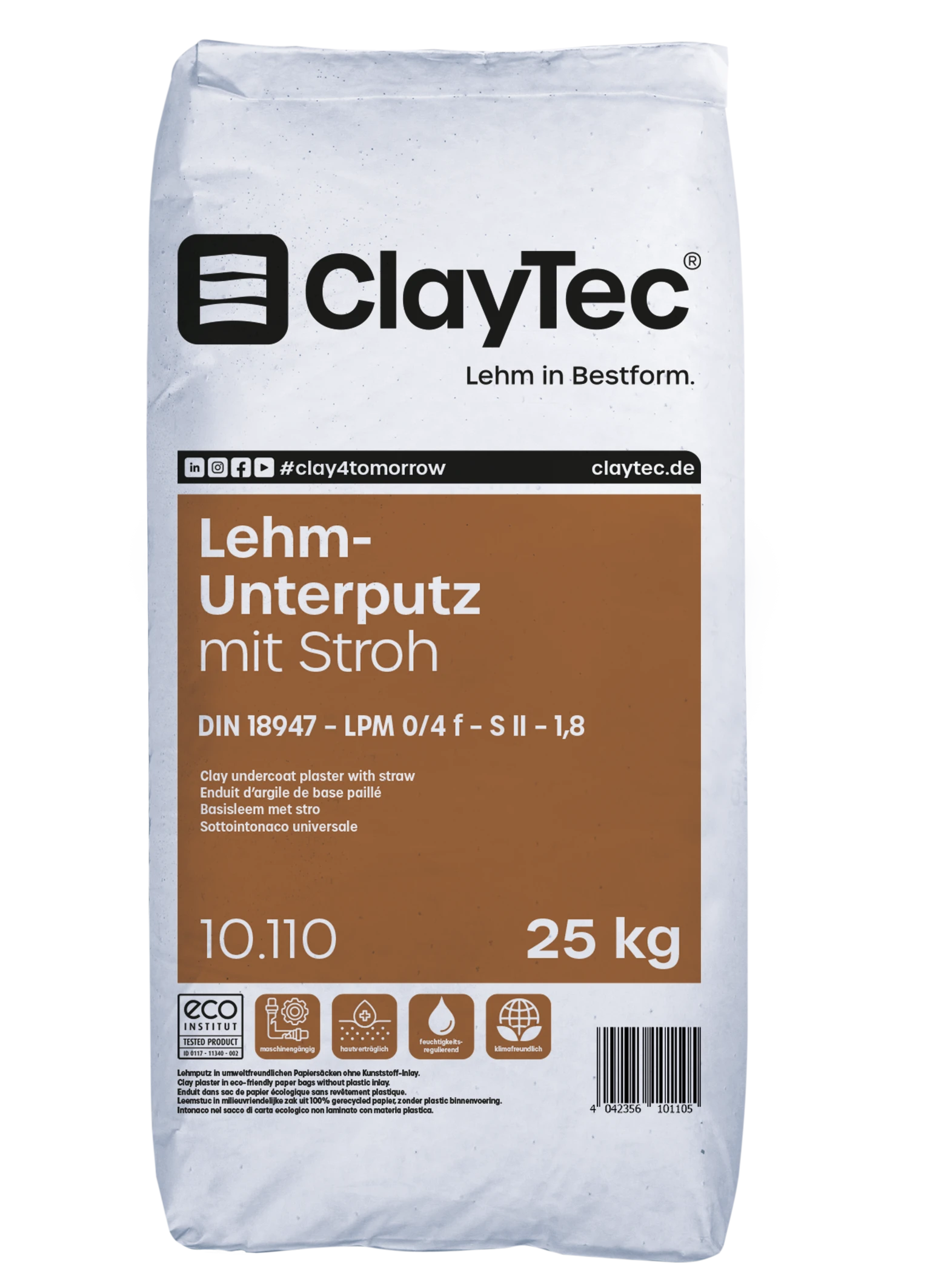
SKU: 10.110| EAN: 4042356101105
Gross price incl. 19 % VAT(0,84 €/kg)
For 40 years the classic clay base plaster from ClayTec for thick layers, e.g. on uneven masonry, for wall surface heating or monument renovation.
Volume discount for full pallets
Deducted automatically in the basket.
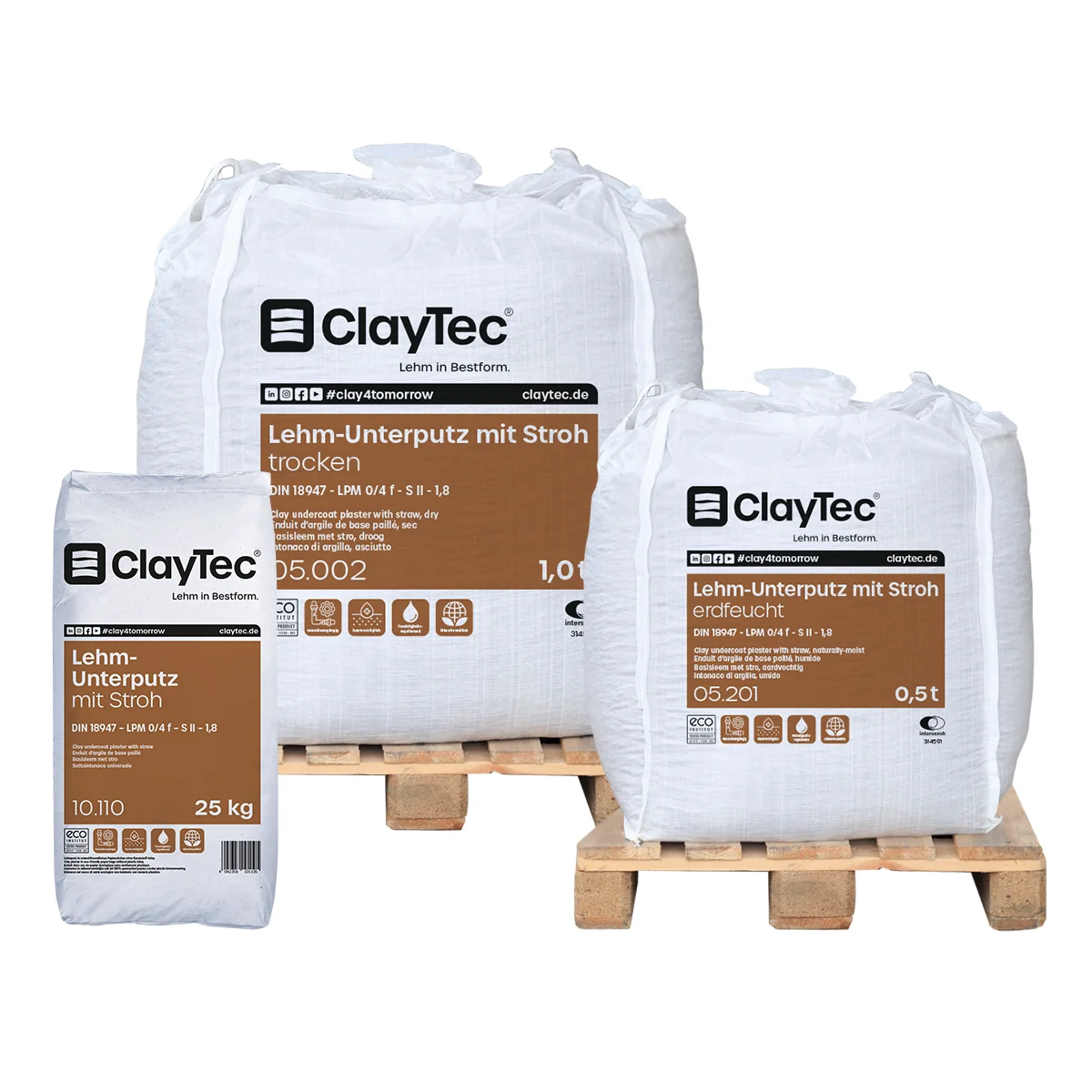
Earth-moist: 1,0 t big bag (item 05.001) or 0,5 t big bag (item 05.201) · dry: 1,0 t big bag (item 05.002) or 25 kg sack (item 10.110)
Prepare the mortar with water added at approx. 20–25 % (dry) or approx. 10–15 % (earth-moist) in a free-fall, pan or trough forced-action mixer, in small quantities with a power whisk or by hand; dry material also with a gypsum plastering machine. Throw on, draw on with the trowel or spray on with the plastering machine. Application thickness 8–15 mm, depending on the substrate up to 35 mm per layer; on concrete, masonry of extruded clay blocks and overhead only 10 mm. Match the consistency to the application thickness. Stays workable for several days when covered. Clay plasters adhere only mechanically. The substrate must be load-bearing, frost-free, dry, clean, free of salt contamination, sufficiently rough and absorbent. If necessary, primer DIE ROTE for coarse clay plasters (ClayTec 13.435-.430). Bind surface dust if necessary by pre-wetting with a spray mist. Reed mesh must be dry; remove film-forming old coatings. For YOSIMA clay design plaster, create a well-floated, level surface or a thin coat with clay top plaster fine 06.
After application, ensure rapid drying, e.g. by cross-ventilation (24 hrs per day with all windows and doors open) or drying equipment. Under critical conditions, log drying according to DIN 18550-2. A 1 cm thick plaster application on a well-absorbing substrate can be worked further after approx. one week under favourable conditions. Further plastering only after complete drying, at the earliest once any shrinkage cracking has ended.
Store dry. Use earth-moist clay base plaster within 3 months of production at the latest; dry goods can be stored indefinitely. Store earth-moist goods protected from freezing in winter, as otherwise workability is impaired during frost.
25 kg sack dry (10.110): makes 16,7 l of plaster mortar, approx. 1,1 m² at 1,5 cm, approx. 1,50 kg/m² per mm. 1,0 t big bag dry (05.002): 625 l, approx. 42 m² at 1,5 cm, approx. 1,60 kg/m² per mm. 1,0 t big bag earth-moist (05.001): 600 l, approx. 40 m² at 1,5 cm; 0,5 t big bag earth-moist (05.201): 300 l, approx. 20 m² at 1,5 cm; earth-moist approx. 1,67 kg/m² per mm. Coverage 25 kg sack: approx. 1,7 m² at 1 cm, approx. 0,8 m² at 2 cm, approx. 0,6 m² at 3 cm.
Values for the selected variant: Sacked goods 25kg
| Grain size | 0 to 4 mm |
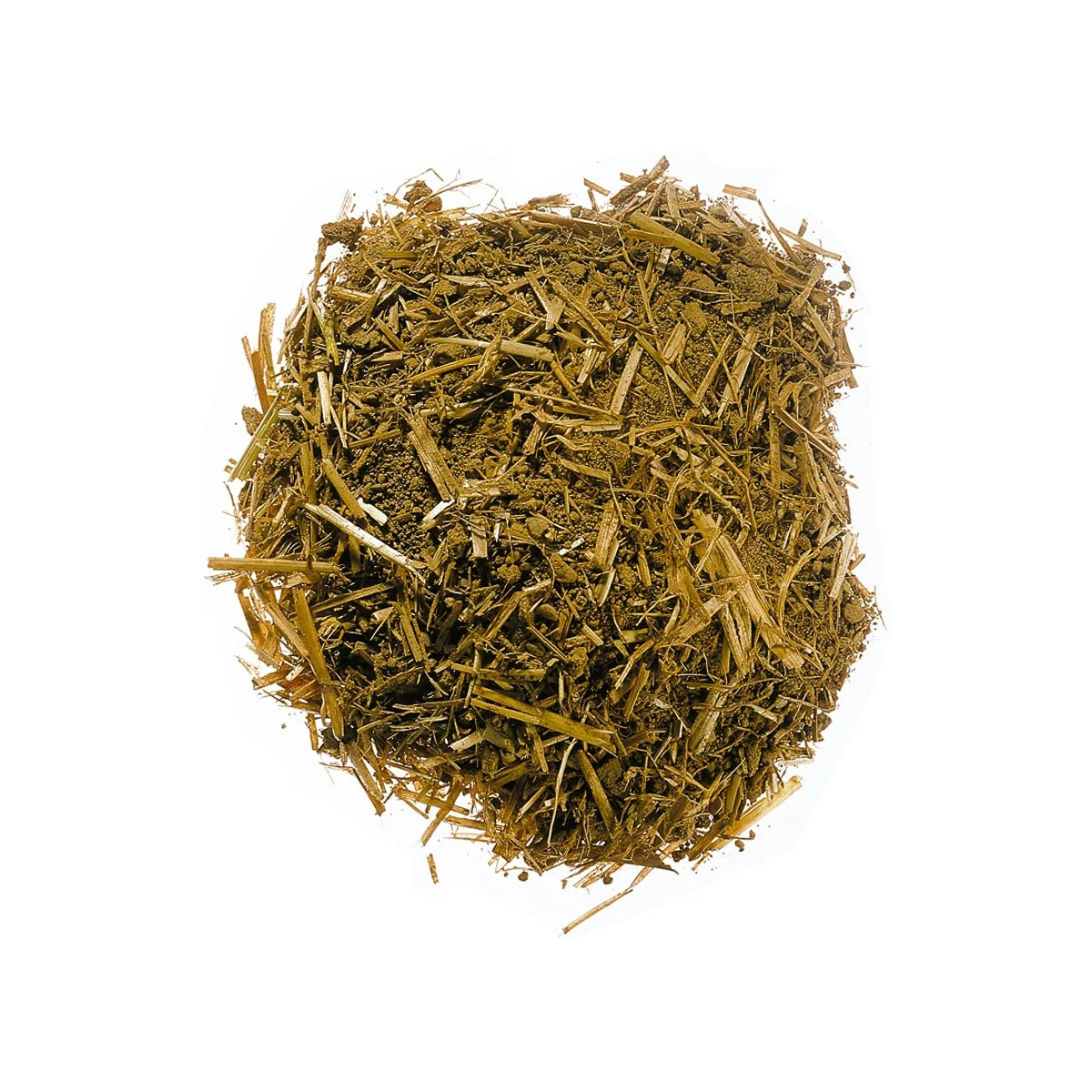
| Fibres | Barley straw up to 30 mm |
| Coverage (litres) | 16,7 l |
| Coverage per sack | 1,1 m² |
| Reference layer thickness for consumption | 15 mm |
| Consumption at 1 mm | 1,50 kg/m² |
| Maximum layer thickness | 35 mm |
| Minimum layer thickness | 8 mm |
| Recommended layer thickness | 15 mm |
| Bond strength | 0,10 N/mm² |
| Flexural strength | 0,7 N/mm² |
| Compressive strength | 1,5 N/mm² |
| Strength class | S II |
| Fire behaviour (EN 13501) | A1 |
| Thermal conductivity λ | 0,91 W/mK |
| Water vapour diffusion resistance μ | 5/10 |
| Sorption class (water vapour) | WS III |
| DIN standards | DIN 18947 – LPM 0/4 f – S II – 1,8 |
| Bulk density class | 1,8 |
| Shrinkage | 3,0 % |
| Material composition | Building clay up to 5 mm, mixed-grain washed sand 0–2 mm, barley straw up to 30 mm |
| Special notes | Timber framing: timber beams get a plaster base, e.g. reed mesh St70; with straw-reinforced clay base plaster it can be dispensed with if the beams are < 8 cm wide and do not bound a plaster area. On HFD interior insulation boards after primer DIE ROTE, max. 8 mm per layer (wall) or 5 mm (ceiling, sloping roof), total thickness max. 15 mm or 10 mm, at least two layers with glass mesh 60. Plaster gypsum drywalls thickly only in exceptional cases and on small areas: on the dry reinforcement layer one layer of max. 6 mm, a second application possible after drying. |
| Water addition | approx. 20–25 % (dry); approx. 10–15 % (earth-moist, big bag 05.001/05.201) |
| Units per Euro pallet | 48/Euro pallet |
To go with it: my free clay building diary with drying log.
Download free of chargeFurther expert knowledge
Base plaster with straw in the clay plaster system, application and layers are explained in the article Building up clay plaster: base coat, finishing coat and fine plaster.
Base plaster in timber frame renovation, choice of mortar and build-up are explained in the article Renovating timber framing with clay: step by step to a healthy timber frame wall.